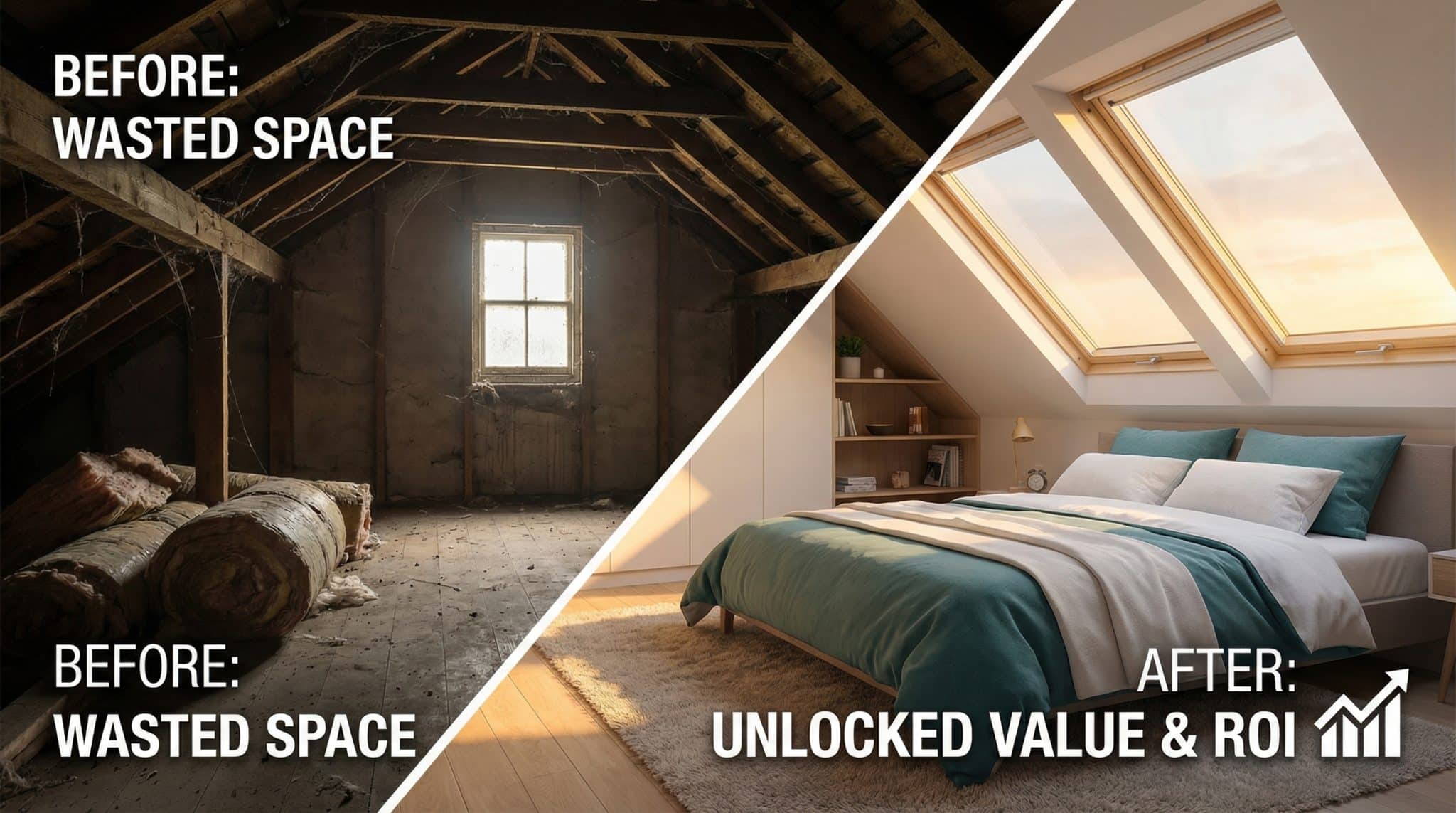

Will Your Attic Conversion Actually Pay Off? (Or Will It Become Your Most Expensive Regret?)
You know that moment when you look up at your attic and think, “We could totally turn that into a dreamy extra bedroom / office / teen lair / hideout from my own family”? And then a contractor shows up, squints at the ceiling joists like they’re reading tea leaves, and hands you a quote that makes you consider living in a tent instead?
Yeah. That.
Attic conversions can be a fantastic use of space… or they can be a money eating raccoon trap that never pays you back. The difference is asking a few unsexy but crucial questions before you fall in love with the idea of shiplap under a sloped roof.
So let’s talk real world returns, the budget stuff nobody tells you until you’re already emotionally committed, and the code rules that will either bless your project or shut it down immediately.
First: What Kind of “Attic Project” Are You Actually Doing?
Because “finishing the attic” can mean anything from “I threw down carpet squares and put a beanbag up there” to “I basically built a tiny upstairs apartment.”
Here’s the quick and honest ROI vibe for the most common options:
- Bedroom conversion ($35k-$55k): usually 60-75% ROI. This is the sweet spot if it legitimately counts as a bedroom (more on that in a second).
- Bedroom + bathroom ($50k-$121k): usually 50-70% ROI. Amazing for real life. Less amazing for “getting every dollar back” because plumbing is a spendy little diva.
- Home office ($25k-$40k): about 50-67% ROI. Useful, yes. Counts like a bedroom for appraisal? No.
- Bonus room / upgraded storage ($15k-$25k): around 50% ROI. Buyers like it, but “bonus room” is real estate code for “I don’t know what this is, but it has drywall.”
- Insulation + air sealing only ($2.5k-$4.5k): 100-120% ROI (sometimes more, because you save energy). This is the boring hero. The broccoli of home improvement. It works.
My opinion? If you’re doing an attic conversion mostly for resale, the “countable bedroom” angle is the only one that consistently moves the needle. If you’re doing it to make your life better, then ROI is only part of the story (and I will happily cheer for “make your life better” projects).
The Timeline Thing Everyone Ignores (Until It’s Too Late)
Most attic conversions don’t “pay you back” the minute the paint dries. They pay back when you sell. Which means how long you’re staying matters more than whether you picked the perfect throw pillow.
Here’s the general rule of thumb:
- Selling in under 2 years: I’d avoid a full conversion unless your market is bananas. Transaction costs and timing can swallow your gains.
- 2-5 years: insulation still makes total sense. A full conversion is… maybe. You really need local comps to justify it.
- 5+ years: conversions start to make way more sense because you get daily use and eventual resale value.
And yes your location changes everything. If you’re in a tight urban market where space is scarce, added finished square footage can be gold. If you’re rural and everyone has land and three sheds already, buyers might shrug politely and go back to looking at the acreage.
Okay, But How Much Does This Actually Cost?
Attic conversions have a hilarious range because some attics are basically ready to become rooms, and others are more like “a wooden obstacle course filled with mysterious insulation from 1974.”
A rough cost per square foot range is $30 to $200, and that giant gap is basically the difference between:
- finishing what’s already there,
- or having to add structure, HVAC, wiring, stairs, windows, and possibly your will to live.
As a super loose baseline:
- 200 sq ft: $10k-$30k
- 400 sq ft: $20k-$60k
- 600 sq ft: $30k-$90k
But let me tell you where budgets go to die…
The Hidden Costs That Jump Out From Behind the Walls
If you remember nothing else, remember this: attics love surprises. Not cute surprises like “I found a $20 bill in my pocket.” More like “your floor can’t hold humans.”
Common budget busters:
- Structural reinforcement: comes up a lot (think 30-40% of projects). If your joists aren’t beefy enough, you may need “sistering” or other reinforcement—often $5k-$15k.
- Heating & cooling: extending HVAC or adding a mini-split can run $3k-$8k.
- Electrical upgrades: for safe, code-compliant living space, often $2k-$6k.
- Permits: typically $500-$3k (and yes, you want permits—future buyers do not enjoy “mystery renovations”).
Bathrooms? Love them. Want one. But plumbing is why “bedroom + bath” costs can leap into the stratosphere. Add a bathroom because you’ll use it and it will make the space function—not because you think it’s a magical ROI booster.
My Three Budget Rules (Because Hope Is Not a Strategy)
When people blow past their budget on an attic conversion, it’s usually because they treated the quote like it was a maximum instead of… the beginning of negotiations with reality.
Here are the rules I’d personally use:
- 1) Add a 15-25% contingency. Attics reveal stuff. It’s basically their whole personality.
- 2) Try to keep the project under ~15% of your home’s value. If your home is worth $400k, you want to keep the conversion around $60k-ish. Go way above that and you risk out improving the neighborhood.
- 3) Be extra cautious once you cross $50k. That’s often where ROI starts sliding, because you’re paying for more complex systems and structural work—not just “making it pretty.”
And here’s a tiny reality check I like: if you’re already near the neighborhood’s “price ceiling” (what comps sell for), a fancy attic suite might not come back to you at resale—even if it’s gorgeous enough to make you cry.
Before You Do Anything Fun: The Code Rules That Decide If Your Attic Counts
This is the part where I gently take the Pinterest board out of your hands for a second.
To count as legal habitable space (and to be valued like it), your attic typically needs to pass what people call the 7-7-70 test:
- 7-foot ceiling height over at least half the usable space
- 7-foot minimum width (so it’s not basically a hallway under a roofline)
- 70 square feet of usable area
If you don’t meet those basics, you might still be able to finish it, but it may not count the way you want it to count (appraisers and buyers can be very “cool story, still not a bedroom”). That hits your ROI hard.
Two other biggies:
- Egress: If you want a bedroom, you generally need an egress window. Budget roughly $3k-$7k per window depending on your house.
- Stairs: A pull down ladder is not going to cut it for official square footage. Real stairs can range wildly ($1k-$18k) depending on design and what has to be rearranged downstairs.
And if your attic is too low? That’s where inside dormer layouts enter the chat, and dormers are not cheap (often $15k-$30k+)—and that’s before you even start “finishing.”
So… Should You Convert Your Attic? Here’s My No Nonsense Gut Check
I’d seriously pause (like, put the checkbook down pause) if:
- Your attic can’t pass the basic headroom test without dormers
- Structural work is eating 30-40% of your budget before you’ve built anything cute
- You already have 4+ bedrooms and you’re doing this purely to “add value” (your market may not reward bedroom #5 the way you think)
- Your finished home would end up priced above most neighborhood comps
On the flip side, I’d feel good about moving forward if:
- The attic meets the 7-7-70 basics (or is close without major roof surgery)
- You can add proper stairs and egress without redesigning half the house
- You’ll be there 5+ years and you’ll actually use the space
- Local comps show finished attics are a thing people pay for in your area
If You’re Still Interested, Do This Next (In This Order)
This is the “save yourself from expensive heartbreak” checklist:
- Measure and confirm feasibility: headroom, width, floor area, stairs, and egress.
- Pick the right scope: bedroom, office, bonus, or just insulation/air sealing.
- Get a real base budget: use the $30-$200 per sq ft range as a starting point, not a promise.
- Price the unsexy stuff: structure, HVAC, electrical, permits, stairs, windows.
- Add your contingency: 15-25%, and don’t pretend you won’t use it (you will).
Then, before you commit, go look at 3-5 comparable sales in your zip code. Find homes like yours with and without finished attics. That price difference is the closest thing to truth you’ll get.
The Part Nobody Can Quantify: The “Life ROI”
Here’s my soapbox moment: sometimes the best “return” isn’t a clean percentage.
If converting your attic means you can stop house hunting, avoid moving costs, keep your kids in the same school, and finally have a guest room that isn’t also your treadmill storage… that matters. A lot.
One way to think about it: if you’d otherwise rent an office or need a bigger house, what would that cost you per year? Sometimes the attic pays you back in sanity and avoided expenses long before resale day shows up.
Bottom Line
An attic conversion pays off when three things line up: it can legally count as livable space, your budget stays proportional to your home’s value, and your timeline is long enough to enjoy it (and let the market catch up).
Start with the planning and building rules, pull local comps, and be brutally honest about the hidden costs—especially structure, stairs, and egress. If it still makes sense after that? Congratulations. You may be about to turn your dusty upstairs void into the most useful square footage in your whole house.