
What a Dormer Loft Conversion Really Costs (So You Don’t Get Jump Scared Mid Reno)
If you’re daydreaming about turning that sad, dusty attic into a legit bedroom, office, or “I need everyone to stop touching me” retreat… hi, welcome. Dormer loft conversions are one of those projects that sound straightforward until you’re halfway in and someone casually says, “Oh yeah, we also need to reframe that,” like you just ordered extra guac.
Here’s the thing: most people underestimate a dormer conversion by $10,000+ (sometimes a lot more). Not because they’re clueless—because a dormer has a talent for hiding expensive little surprises behind drywall and optimism.
So let’s talk real numbers, what actually drives the price, and how to read contractor quotes without needing a stress nap afterward.
Okay, So What Do Dormer Loft Conversions Cost?
For a pretty standard dormer conversion—think “usable bedroom or office, not a spa resort”—most homeowners land around $40,000 to $60,000.
The overall range is big: $15,000 to $80,000 (and yes, the wide range is annoying, but it’s real life). The main things that swing your price are:
- The dormer style (simple vs fancy roof geometry)
- Whether it’s just a room or a room + bathroom
- Where you live (labor costs are not polite)
If you want a quick back of the napkin estimate, use $50 to $150 per square foot for finished, habitable space. That’s not a quote. That’s “should I even bother calling contractors or will I faint?”
And yes—labor is usually the big bite. Materials don’t vary wildly from place to place, but labor sure does. (Boston, I’m looking at you.)
The Dormer Style You Pick = The Price and the Headache Level
Dormers aren’t just “a box on the roof.” They’re “a box on the roof that must not leak, collapse, or anger the building inspector.” The style affects framing complexity, how long the exterior work takes, and how much usable headroom and more usable attic space you actually gain.
Here’s the vibe (and typical costs for a ~250 sq ft conversion):
- Shed dormer: $75-$120/sq ft (about $18,750-$30,000)
My personal favorite if you want the most space for the least drama. One slope, simpler build, big headroom payoff. - Gable dormer: $110-$150/sq ft (about $27,500-$37,500)
Prettier and more “storybook house,” but it costs more because the roof tie in is fussier. - Hipped dormer: $115-$135/sq ft (about $28,750-$33,750)
Works nicely if your home already has a hip roof and you want it to look original. More roof planes = more labor. - Eyebrow dormer: $40,000+ (varies a ton)
Gorgeous. Also… you’re paying for “gorgeous.” Usually less headroom gain for the money.
If your budget is tight, start your planning with a shed dormer. If curb appeal is your love language, a gable can be worth it.
Before You Price Anything: Is Your Attic Even Convertible?
I know, I know. You want to skip right to “how much.” But first you have to confirm your attic isn’t basically a decorative triangle.
Two measurements matter a lot:
- Ceiling height: If you can’t get close to 7 feet at the highest point, things get complicated fast.
- Roof pitch: If it’s below about 6:12, headroom can be stingy unless you do more structural work (aka more money).
Also: if you’ve got moisture issues, sketchy framing, HOA rules that ban roof changes, or anything that makes you think, “Hmm, this seems bad”… fix that first. Don’t build a beautiful new space on top of a problem that’s already auditioning for a mold documentary.
The Bathroom Question (A.K.A. Where Budgets Go to Cry)
Want to know the biggest cost rocket booster? Adding plumbing.
A room only conversion often falls around $50-$110 per sq ft. Add a bathroom and you can jump to $70-$335 per sq ft. That range is not a typo. Bathrooms are tiny but mighty—like chihuahuas with credit cards.
Why bathrooms cost so much:
- You’ll likely need licensed plumbing
- Fixtures add up fast:
$2,000-$4,000 (basic), $4,000-$8,000 (mid range), $8,000-$15,000+ (premium) - Waterproofing, ventilation, maybe floor reinforcement
- Vent stacks and drain routing can get… spicy
My best money saving tip: put the new bathroom above an existing bathroom if you can. That can cut plumbing costs by 40-60%. Plumbing likes to take the shortest route—kind of like teenagers avoiding chores.
Your Location Matters (Because Labor Rates Have Moods)
A conversion that’s $40,000 in Ohio can turn into $60,000 in Boston without anyone doing anything “extra.” It’s just labor reality.
Quick rule of thumb:
- Big coastal metros: +30-50%
- Lower cost regions: -10-20%
- Earthquake zones: sometimes extra structural requirements
So when you’re comparing internet averages to your quotes, adjust for your zip code before you spiral.
Where the Money Actually Goes (So You Can Spot a Sketchy Quote)
Contractors can make quotes look like two totally different projects. Knowing the common buckets helps you sanity check what you’re seeing.
Here’s the usual lineup:
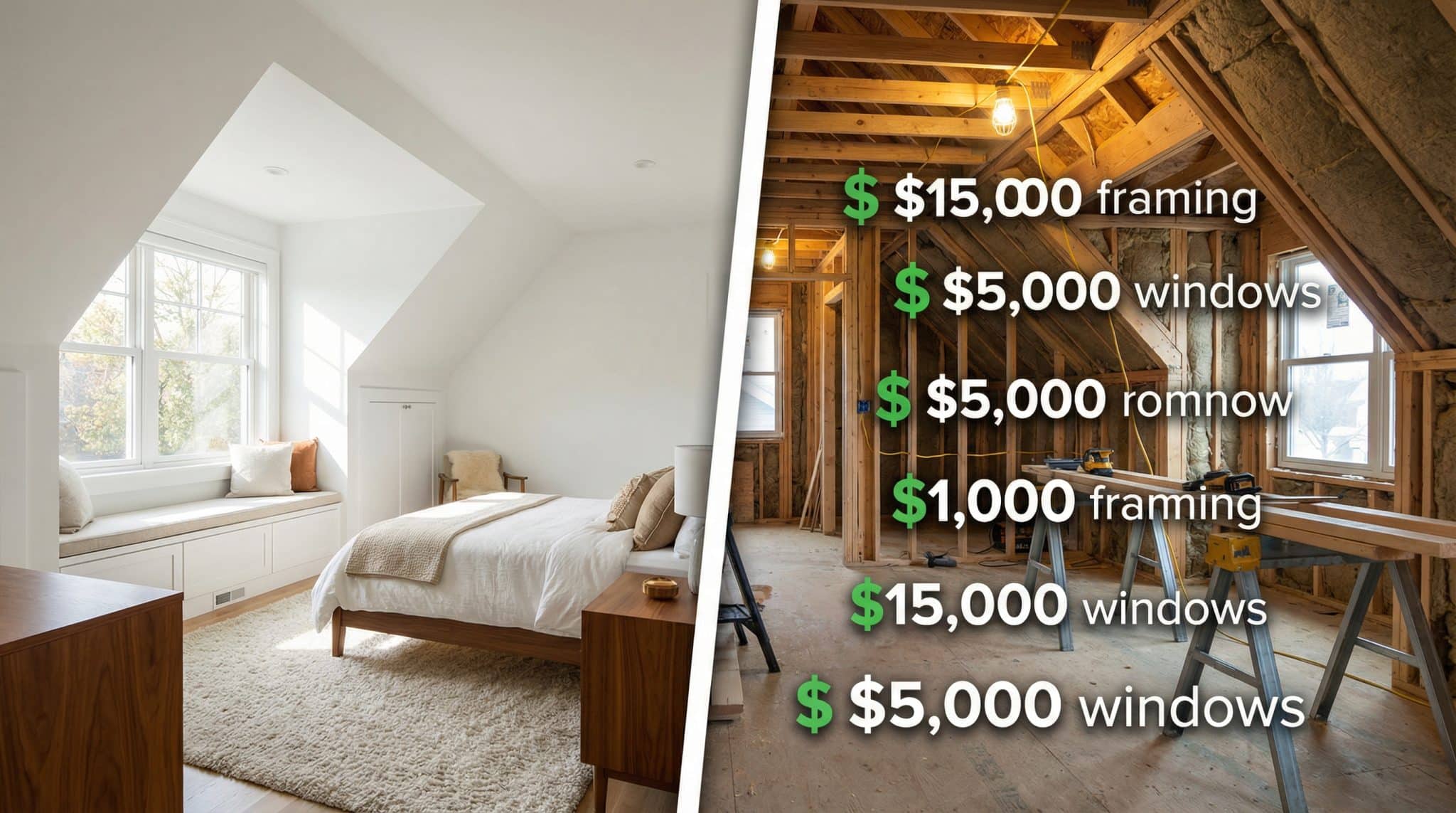
- Structural + dormer build: the core cost (opening roof, framing, weatherproofing, making it not leak)
- Stairs: wildly underestimated and sometimes “oops forgotten”
- Windows: and yes, bedrooms usually need an egress window (code stuff matters here)
- Insulation: sloped ceilings can be tricky—spray foam costs more but often performs better
- Electrical: outlets, lighting, smoke detectors, and sometimes a panel upgrade
- HVAC: huge variable—ductless mini splits can be a budget friendly lifesaver
- Interior finishes: drywall, flooring, trim, paint (and the emotional cost of choosing paint)
One thing I always tell people: if the staircase isn’t clearly included, stop everything and ask. Stairs are not optional unless you’re planning to access your new bedroom by ladder like a pirate.
The “Hidden” Costs That Aren’t Hidden—Just Conveniently Ignored
Please, I’m begging you: hold back a 15-20% contingency. On a $40,000 project, that’s $6,000-$8,000. If your house is older (especially pre-1970), I’d lean 20-25% because older homes love surprises.
Costs that commonly get left out of quotes:
- Structural engineer: roughly $400-$800 (worth it—do it early)
- Permits: about $500-$2,000 (and time… sometimes lots of time)
- Asbestos testing/removal: can be $400 or can be “why is this five figures”
- Scaffolding: $800-$2,500
- Dumpster/waste removal: $400-$1,000 per week depending on your area
And then there are the structural surprises: rotted rafters, awkward framing, trusses that need modification… all stuff you don’t fully know until things are opened up.
How Long It Takes (And Why Delays Cost Real Money)
After permits are approved, a typical build is around 8-12 weeks with typical conversion timeframes. Weather delays happen (because roofs + rain = terrible combo). Trades get scheduled. Materials go on “backorder” the second you feel confident.
Even a short delay can cost a lot because crews aren’t free. A couple weeks of delay can mean a few thousand dollars in extra labor/time costs—plus your personal suffering, which is priceless.
How to Save Money Without Making Regret Your Whole Personality
If you want the biggest savings without cutting corners that matter:
- Pick a simpler dormer style (complex roofs = complex invoices)
- Consider ductless mini split HVAC instead of extending ductwork
- Use standard prefab windows instead of custom
- Do finish work yourself after inspections (paint, trim, some flooring if you’re handy)
- Choose durable, budget friendly flooring (laminate has come a long way; your wallet will thank you)
- If timing is flexible, build in the off season (often October-March) and you may get better labor pricing
There’s also the “shell” approach: build a weather tight, insulated shell and finish it over time. It can reduce upfront cost, but it only works if you’re truly prepared to live with an unfinished space and your lender/insurer is on board. (Also: future you has to actually finish it. Future you is sometimes unreliable.)
Contractor Quote Red Flags (Read This Before You Sign Anything)
Get at least three itemized quotes. If a quote has under ~10 line items, it’s often missing stuff that will magically appear later as change orders.
Red flags I don’t love:
- One big lump sum with no breakdown
- Way above average with no clear reason
- Way below average (usually scope gaps or “we’ll figure it out later” energy)
- Stairs missing
- Vague “electrical” or “plumbing” as a single line
- Huge deposit demands (over 50% up front is a nope)
A pretty typical payment structure is something like: small deposit, payments after framing/rough in milestones, and a final payment after inspections pass. (Don’t let anyone treat “final payment” like a polite suggestion.)
So… Is a Dormer Loft Conversion Worth It?
If you need the space and you plan to stay in your home for a while, yes, usually. You’re often getting functional square footage for less than a ground floor addition.
But if you’re doing it purely for resale math, temper expectations. A dormer conversion can add value, but it’s not always a dollar for dollar return. The real payoff is everyday life: a bedroom that isn’t a closet, an office with a door, a bathroom that prevents morning traffic jams.
Honestly? That’s the kind of ROI I care about most.
Your Mini “Do I Even Start?” Checklist
Before you call contractors this week, do these two things this weekend:
- Measure your ridge height (floor to roof peak).
- Figure out your roof pitch (even a rough idea helps).
Those two numbers alone will tell you whether this project is straightforward, complicated, or “maybe let’s just finish the basement instead.”
And if you take one budgeting tip from me: price the stairs, price the bathroom, and keep a contingency. That’s how you avoid the mid project financial jump scare.