
Mirror Placement Tricks That Make Any Room Feel Huge (Without Knocking Down Walls)
If your room is giving “cozy” when you were aiming for “airy,” I have excellent news: you don’t need to start pricing out contractors or Googling “how to remove a load bearing wall without crying.”
You need a mirror. One good mirror. Placed like you meant to place it.
I’ve seen a tiny 120 square foot bedroom go from “shoebox with feelings” to “oh, hello there, actual breathing room” with a single well placed mirror. It’s not witchcraft. It’s just light + sightlines + your brain being extremely easy to trick. (Same, honestly.)
Let’s make your space feel bigger on purpose.
Why mirrors work (and why yours might not)
Mirrors do two big things:
- They bounce light into corners that sunlight and lamps don’t naturally reach.
- They create depth—your eye sees a “second space” in the reflection and your brain files it under more room exists here.
The catch is… a mirror is only as good as what it reflects.
A mirror reflecting a window = chef’s kiss: brighter + deeper.
A mirror reflecting a blank wall (or a laundry pile that looks like it’s trying to become a mountain range) = meh.
Also: one clean, continuous reflection beats a bunch of little broken ones. I love a cute gallery moment, but if your goal is “bigger,” a single large mirror usually wins.
Quick test: stand in your doorway and imagine what a mirror would show from the wall you’re considering. If the reflection is window/light/pretty view? Yes. If it’s clutter/cords/the back of the TV? Hard pass.
The mirrors that actually make a room feel bigger (aka don’t go tiny)
Here’s my slightly bossy opinion: small mirrors are decor. Big mirrors are strategy.
If your mirror is under ~30″ wide, it usually reads like an accessory, not a “wow, this room feels bigger” moment especially from across the room.
My favorite space making picks:
1) A full length rectangular mirror
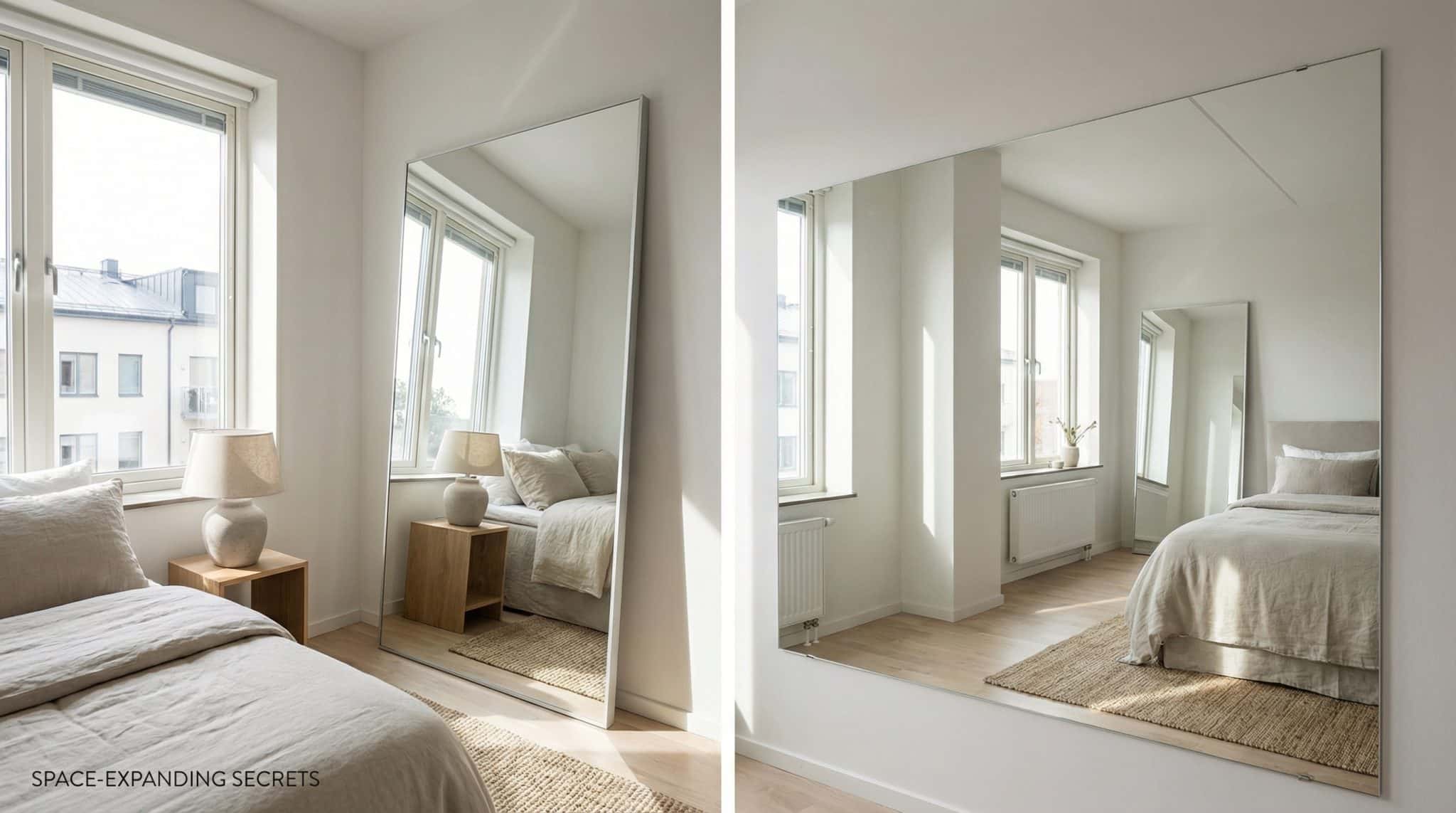
This is the “instant upgrade” option. It reflects the full height of the room, which makes the space feel taller and more open.
- Best size: roughly 48-72″ tall (bigger if you can)
- Leaning mirrors: yes, always. They’re renter friendly and weirdly forgiving in awkward rooms.
- A slight tilt can catch more ceiling, which helps if your room feels squatty.
2) One large wall mirror
If you’ve got one decent wall, this is your moment.
- Go wider than you think. If you’re debating between two sizes, pick the bigger one.
- I like a mirror that takes up roughly about a quarter to a third of the wall width—large enough to matter, not so large that it screams “dance studio.”
3) Mirrored closet doors (the undercover MVP)
I know, I know some people have strong feelings about mirrored doors. But in a small bedroom? They can make the room feel noticeably wider because they’re one big uninterrupted reflective surface.
If you’re swapping closet doors anyway, it’s a high payoff change.
Bonus for tricky spaces: backlit/LED mirrors
Windowless powder rooms and dark hallways can feel like little caves. A plug in LED mirror adds light right where you need it, and it still gives you that depth boost. (Adjustable color temperature is nice if you don’t want your bathroom to glow like a spaceship.)
Frames: the “this helps” vs “this fights you” situation
Frames matter more than people think.
- Frameless or super thin frame: maximum “expanded” effect (especially in small rooms)
- Thin metal or simple wood: still light, still good, adds a bit of style
- Big chunky ornate frame: gorgeous sometimes… but it can read like visual furniture, which steals attention instead of creating openness
If your #1 goal is “bigger,” keep the frame quiet. Let the reflection do the heavy lifting.
Where to put the mirror (so it does the most work)
If you only remember one thing, make it this:
Put a mirror where it can reflect light and a pleasant view.
Light + depth. That’s the combo.
Here are the placements I use the most:
1) Directly across from a window (highest impact)
This is the classic for a reason. It can make a room feel brighter fast.
- Don’t angle it like a funhouse trick straight across usually works best.
- If you get glare at certain times of day, you can tilt it slightly downward, but don’t overthink it.
2) Near a corner (but not jammed into it)
A tall mirror 6-12″ away from the corner helps light bounce around instead of getting swallowed by the corner shadow.
3) Behind a console/dresser (sneaky depth)
A mirror above a dresser or console is a great way to add depth without the mirror becoming the whole personality of the room.
- Leave a little breathing space: I like the furniture not smashed flush to the wall if you can help it.
4) Hallways: break the “tunnel”
A full length mirror on a side wall helps a narrow hallway feel less like a bowling lane and supports hallway and landing styling.
A mirror at the end of the hall can work too… but only if it reflects something worth looking at (not the coat pile you swear is “temporary”).
Height rules (so it looks right, not accidental)
- Wall mirrors: center around eye level (roughly 60″ to the center is a good starting point)
- Over furniture: keep the bottom edge about 12-18″ above the surface
- Full length mirrors: I like the bottom edge around a foot off the floor, or just lean it and let it do its thing
If it feels “off,” it usually is. Trust your gut. Your gut knows.
Mirrors need “fuel”: how to capture more light
A mirror doesn’t create light—it just moves it around like a helpful little light courier.
- If you have a window: placing a mirror across from it can seriously boost how bright the room feels.
- If you don’t have a window: place mirrors near lamps, sconces, or ceiling fixtures to spread artificial light.
Also, a slightly spicy truth: mirrors amplify whatever they face.
If they face light wall paint choices and calm views, your room feels bigger and brighter.
If they face dark paint, busy patterns, or clutter… congratulations, you’ve doubled the chaos.
Mistakes that ruin the illusion (ask me how I know)
- Reflecting clutter. Mirrors don’t judge, but they do snitch.
- Going too small. Tiny mirrors are cute, but they won’t change the room.
- Putting mirrors directly across from each other. The endless reflection thing can feel weird fast (and it stops being “bigger” and starts being “infinity portal”).
- Mirror facing the bed. Not everyone cares, but enough people say it messes with their sleep that I’m mentioning it. If you wake up at 2 a.m. and see a “person” sitting up in bed (it’s you), you’ll remember this moment.
- Too many mirrors. If the room starts to feel jumpy, you’ve gone from “airy” to “funhouse.”
- Warped cheap mirrors. If the reflection looks wobbly, it kills the depth effect. Clear, standard mirror glass is usually best for making a room feel bigger.
Quick room by room cheats (because you’re busy)
Small bedroom:
Go full length in a corner or on a wall where it can catch window light. I like it placed so you notice it from the doorway, not so it’s staring at you from the bed like a haunted Victorian child.
Small bathroom:
One larger vanity mirror beats a bunch of tiny ones. If the bathroom is dark, an LED mirror is a legit upgrade. (Humidity friendly features like anti-fog are nice if you’re fancy or just tired of wiping steam off everything.)
Narrow hallway:
Side wall mirror to widen the vibe. End of hall mirror only if it reflects something decent.
Small living room:
A statement mirror above a mantel or console is a classic for a reason. Leave a few inches of space above the surface so it doesn’t look crammed in like an afterthought.
No wall space?
Mirrored furniture can help—coffee tables, consoles, even a mirrored tray. But keep it reasonable. Two mirrored pieces in one room is usually plenty before it starts to look like you’re opening a disco themed escape room.
Hanging it safely (so your “upgrade” doesn’t become a crash)
Mirrors can get heavy fast. Don’t gamble with drywall and vibes.
General rule of thumb:
- Under ~25 lbs: solid drywall anchors can work (follow the mirror/hardware instructions)
- 25-50 lbs: use toggle bolts or heavy duty anchors rated for the weight
- 50-100 lbs: mount into studs with appropriate hardware
- Over 100 lbs: honestly, hire help/installer—your toes will thank you
Renters:
- Leaning mirrors = easiest win (add non-slip pads so it doesn’t scoot)
- Command strips can work for lighter mirrors (roughly 16-20 lbs per pair, but read the package and don’t use them in steamy bathrooms)
- Over the door hooks are usually for lighter stuff—don’t hang a beast of a mirror and hope for the best
My favorite “don’t regret this later” step: outline the mirror with painter’s tape and live with it for a couple days. Check it in morning light, afternoon light, and night lighting. Make sure it reflects what you want reflected.
It’s like test driving the mirror, except you don’t have to talk to anyone at a dealership.
The takeaway
If your room feels small, you don’t need more square footage—you need better visual tricks.
Go bigger than you think, place your mirror where it reflects light (and not your doom pile), keep the frame from getting too chunky, and do a quick painter’s tape test before you commit.
And if you take nothing else from me: mirrors don’t just reflect your room—they reflect your choices. So let’s make some good ones.