
Can Your Dormer Actually Support a Bathroom? (Or Are You About to Start a Very Expensive Hobby?)
If you’ve ever stood in your attic/dormer space and thought, “This would be a cute little bathroom,” you’re not alone. It’s basically a homeowner rite of passage right up there with buying a gallon of paint you swear is “warm white” and then realizing it’s the color of skim milk under fluorescent lighting.
And yes, adding a bathroom can bump your home’s value. But dormer bathrooms have a special talent for looking simple on Pinterest and turning into a budget eating gremlin in real life usually because of headroom, structure, or plumbing. (Plumbing is the drama queen here. Always.)
So let’s do a reality check that doesn’t require you to remortgage your soul.
The “Can I Even Do This?” Quick Check (Do This Before You Fall in Love with Tile)
Before you design your dream spa oasis, you need three big green lights:
1) Headroom you can actually stand in
A dormer helps a ton because it gives you those lovely vertical-ish walls where attic spaces usually try to bonk you in the head.
Rule of thumb: you generally need 7 feet of finished ceiling height over enough of the room to satisfy code (often at least half the required floor area). Translation: you don’t need 7 feet everywhere, but you do need it where humans do human things like… stand up.
Super quick measuring tip: grab a tape measure and check the height before finishes (subfloor, drywall, tile, etc. will eat some height).
- 9 ft+ at the peak: you’re living the dream.
- Around 8 ft: workable, but you’ll want to plan carefully.
- Under 8 ft: this is where projects start getting “creative” (aka expensive). A powder room might make more sense than a full shower situation unless you’re ready for structural changes.
2) Floor joists that won’t resent you
Bathrooms are heavy. Tile, tubs, water, humans… it adds up fast. A filled tub can be hundreds of pounds before anyone climbs in with a bath tray and a sense of luxury.
If you peek at your floor framing and see 2x8s (or larger) spaced around 16″ apart, you’re often in decent shape. If you see 2x6s, wide spacing (like 24″), sagging, rot, or water staining… pause.
This is when you bring in a structural pro, because guessing is not a strategy I recommend for “room full of water above my kitchen.”
(And yes, reinforcing is a thing often done by “sistering” joists so weak framing isn’t always a dealbreaker. It’s just a “let’s not wing it” situation.)
3) The waste stack better not be on a different planet
This is the one that makes people quit halfway through the “fun dreaming” stage.
Your main waste stack is that big vertical drain pipe (usually 3-4″) that runs down through the house and out to the sewer/septic. If your new bathroom can tie into it without an obstacle course, your budget stays relatively sane.
If it’s far away? Costs can go from “okay, we can do this” to “why is this bathroom priced like a small yacht?”
Layout Reality: Make the Slopes Work For You
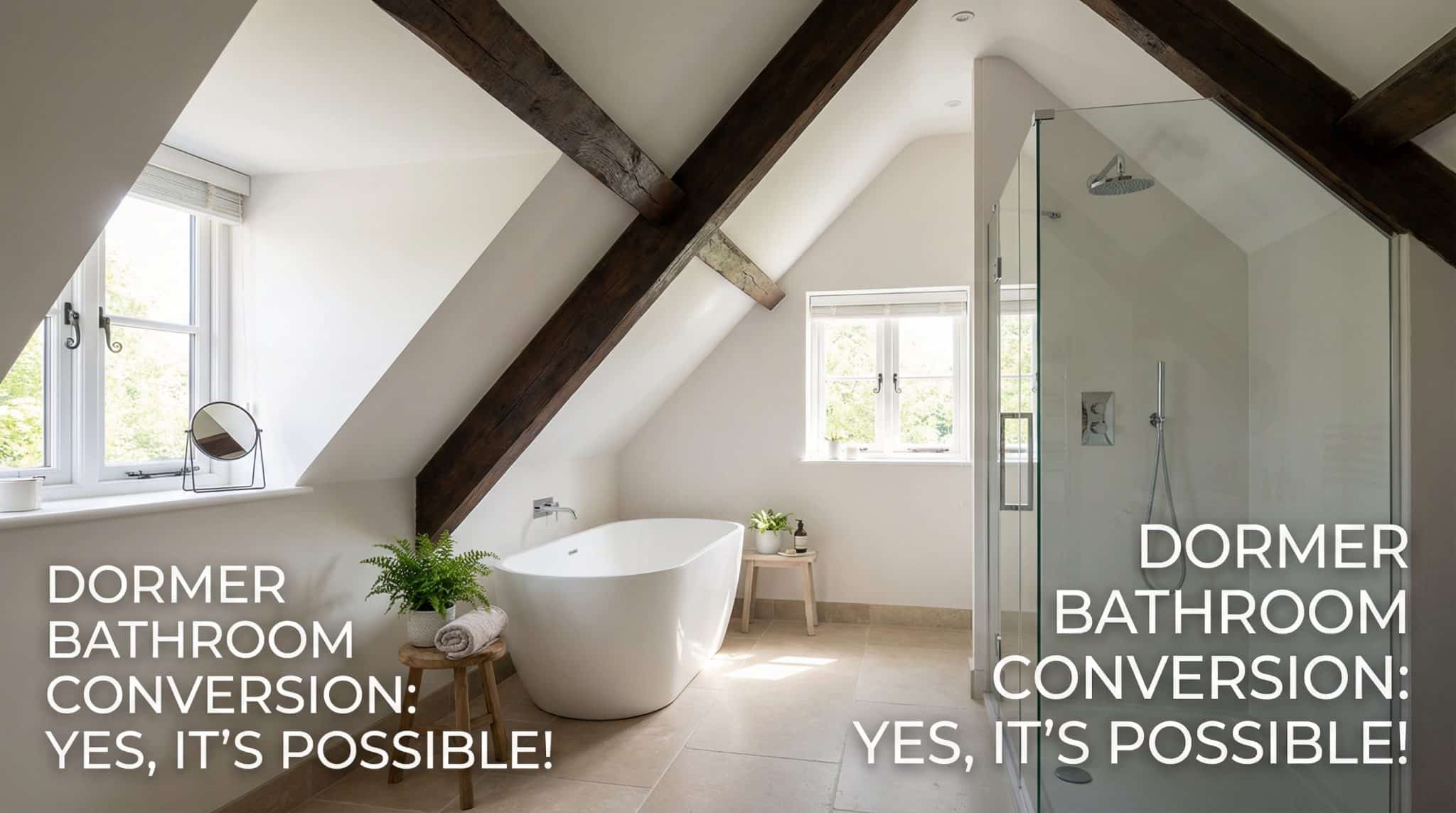
Dormer bathrooms are basically a game of Tetris except the pieces are porcelain and the ceiling is trying to slope into your personal space.
Here’s what I’ve found works best (and what I’d do in my own house):
Put the tub where the ceiling is low
You don’t need to stand up in a tub (unless you’re auditioning for a shampoo commercial). So the low eaves are a perfect spot.
If you want a full bath but the space feels tight, this one move can be the difference between “we can only fit a toilet up here” and “wait… we can actually pull off a tub.”
Put the shower where the ceiling is high
Showers need standing height obviously. Aim for about 6.5 feet or more where the showerhead will be. Dormers usually give you a sweet spot under the highest section of roof for more usable loft space. Put the shower there and don’t overthink it.
Toilets and sinks go in the “meh” middle zone
The mid height areas are great for a vanity and toilet stuff you’re not standing fully upright at for long periods.
And if you’re short on space, consider:
- A pocket door (because swing doors love to steal the exact space you need)
- A compact vanity (you don’t need a 72″ double vanity in a dormer unless you’re trying to humble-brag)
- Built-in storage in those wedge shaped dead zones (they’re awkward, but they’re useful)
A few code-ish clearances you shouldn’t ignore
Codes vary, but these are common minimums that keep your bathroom from feeling like an airplane lavatory:
- Toilet: 15″ from centerline to side wall
- Clear space in front of toilet: about 21″
- Clear space in front of sink: about 24″
- Shower entry clearance: roughly 24-30″
(If you’re thinking, “My current bathroom doesn’t even have that,” same. Older homes are the wild west. New work has to behave.)
Plumbing: The Part That Drives Your Budget (And Your Mood)
Let’s talk about the waste stack distance, because it’s the difference between “normal remodel” and “why is my plumber suddenly a structural engineer too?”
The big idea: drains need slope
Most bathroom drains rely on gravity. That means your pipes need a continuous downhill slope often around 1/4″ per foot all the way to the tie-in. The longer the run, the more likely you’ll hit joists, beams, stairs, and framing that make that slope tricky.
Best case scenario: your dormer bath is stacked above an existing bathroom or kitchen. If water already runs there, your life gets easier.
Rough budget reality based on distance
Not exact (nothing is, because houses love surprises), but generally:
- Under ~15 feet to the stack: usually straightforward.
- 15-25 feet: you may need more venting/routing work (aka more labor).
- Over ~25 feet: this is where a macerating pump system starts showing up in the conversation.
Macerating pumps: the “fine, we’ll make it work” option
A macerating pump (think Saniflo style systems) grinds waste and pushes it through smaller pipe so you’re not hostage to gravity.
Tradeoffs:
- They make noise (not horrifying, but not silent)
- They need maintenance/attention
- They don’t last forever (plan on replacing someday)
But if your dream is “bathroom up here or bust,” they can be the thing that makes it possible.
Don’t forget water pressure
Water pressure drops as you go up. A rough guide: every 10 feet of vertical rise can cost about 4.3 PSI.
If your house already has “meh” pressure, a third floor dormer shower can end up as a sad trickle. You can test pressure with a cheap gauge on an outdoor spigot. If you’re below ~40 PSI at ground level, you may want to talk to a plumber about solutions (like a booster pump).
Ventilation: Yes, You Need a Fan (Your Future Self Will Thank You)
I know. You’re thinking, “But there’s a window.” Cute. Moisture does not care.
A dormer bathroom needs a mechanical exhaust fan vented to the outside. Not into the attic. Not “kind of near the soffit.” Not “we’ll deal with it later.” Outside.
General sizing rules:
- 50 CFM minimum for small baths
- Most dormer baths do better with 75-100 CFM (it’s usually a small price jump for a big comfort upgrade)
Also: keep duct runs reasonable. Long duct runs need stronger fans, and weak airflow is how you get that charming “mysterious mildew smell” vibe.
If you want to be fancy, humidity sensing fans are honestly great less forgetting, less noise, less swamp air.
Permits + Inspections: Annoying, Yes. Optional, No.
You’ll typically need permits for:
- Building (structural/framing work)
- Plumbing
- Electrical
Permit costs vary wildly, but you’re often in the few hundred to low thousand range total. The bigger “cost” is the renovation timeline and scheduling.
Common inspection hiccups I see:
- GFCI placement issues (especially around sinks)
- Bad exhaust duct routing
- Drain slope problems
- Trying to squeeze fixtures into too tight clearances
Your local codes are the boss here, so don’t treat anything you read online (including me, hello) as your final authority. Use it to ask smarter questions.
Okay, So What Does a Dormer Bathroom Cost?
Here’s the straight talk: dormer bathrooms can be very worth it, but they’re rarely cheap cheap.
Typical ranges (ballpark!):
- Half bath (toilet + sink): ~$8,000-$14,000
- 3/4 bath (shower): ~$14,000-$28,000
- Full bath (tub): ~$18,000-$35,000
- Wet room / curbless shower: ~$22,000-$40,000+
Why the huge spread? Plumbing complexity and structural work. The same bathroom can cost wildly different amounts depending on how easily you can connect drains/vents and whether the floor needs reinforcing.
Also: add a contingency. Attics are where houses hide their weirdest secrets. I’d plan 15-20% extra if you don’t enjoy stress rashes.
“Will I Get My Money Back?” (The Least Fun Question, But Fair)
Adding a bathroom can help resale, sure. But if you’re doing this purely for ROI, keep your expectations realistic.
In my opinion, the sweet spot for many dormers is a 3/4 bath (nice shower, no tub):
- It delivers most of the day-to-day value
- It often costs less than squeezing in a tub
- It’s easier to fit into awkward rooflines
A tub is worth it if you need it (kids, primary suite expectations in your market, etc.). But if you’re adding a tub just because you think you’re “supposed to,” I’d rather you spend that money on a great shower and good ventilation.
So… Should You Do It? My Honest Decision Filter
Go for it if:
- You’ve got workable headroom (ideally close to that 7′ finished requirement where it matters)
- Your floor structure looks solid (or reinforcement is straightforward)
- The waste stack is reasonably close (or you’re okay budgeting for a pump)
- Your budget is realistically at least in the mid teens for anything beyond a very basic setup
Pause and rethink if:
- Headroom is mostly “hobbit house”
- Joists look undersized or damaged
- Plumbing would require a complicated cross house route through a bunch of framing
- Your water pressure is already weak and you’ll need upgrades
Hard stop if:
- You have multiple big constraints at once (low headroom + far plumbing + questionable structure)
- Your existing plumbing already struggles (slow drains, backups don’t add more demand to a system that’s waving a white flag)
- HOA/historic rules prevent the dormer changes you’d need
How to Get Started (Without Spiraling)
Do this first free, fast, and weirdly empowering:
- Measure headroom in several spots (not just the peak)
- Rough sketch where a toilet/shower/vanity might go
- Locate the waste stack and estimate distance/route
- Peek at your joists for size/spacing/condition
If those basics look promising, then I’d bring in pros in roughly this order:
- A contractor to sanity check feasibility and layout
- A structural engineer if framing looks questionable
- A plumber to confirm your drain/vent plan (gravity vs pump, routing, etc.)
And please, for the love of dry ceilings: let licensed pros handle rough plumbing/electrical if you’re not experienced. You can absolutely save money doing finish work later (paint, trim, maybe even some tiling if you’re brave and patient), but the behind-the-walls stuff is not where you want to freelance.
If you want, tell me your dormer’s rough dimensions, peak height, and where the nearest bathroom/kitchen sits below it and I’ll help you think through whether you’re looking at a “totally doable” project or a “this will be a plumbing soap opera” project.