
DIY Hillside Fixes: The One Number That Changes Everything
If you’ve ever stood at the top of your yard, looked down at your “cute little slope,” and thought, How bad could it be? …welcome. You’re among friends.
Because here’s the not so cute part: when hillside projects fail, they don’t fail like “oops, the petunias died.” They fail like “why is my fence leaning” and “why is there a new crack in my foundation” and “how did I just spend $12,000 I didn’t have.”
The number that separates weekend DIY from please call an engineer before gravity humbles you is:
33% slope grade
- Under ~33%: normal landscaping and smart drainage usually hold up fine.
- Over ~33%: water moves faster, soil wants to leave, and your fixes need to get more serious (even if you still DIY the labor).
- Over ~50%: this is where I personally put my shovel down and pick up a phone.
Before you buy a single plant, a single block, or rent a mini skid steer you’ve never driven (no judgment), let’s measure what you’re actually working with.
Measure your slope (so you’re not just vibes based landscaping)
You don’t need fancy tools. You need:
- 2 stakes
- string
- a tape measure
- a cheap little line level (the $2 kind that looks like it came out of a gumball machine)
The quick and not annoying method
- Pound in two stakes: one near the top of the slope, one near the bottom (about 10 feet apart is perfect).
- Tie string between them and use the line level to make the string perfectly level.
- At the lower stake, measure straight down from the string to the ground. That’s your rise.
- Your run is the horizontal distance between stakes (so if they’re 10 feet apart, that’s 120 inches).
The only math you need
Rise ÷ Run × 100 = slope %
Example: if the string is 30 inches above the ground at the lower stake and your run is 120 inches:
30 ÷ 120 × 100 = 25% slope
Do this in 3-5 different spots because hillsides love surprises.
What your number means (aka: should you panic?)
Here’s the reality check I use:
- Under 10%: You’re fine. This is “normal yard” territory.
- 10-25%: Still manageable, but water starts getting bossy. Plan for better drainage.
- 25-33%: Steep ish. Mowing starts to feel like a life insurance decision.
- 33-50%: You can DIY, but I’d strongly consider a paid consult (more on that in a minute).
- Over 50%: Call a pro. This is not me being dramatic—this is me liking your house where it currently sits.
Quick mower reality check (because this matters)
If your slope is over ~25%, grass becomes a high maintenance frenemy. Even if it grows, you’ll hate maintaining it. Nobody wants to be That Neighbor doing a shaky sideways mower dance while everyone pretends not to look.
Over ~25%? Start thinking groundcovers, natives, shrubs—stuff that holds soil and doesn’t require you to risk your ankles every Saturday.
Drainage is the whole game (yes, even if you “just want plants”)
I know. Drainage is not sexy. Nobody pins “French drain goals” on Pinterest.
But on a slope—especially over 33%—water doesn’t politely soak in. It tends to:
- run over the surface,
- carve little channels,
- steal your topsoil,
- and slowly turn your hill into a sad dirt slip n slide.
If you only remember one thing, make it this:
You can’t “plant your way out” of a water problem.
What I’d do in real life:
- On gentler slopes: shape the surface so water flows where you want (away from the house, away from the neighbor’s yard, away from chaos).
- On steeper slopes: add simple features that interrupt runoff—like shallow swales (basically a gentle ditch that catches water before it speeds up).
- If you’ve got wet spots, seepage, or water that collects and then zooms downhill: that’s when a French drain or proper drain system can make sense.
And before you dig anything deeper than “plant a shrub,” do yourself a favor and call utility locating (in the U.S. it’s 811). Accidentally finding a cable line with a shovel is not the kind of DIY story you want.
Stabilizing the slope: what actually works (by steepness)
1) Under ~33%: plants can do a lot of the heavy lifting
This is the sweet spot where you can often stabilize with dense planting and maybe a light erosion control layer while things fill in.
My best advice: plant closer than you think you should. Slopes don’t give plants the same cozy, watered evenly conditions as flat ground. You want roots holding hands down that hill.
If you leave bare soil, it will wash. Bare soil on a slope is basically an invitation to disaster (and weeds—always weeds).
2) 33-50%: still DIY able, but protect the soil while plants establish
On these slopes, plants often need slope blankets and groundcovers while they get rooted in. That backup can look like:
- erosion control blankets (biodegradable mats that hold soil in place)
- geotextile under stone in strategic areas
- professional input on drainage and layout (sometimes one consult saves you thousands)
This is the zone where a lot of people fail because they skip the boring steps (water management + proper installation) and jump straight to “let’s plant pretty stuff.”
Pretty stuff is not structural. Sorry, pretty stuff.
3) Over ~50%: grids, rock, or engineering (pick your adventure)
This is where solutions get more like:
- geocells (honeycomb grids that hold soil or gravel in place)
- riprap (big angular rock for fast moving water areas)
- retaining/terracing systems
- and often, an engineer if there’s any risk near structures
If your hill is starting to look more like a dramatic cliff scene from a movie—please don’t DIY your way into a headline.
Retaining walls: the “4-foot rule” you really need to know
Retaining walls are where a lot of homeowners accidentally wander into Permit Land.
The rule of thumb:
Walls under ~4 feet (per tier) are often the DIY friendly zone.
Over ~4 feet is where permits and engineering commonly kick in.
And even if your area technically allows it, a tall wall without proper design is one of those “looks fine until it suddenly doesn’t” situations.
Tiered > Tall (almost always)
If you’re trying to hold back a big height difference, multiple shorter walls usually beat one giant one. It spreads out the pressure and gives water more chances to behave.
Drainage behind the wall is not optional
If you take nothing else from this section: a retaining wall needs a way to relieve water pressure behind it. Water builds pressure, pressure blows out walls, walls make you cry.
(Ask me how I know. Actually don’t. I’m still emotionally recovering.)
Also: I personally avoid timbers/railroad ties near food gardens because chemical leaching is a real concern. I’m not trying to grow herb roasted anything with a side of mystery toxins.
When to call a pro (and not feel weird about it)
Some situations aren’t “you failed at DIY.” They’re “you’re smart enough to outsource the scary part.”
I’d get professional help if:
- Your slope is over 50%
- You’re building a retaining wall over 4 feet
- The slope is near your house, a driveway, a neighbor’s fence, or a waterway
- Your area has a history of soil movement/landslides
- You’ll need permits and you’d rather eat glass than deal with that paperwork
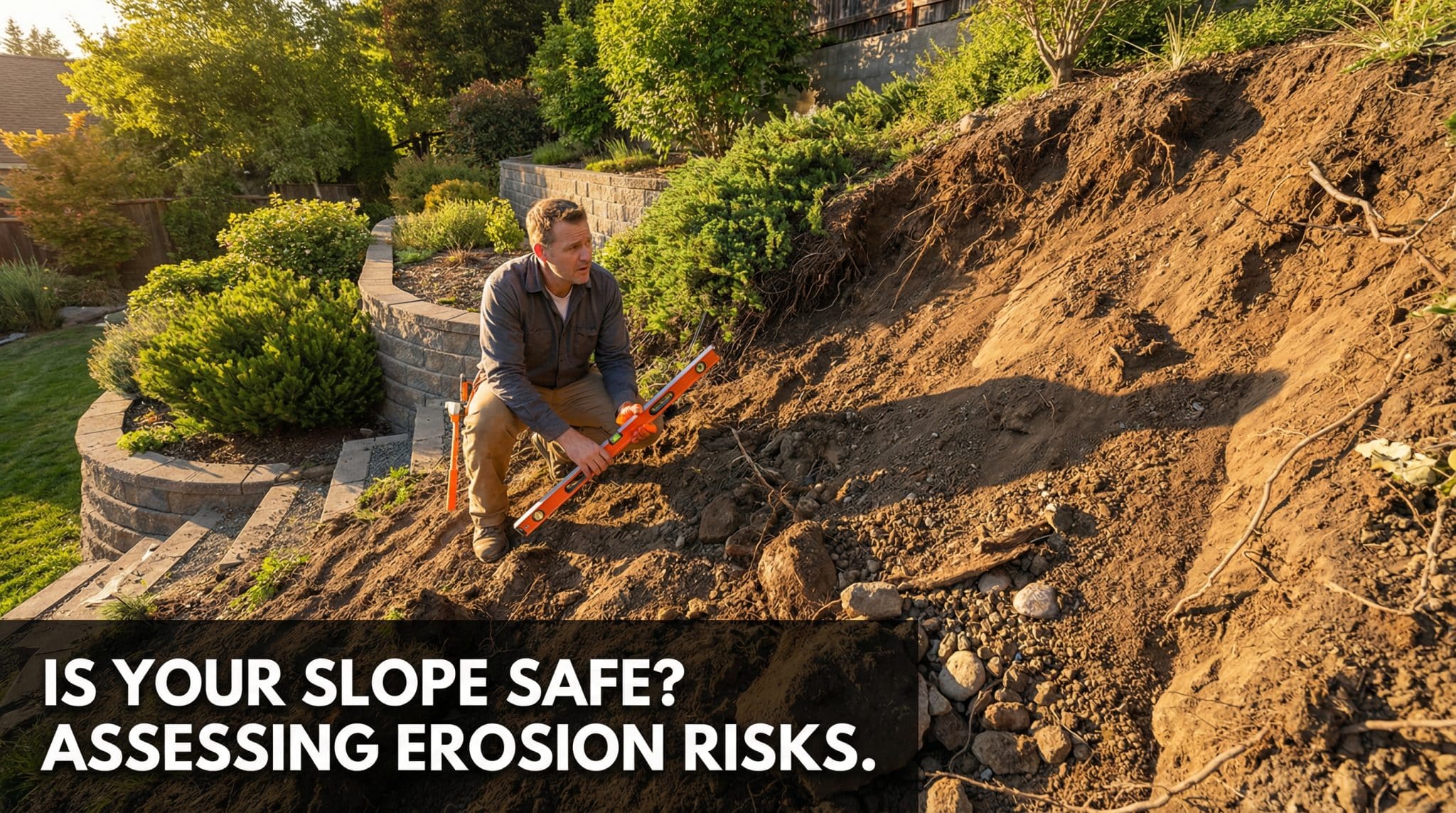
Red flags that mean: stop digging
If you see any of these, pause the project and get an assessment:
- water seeping out of the hillside after rain
- mushy soil, sudden soft spots, or tilted plants/trees
- deep erosion channels forming fast
- the ground looks like it’s settling, cracking, or shifting
This isn’t me being alarmist. This is me being Team Your House Stays Put.
What this usually costs (ballpark, not a blood oath)
Costs vary wildly by region and access (steep, tight spaces = pricey), but roughly:
- Plants/vegetation approach (under 33%): often a few dollars per square foot, especially if you DIY planting
- Blankets + planting (33-50%): more, because materials add up
- Geocells/rock/structural systems (50%+): more again—usually where pros enter the chat
- Retaining walls: can go from “okay manageable” to “why is this wall the price of a used car” depending on height, material, drainage, and engineering
Also don’t forget rentals: even basic equipment can run a couple hundred bucks a day, and hillsides love turning “one day” into “three days and a sore back.”
Plants that actually help on slopes (not just look cute for a week)
My favorite way to think about slope planting is layers:
- Groundcovers + grasses: hold the surface
- Perennials: fill in and add root variety
- Shrubs (and sometimes small trees): deeper anchoring (but don’t plant big thirsty trees where water is already a problem)
A few solid, common options (depending on your region—always double check what’s invasive where you live):
Sunny / drier slopes
- Grasses: little bluestem, switchgrass
- Groundcovers: creeping juniper, creeping phlox
- Shrubs: fragrant sumac (tough as nails), eastern red cedar (where appropriate)
Shady / moist slopes
- Ferns: Christmas fern, ostrich fern
- Groundcovers: wild ginger, pachysandra (again—check invasives locally)
- Shrubs: winterberry holly, rhododendron/mountain laurel (if they like your soil)
Big tip: don’t over irrigate a slope. Saturated soil is heavier and more likely to move. Water to establish, then aim for plants that don’t need daily babysitting.
Two quick questions I always get
“Can I terrace to make my slope ‘less steep’?”
Yes—and terracing can be amazing. You’re basically turning one big stressful hill into a sloped garden transformation with a few smaller, manageable zones. Just remember: terracing often means walls, and walls mean drainage and (sometimes) permits/engineering.
“Do I need a landscaper or an engineer?”
- Landscaper: design, plants, install, aesthetics—great for stable slopes under ~33% with no scary signs.
- Engineer (often geotechnical): evaluates soil stability, water behavior, structural risk—worth it when things are steep, wet, near structures, or already moving.
The takeaway (the one rule that saves you money)
Measure your slope and take the number seriously.
Under 33%? You’re usually in solid DIY territory with smart planting and drainage.
33-50%? DIY can still happen, but a consult and extra erosion control are worth it.
Over 50%? Get professional guidance before you “see what happens.”
Because gravity is patient. It doesn’t care that you got a great deal on mulch. It will wait for the first big storm and then collect its payment.
So go grab the stakes and string. Turn your hill from a mystery into math. Then you can fix it like a person who enjoys sleeping at night.