
Where Should Your TV Go When You Also Have a Fireplace (aka: The Battle of the Focal Points)
If you’ve ever stood in your living room holding a tape measure, staring at your fireplace, then staring at your TV, then staring into the middle distance like you’re in a sad indie film… hi. Same.
A fireplace and a TV are both attention hogs. They both want to be the moment. And when you try to force them to share a wall, the room can go sideways fast: neck cramps, heat worries, weird furniture layouts, and that general vibe of “we just kinda stuck it there.”
So here’s how I actually think about it (without turning your living room into a chiropractor’s waiting room).
First, decide what you care about most (because you can’t have everything)
Every fireplace/TV setup is a three way tug of war:
- Comfort: Can you watch a whole movie without your neck filing a formal complaint?
- Heat safety: Is your fireplace going to slowly roast your expensive electronics like a tiny, bougie rotisserie?
- Looks: Does it feel intentional… or like you moved in yesterday and haven’t unpacked your decision making skills yet?
If you pick your #1 priority, the “right” placement usually becomes obvious.
The only numbers you really need (I promise)
You do not need an engineering degree. You need three sanity checks:
1) TV height: eye level wins
The sweet spot is the center of the TV around 42-48 inches from the floor (about seated eye level).
If you’re looking up more than about 15 degrees to the middle of the screen, your neck will notice. Quickly.
2) Viewing distance: don’t sit in the front row
Most living rooms land somewhere around 8-12 feet from couch to screen.
3) TV size: a simple rule of thumb
A handy guideline: TV diagonal size (in inches) ≈ 1.5 × viewing distance (in feet).
So if you sit about 10 feet away, a ~65″ TV usually feels right.
My favorite “don’t regret this later” trick
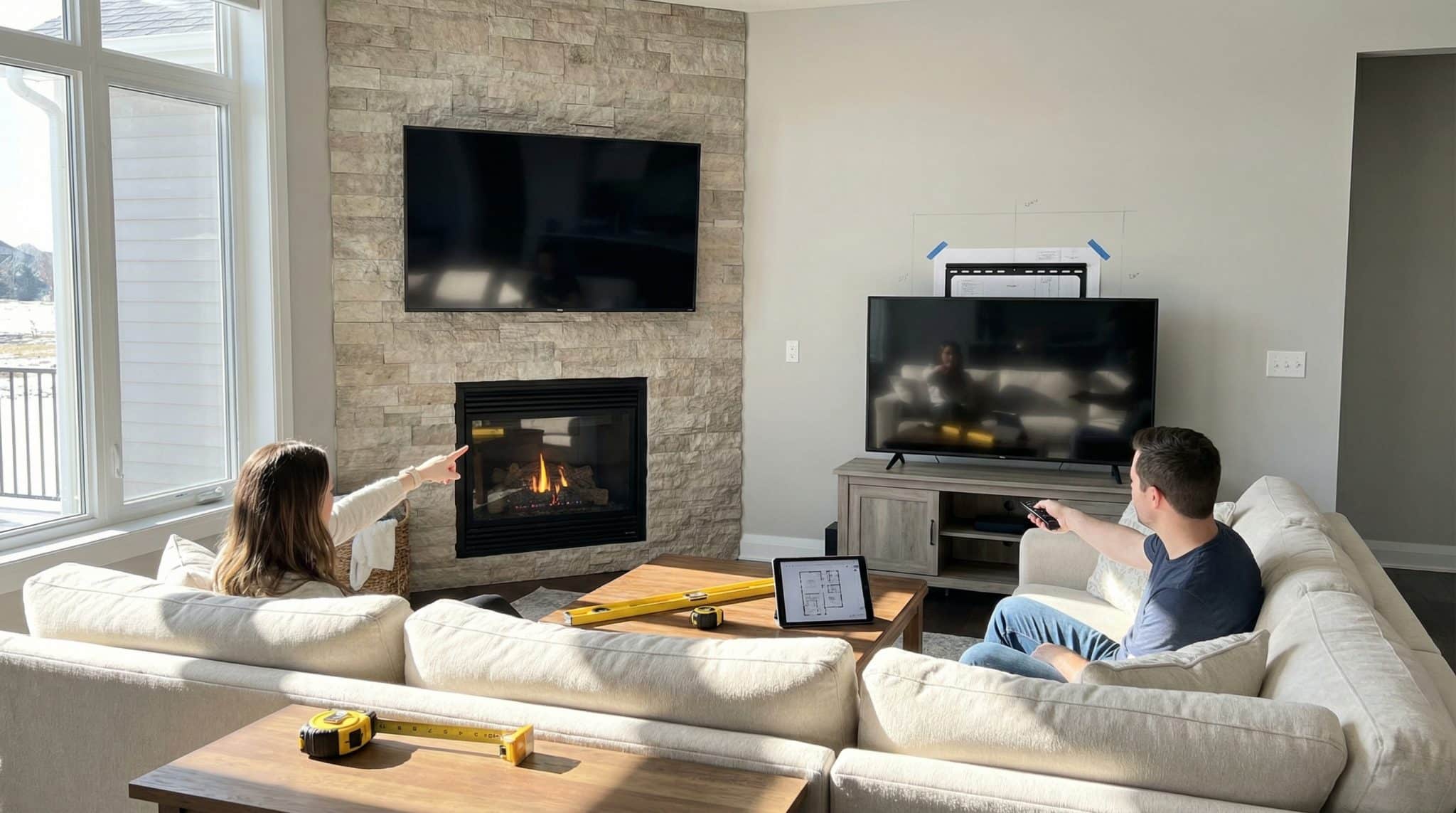
Before you drill anything, tape up a cardboard rectangle the size of your TV where you think it should go. Sit down. Scroll your phone. Pretend you’re watching something for 10 minutes.
If you catch yourself doing the “chin up” posture… abort mission.
The 5 placements I see most (and when each one actually works)
1) Above the fireplace (the controversial classic)
Sometimes it’s the only wall that makes sense. Sometimes it’s a trap.
Works best when:
- It’s an electric fireplace (lower heat, generally less risky)
- You’ve got decent ceiling height
- You’re willing to use a tilting or pull down mount (more on that in a sec)
Where it goes wrong:
Most mantels sit 4-5 feet high, which shoves your TV into the sky. The TV center ends up 5-7 feet off the floor, and suddenly you’re watching Netflix like you’re sitting in the front pew at church.
My opinion:
If you mount above a working wood/gas fireplace without a plan for heat and height, you’re basically volunteering for discomfort. And I say that with love.
Fixes that actually help:
- A tilt mount that angles the TV down (usually 15-30°)
- A pull down mount (like the MantelMount style ones) that lets you bring the TV down to a human neck zone during viewing, then push it back up later
I’ve seen pull down mounts look a little “Transformer-y” in motion, but if you’re stuck with the above mantel location, they’re a genuinely solid solution.
Heat clearance reminder:
Don’t mount the TV hugging the fireplace opening. You want breathing room for airflow. Many setups aim for at least 8-10 inches between the top of the opening and the bottom of the TV (more is often better, especially with higher heat). And yes—testing matters (I’ll get to that).
2) Beside the fireplace (my personal favorite when there’s room)
This is the one that tends to look the most intentional while also being comfortable and safer.
You’ll like this if:
- You have 3-4 feet of usable wall beside the fireplace
- You want the fireplace to stay “special” without the TV perched over it like an awkward hat
The one downside:
You now have two focal points. If you do nothing else, the room can feel a bit scattered—like your eyes don’t know where to land.
Easy way to make it feel on-purpose:
Add something that visually connects the area: log burner wall design, matching cabinets, a long console, shelving, or even artwork that balances the whole wall. (No, you don’t need to buy a truckload of decor. Just give the TV a reason to be there.)
3) Opposite wall from the fireplace (comfort queen)
If your room is about 14 feet deep or more, this is often the most comfortable setup.
Why it’s great:
- You get proper viewing distance
- The TV can be at normal eye level
- Zero heat risk, because it’s not near the fireplace
Furniture tip (that feels weird until you try it):
Don’t shove everything against the walls. Float your seating a bit so the room feels like a conversation zone, not a high school dance with everyone lining the perimeter.
Trade-off:
You can’t enjoy the fire and the TV at the same time without turning your head. (Some people don’t care. Some people deeply care.)
4) In a corner (for chaos layouts and “there are too many windows” rooms)
Corners can save the day when the obvious walls are eaten up by doors, windows, or weird traffic paths.
Make it better with:
- An articulating/swivel mount so you can pull the TV out and aim it at the seating
When I don’t love it:
If you regularly have a bunch of people watching together, corners can create awkward viewing angles where half the room gets the “side eye screen.”
5) In front of a non-working fireplace (only if it’s truly dead)
If your fireplace is actually decommissioned (not “we just never use it”), you can absolutely put a media console in front of it and move on with your life.
A typical console height (24-30 inches) usually lands you in a comfortable TV height range.
Make it look intentional:
- Choose a console with a width that feels proportional to the opening
- Cover the dark firebox void with a decorative screen, a panel, or an insert so it doesn’t look like a cave behind your electronics
The “side wall” option (perpendicular to the fireplace) that people forget about
If the fireplace wall is a mess of glare, windows, or heat concerns, mounting the TV on a perpendicular wall can be the cleanest compromise—especially with wood burning fireplaces.
It also helps avoid the “sun reflecting directly into the screen” situation, which is a special kind of daily annoyance.
Heat safety: please test before you cook your TV
If you’re even considering mounting above or very near an active fireplace, do these wall temperature test steps. It’s easy and it’s way less painful than replacing a TV.
The simple heat test
- Mark three spots on the wall where the TV would be (left, center, right).
- Run the fireplace at maximum heat for 30 minutes.
- Use an infrared thermometer to read the wall surface temp at those spots.
- If any spot is over 95°F, rethink it: more clearance, a deflector, or a different placement.
If you run your fireplace for long stretches in winter, test longer—up to 2 hours—because some setups keep creeping warmer over time.
Also: after normal fireplace use, your TV should not feel warm to the touch. If it does, that’s your sign.
Mount talk (because the mount is often the whole problem)
Here’s the quick and useful version:
- Fixed mount: great when the TV is already at a normal height and you sit straight on.
- Tilting mount: helpful when the TV is a bit high and you need to angle it down.
- Articulating mount: best for corners, multiple seating areas, or when you need flexibility.
- Pull down mount: the “I’m mounting above the fireplace but I want my neck to survive” option.
Personally, if you’re going above the mantel, the mount choice is not where you cheap out. Your body will invoice you later.
Cable hiding: because dangling cords ruin everything
A gorgeous fireplace wall with a sad cord waterfall is just… painful.
- Best look: in wall routing (but follow local code—especially for power cables)
- Good backup: paintable surface raceways/conduit (they’re not fancy, but they work)
- Stone/brick reality: you’re usually doing surface mounted solutions unless you want to get into masonry work (and a new personality)
DIY or hire a pro?
I’m all for DIY when it’s straightforward.
DIY is usually fine if:
- You can hit studs confidently
- It’s a standard drywall situation
- Your TV isn’t enormous/heavy (and you’re not guessing with anchors)
Hire help if:
- You’re drilling into brick, stone, plaster, or concrete
- You need outlets moved or added
- You’re anywhere near chimney weirdness
- Your TV cost enough that you’ll cry if something goes wrong
Mounting is one thing. Electrical work is another. Pay someone if you’re out of your depth—future you will be so smug about it.
My “final decision” cheat sheet
If you want the simplest nudge:
- Electric fireplace + limited walls: above mantel can work (especially with tilt or pull down)
- Wood burning (or you actually use your gas fireplace): try beside or opposite first
- Deep room (14’+): opposite wall is usually the most comfortable
- Weird layout: corner/perpendicular wall with an articulating mount
- Dead fireplace: cover it and reclaim the wall like the practical legend you are
Do the cardboard test. Do the heat test if you’re near the fireplace. Pick the layout that makes everyday TV watching comfortable—because “it looks nice” stops being cute when your neck hurts.
And if you’re stuck between two options, choose the one that doesn’t make you mutter “ugh” every time you sit down. Your living room should not be beefing with you.