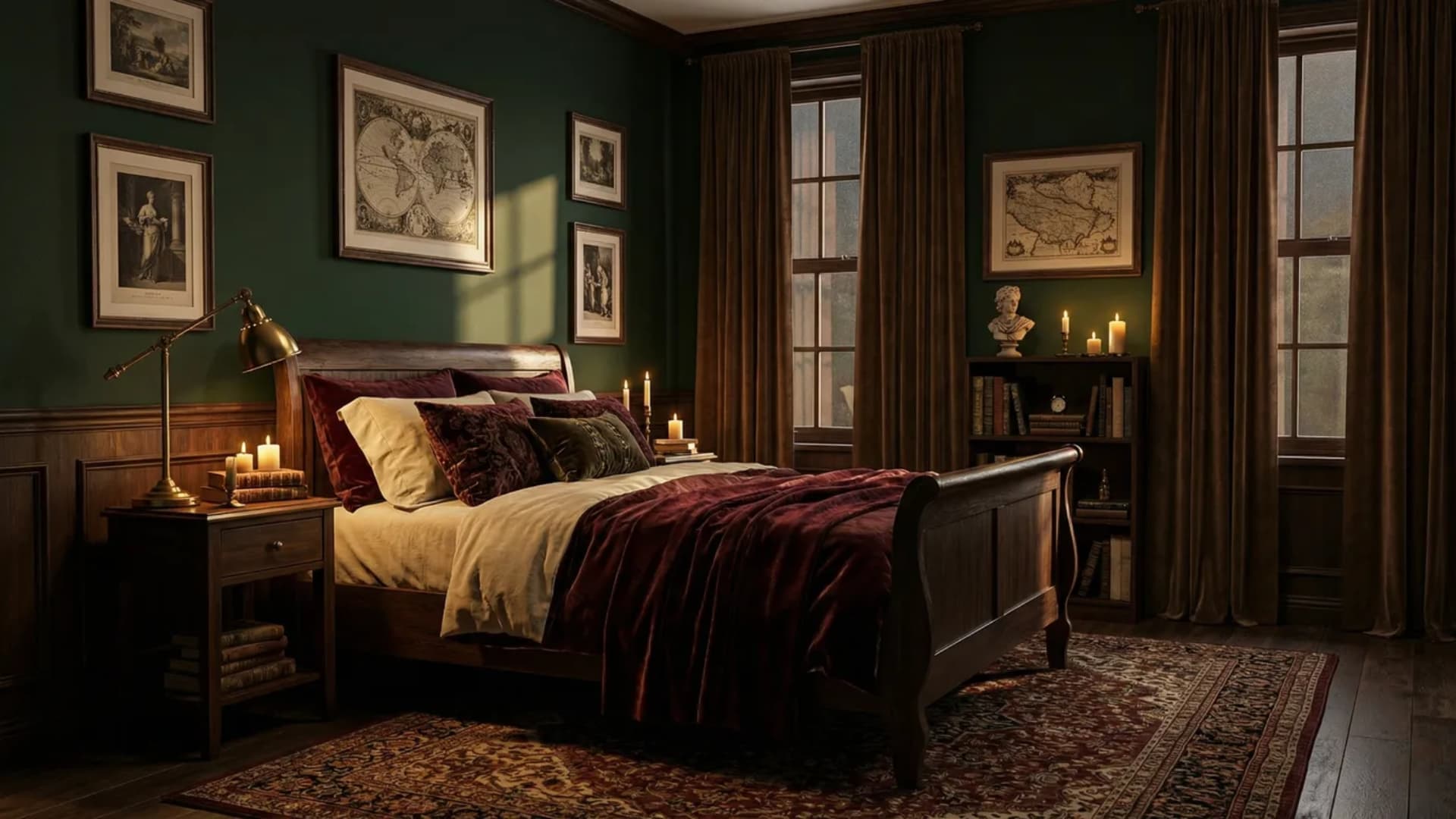

You have seen it a hundred times on Pinterest. That bedroom with the dark wood desk, the warm lamp glow, and shelves full of worn books.
It looks effortless. It looks like someone actually lives and thinks in that room.
So you try to recreate it. You buy a few dark pieces, throw in some candles, and suddenly your room just looks gloomy instead of moody.
The difference between those two outcomes is not money or luck. It is knowing which elements to layer, in what order, and why each one matters.
This blog breaks down the dark academia bedroom style from the ground up. Colors, furniture, lighting, decor, and the small touches that make the whole thing click.
What Is the Dark Academia Bedroom Style?
Dark academia draws from 19th-century Romanticism, a movement that valued emotion, history, and the beauty of old things.
Over time, that feeling found its way into interior design, inspired by grand university libraries, Gothic architecture, and the look of a scholar’s study.
It is not the same as Gothic decor. Gothic leans dark and dramatic. Dark academia leans intellectual and lived-in.
The mood is closer to a rainy afternoon in a university common room than a haunted mansion. What makes it distinct is the sense of story.
Every object in a dark academia bedroom feels like it belongs to someone with a rich inner world. Nothing looks like it was bought in bulk or placed without thought.
That’s a great standard to keep in mind as you work on building your style, one room at a time.
The Color Palette: What Shades Work Best
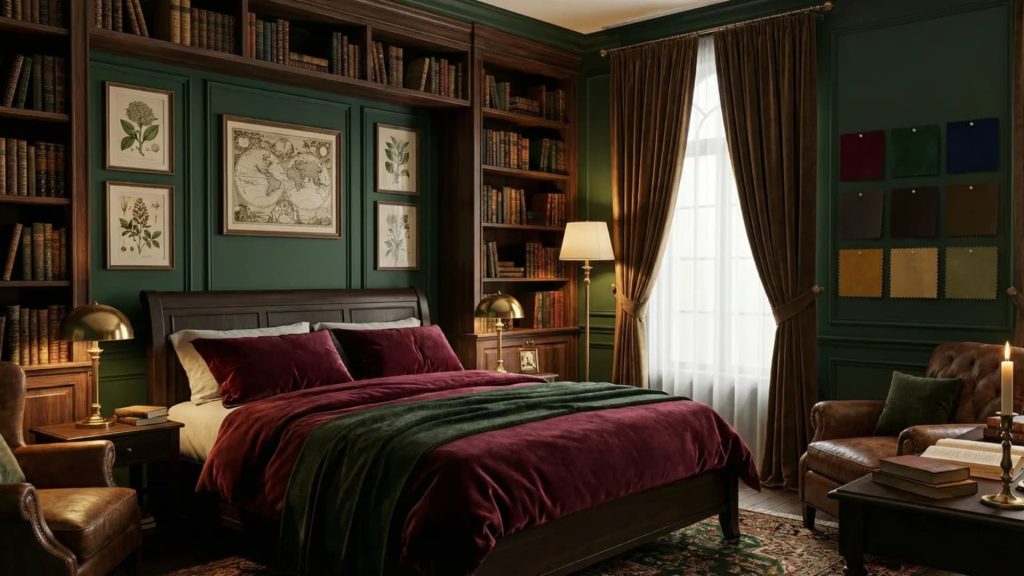
Think of the color inside an old library. Dark wood panels, leather chairs worn soft with age, and walls that have absorbed decades of candlelight. That is the feeling you are building toward.
| Color Category | Colors | Best Used On |
|---|---|---|
| Foundation Colors | Burgundy, Forest Green, Navy Blue, Dark Brown | Walls, bedding, curtains, and large furniture |
| Accent Colors | Deep Gold, Dusty Mustard, Olive Green | Cushions, throws, lamps, small decor |
| Colors to Avoid | Bright White, Cool Gray, Pastel Tones | Any surface, as these break the warm, moody feel |
| Wallpaper Alternative | Dark Florals, Aged Textures, Plaid | Accent wall or full room if painting is not an option |
You do not need all four foundation colors. Pick two that feel right together and build from there. Deep gold, dusty mustard, and olive green work well as accents without competing for attention.
Skip cool grays and stark whites here, and check pairing wall colors with oak furniture before committing to a shade.
If painting is not an option, removable wallpaper in aged textures, dark florals, or plaid gets you to the same place without touching a wall.
Once your colors are in place, the next step is filling the room with the right furniture and textiles.
Furniture, Bedding, and Textiles: Building the Base
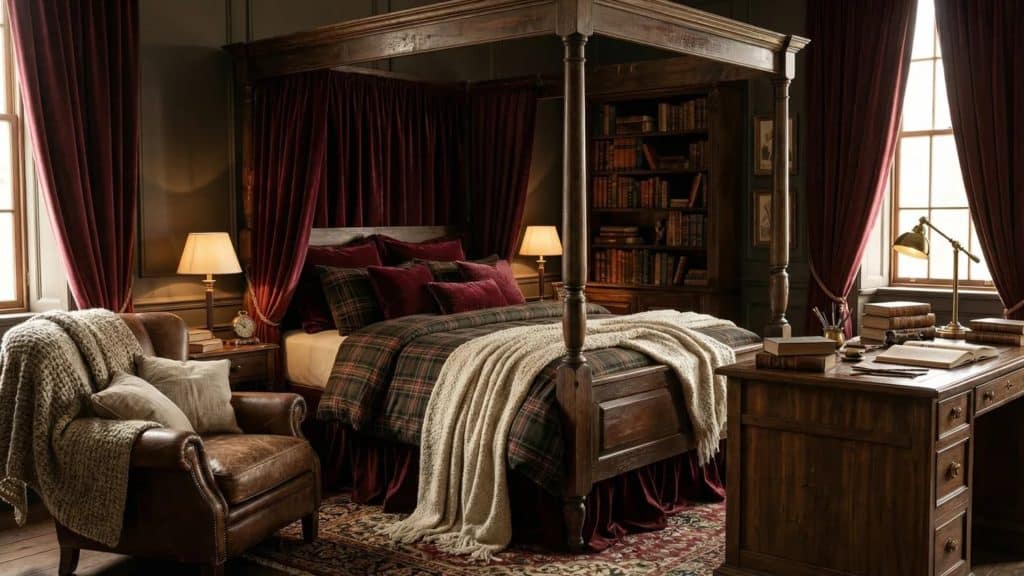
Walk into any dark academia bedroom that works, and you will notice the furniture first. Not because it is loud, but because it feels like it has been there for years.
Heavy, worn, and full of quiet character. That is exactly what you are going for.
Before anything else, get three pieces right: a writing desk in dark wood with visible grain and some sign of age, an ornate bookshelf with open shelving and decorative molding, and a solid bed frame, ideally a four-poster, in dark or aged wood.
You do not need genuine antiques. Pieces that look substantial and worn work just as well.
What kills this style fast is anything sleek, flat-packed, or finished in metal. Those finishes belong in a different room entirely.
Once the furniture is in place, build the bedding and textiles around it:
- A thick duvet with a plaid or jacquard cover as the base layer
- A velvet or wool throw draped loosely across the foot of the bed
- Floor-length velvet curtains that pool slightly at the base of the window
- Linen cushions and a chunky wool blanket layered onto seating
The moment you swap out thin or synthetic fabrics for heavier ones, the whole room shifts.
That single change does more for this style than most people expect. With the foundation set, the right lighting will bring the whole room to life.
Lighting That Sets the Right Mood
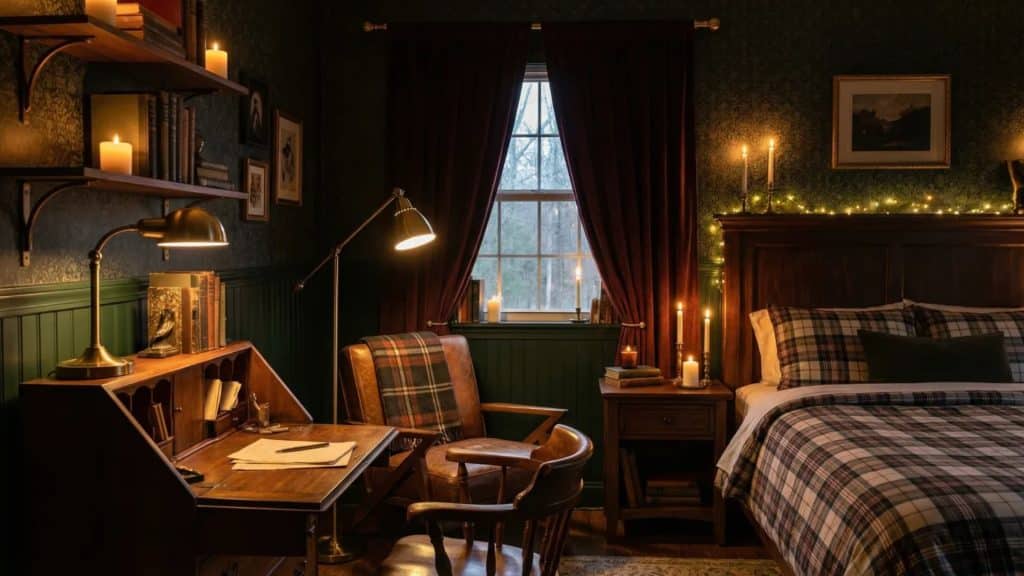
Layer these light sources instead of relying on one overhead fixture, and the room’s mood shifts entirely.
- Brass or bronze table lamp: placed on the desk for focused warm light
- Warm floor lamp: angled near the reading chair
- Candles: real or battery-operated, sitting on shelves and surfaces
- String lights: run behind the headboard or tucked along a bookshelf for a quiet glow
Always use warm bulbs in the 2700K range. Anything cooler strips the color straight out of your palette and turns a moody room into a bright one.
If your room does not get much natural daylight to begin with, placing fixtures in a naturally dark room the right way matters even more, since you are relying on artificial light to do all the work.
If you can add a dimmer, do it. The room at 7 pm, with everything turned down low, feels completely different from the same room at noon. That shift is what dark academia lighting is actually chasing.
The goal is simple. The room should look like the light has a source you cannot quite find.
Once the lighting is right, the walls and surfaces are next.
Wall Decor, Books, and Accent Pieces
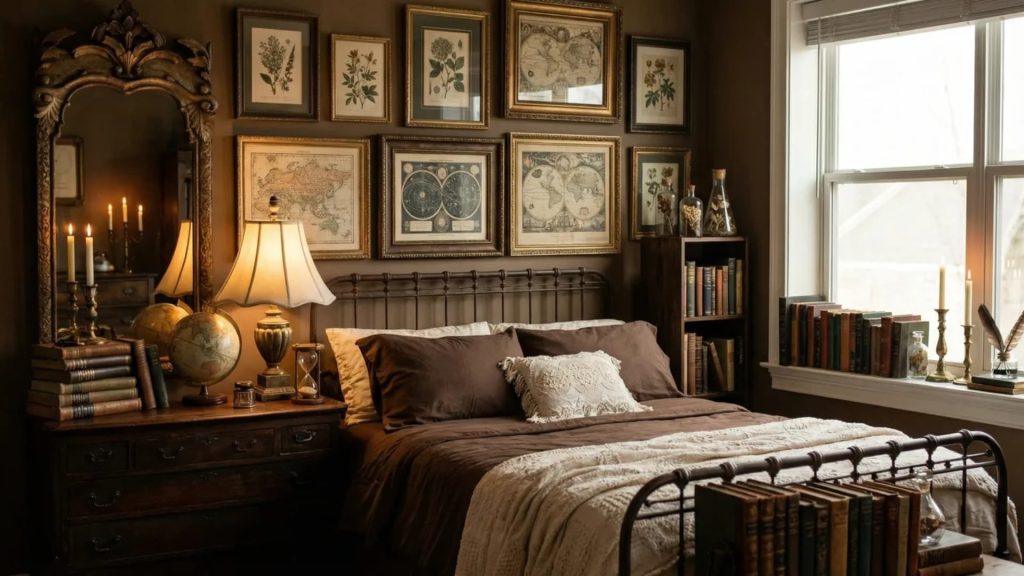
The furniture and lighting set the mood. This section is where the room starts to feel like it belongs to someone specific.
Dark academia walls work best when they look collected rather than decorated. Decorated walls look like someone went shopping. Collected walls look like someone has been gathering things for years. That distinction is everything.
- Gallery wall: mismatched vintage frames with old botanical prints, manuscript illustrations, antique maps, or astronomy charts
- Books everywhere: stacked on the nightstand, lined along a windowsill, or used as a base under a lamp
- Accent pieces: a vintage globe, brass hourglass, old inkpot, tarnished candlestick, or dried botanicals in glass vessels
- Ornate mirror: a dark frame that adds character and reflects warm light back into the room
Once the room feels like a collection rather than a showroom, the next step is building this look without overspending.
How to Do Dark Academia on a Budget?
Dark academia costs less than most decorating styles because worn, aged, and imperfect pieces fit the look better than anything brand new.
The key is knowing where to put your money and where to save it. Not every element needs investment. Some of the best finds for this style cost almost nothing.
Here is a breakdown of where to spend and where to save:
| Element | Where to Find It | What to Spend |
|---|---|---|
| Dark wood furniture | Thrift stores, Facebook Marketplace, estate sales | Save |
| Velvet curtains | Amazon, IKEA, HomeGoods | Mid-range |
| Vintage frames | Thrift stores, flea markets | Save |
| Bedding and throws | TJ Maxx, HomeGoods | Mid-range |
| Accent pieces | Etsy, antique fairs, your own shelves | Save |
| Lighting fixtures | Thrift stores, Target, Amazon | Mid-range |
| Books | Second-hand bookshops, charity shops | Save |
| Statement mirror | Invest here; it does the most work | Spend |
The single best shopping habit for this style is checking thrift stores before anywhere else. Vintage globes, brass objects, ornate frames, and dark wood furniture show up regularly and cost a fraction of what they would elsewhere.
Estate sales are worth watching, too. You will often find entire collections of the kind of objects this style is built around, all in one place.
Now that the budget is covered, here is how to make it all work inside a small room or rental.
Dark Academia Bedroom Ideas for Small Rentals
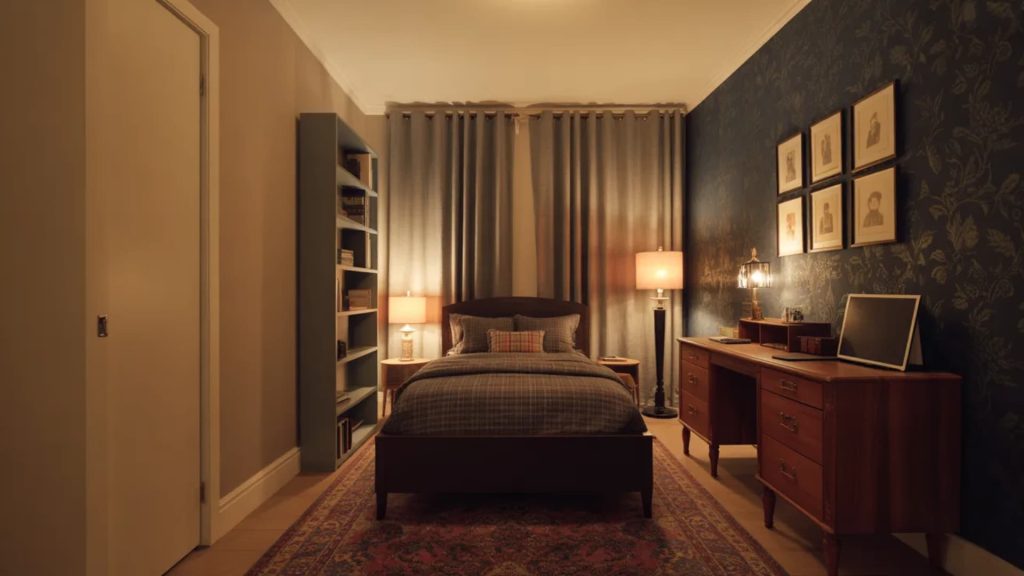
A small room shouldn’t stop you, but going dark on every surface tips it from moody into suffocating fast.
Pick one wall for a deeper tone or removable wallpaper and keep the rest warm and neutral. For renters, these swaps do the job without touching a single wall or floor permanently:
- Removable wallpaper: aged textures, dark florals, or plaid patterns
- Peel-and-stick picture rails: hang frames without drilling
- Large area rugs: rich patterns to cover plain or light flooring
- Freestanding bookshelves: work as room dividers instead of wall-mounted units
- Floor and table lamps: stand in for fixed ceiling fixtures
Every piece in a smaller room should earn its place: a desk with drawers for storage, a bookshelf as a room divider, an ottoman that hides clutter underneath.
Vertical space is the most underused tool in a tight room. Tall bookshelves, floor-length curtains, and vertical art clusters pull the eye upward, so the room stops feeling small even if it doesn’t get bigger.
Mistakes to Avoid When Decorating a Dark Academia Bedroom
Getting the big elements right is one thing, but a few common missteps can quietly undo everything you have built. These are the ones that show up most often and the ones most guides never mention.
- Making the room too dark: balance deeper tones with warm neutrals and let lighting carry the mood, since depth should come from layers, not an absence of light
- Buying everything new: shop second-hand first, since worn edges and faded finishes are exactly what the style asks for
- Skipping the layers: stack textiles, group frames, and use multiple light sources, since a single duvet and one lamp leaves the room flat
- Overcrowding every surface: edit down to pieces that earn their place and give each one room to be noticed
- Ignoring the scent of the room: a candle in cedar, sandalwood, or tobacco keeps the atmosphere consistent even when no one is looking at the decor
Now that you know what to avoid, here is how to bring it all together.
Conclusion
A dark academia bedroom is not built in one shopping trip. It comes together slowly, one considered piece at a time.
Start with the colors and furniture. Build the lighting next. Then fill the walls and surfaces with objects that feel like they have a past. Keep the fabrics heavy, the light warm, and the scent of the room as intentional as everything else.
The style rewards patience. The more time you give it, the more it starts to feel like the room has always been this way.
If you are starting from scratch or working with a tight budget, pick the three furniture anchor pieces first and build outward from there.
What part of your room are you tackling first? Let us know in the comments below.
Frequently Asked Questions
Can I Mix Dark Academia With Other Bedroom Styles?
Yes. It pairs well with cottagecore and vintage styles. Both share a love of natural textures and old objects. Just keep the color palette consistent so the room does not feel pulled in two directions.
What Type of Flooring Works Best for This Style?
Dark hardwood or aged wood floors work best. If you have light or plain flooring, a large area rug in a rich pattern covers it well and adds warmth to the whole room.
Can a Dark Academia Bedroom Work In a Dorm Room?
Yes. Focus on what you can control. Swap out bedding, add a desk lamp with a warm bulb, stack a few books, and hang a couple of vintage frames. Small changes go a long way in a tight space.