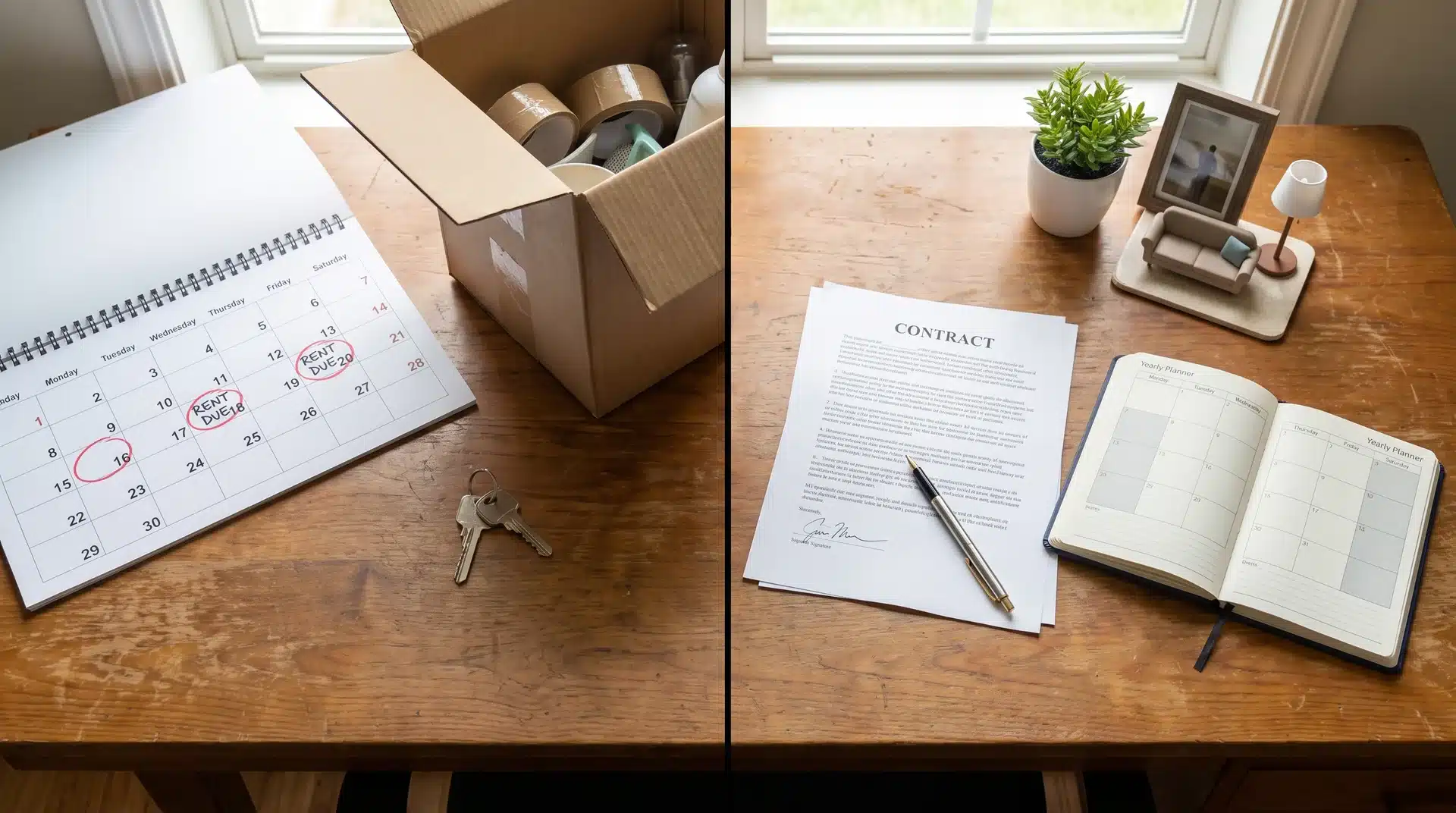

I still see lease and rent used interchangeably on most property listings, and after years of guiding first-time buyers and investors through tenancy decisions, that mix-up is one of the costliest mistakes I come across.
They are not the same thing. The contrast between rent and lease comes down to duration and flexibility, and choosing the wrong type can cost you real money if your plans change.
Here’s how each works, what your rights are, and which type suits your situation.
What Is the Difference Between Rent and Lease?
Both terms describe a contract giving you the right to live in a property in exchange for regular payments. What separates them is how long the contract runs and how easily either side can end it.
- Rental agreement (rolling or periodic tenancy): runs month-to-month or week-to-week with no fixed end date. Either party can end it with proper written notice.
- Lease agreement (fixed-term tenancy): runs for a set period, most commonly 6 or 12 months. The key terms stay the same until the agreement expires.
In everyday UK usage, both are called tenancy agreements. The word lease also carries a separate meaning in UK property law.
It refers to a long leasehold running 99 to 999 years, most often associated with owning a flat. That is a different arrangement entirely and is not covered here.
How a Rental Agreement Works in Practice
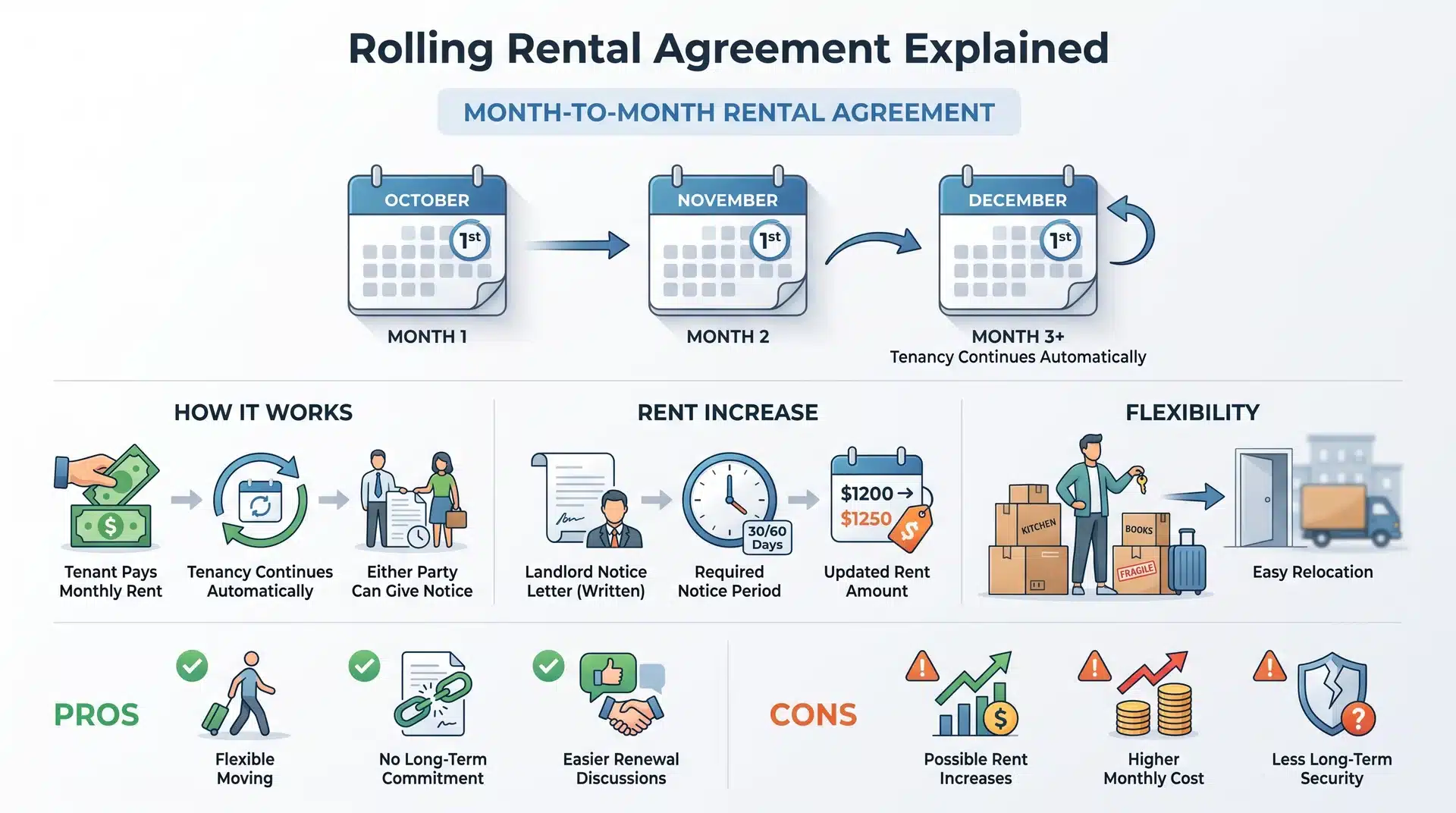
A rolling tenancy sounds simple, but the flexibility it offers comes with trade-offs most listings do not mention.
Under a month-to-month agreement, the landlord can propose a rent increase at the end of each period.
They must give proper written notice. In England, the Renters’ Rights Act 2025 came into force on 1 May 2026.
Landlords must give 2 months’ notice before any increase takes effect. Tenants can challenge an above-market increase at a First-tier Tribunal if they believe the new amount is unfair.
Since 1 May 2026, all new residential tenancies in England are Assured Periodic Tenancies (APTs). They are open-ended and rolling by default. Even a fixed-term agreement converts to a rolling APT when the term ends, unless both parties sign a new one.
Month-to-month tenancies also tend to carry a slightly higher monthly cost than fixed-term leases on comparable properties. Landlords factor in higher turnover rates and adjust their pricing to cover the additional admin costs.
Pros:
- Freedom to leave with short notice, no long-term commitment
- Suits temporary situations such as relocation, job changes, or house hunting
- Easier to negotiate terms at each renewal period
Cons:
- Rent can increase at the end of each period with proper notice
- Monthly cost is often slightly higher than a fixed-term equivalent
- Less security; landlord can end the tenancy on valid legal grounds with notice
How a Fixed-Term Lease Works in Practice
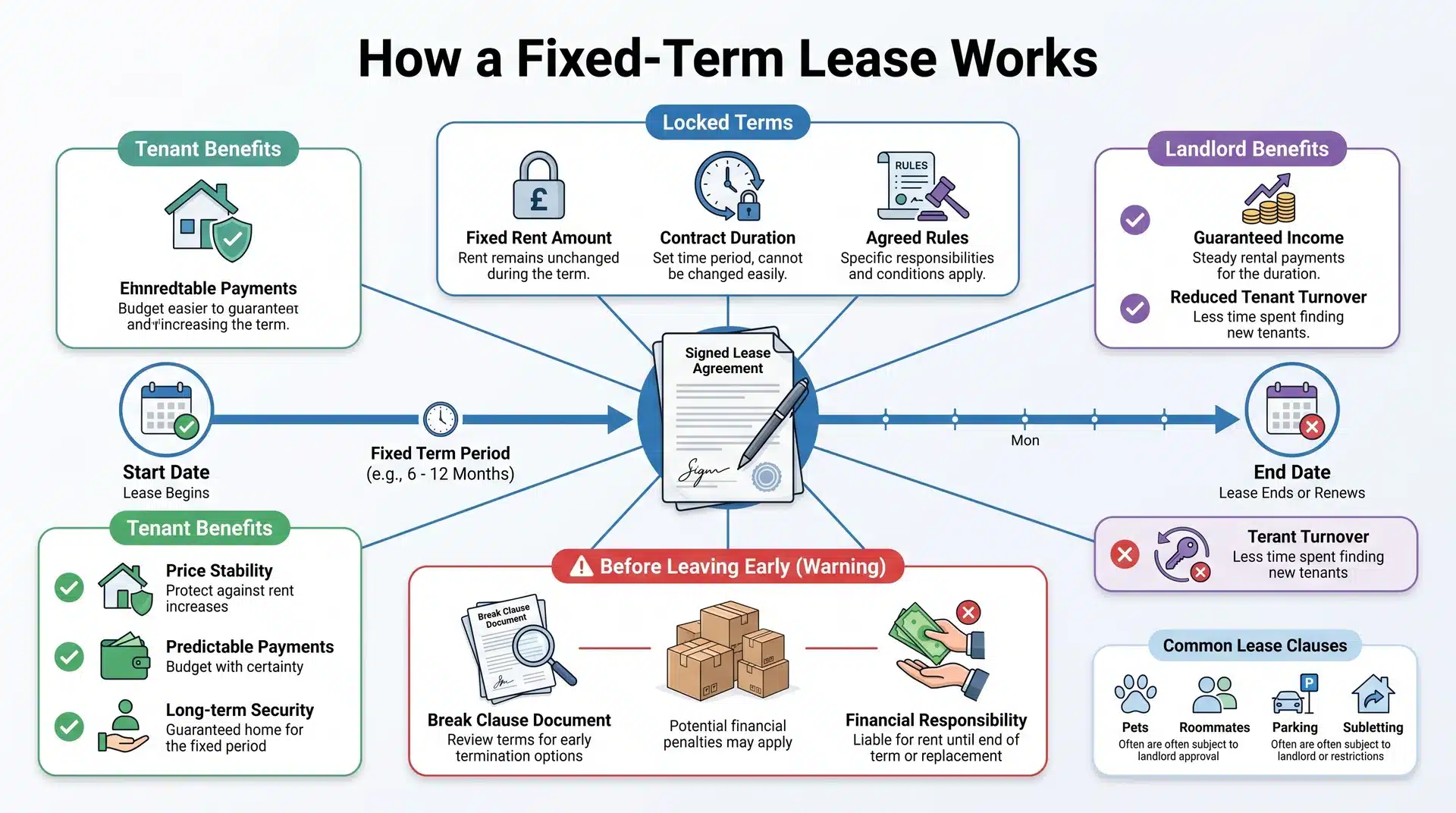
A fixed-term lease locks in the core terms, rent amount, duration, and agreed rules, for the full period. Neither side can change those terms without the other’s agreement.
This gives tenants genuine certainty. The rent you sign for is what you pay for the full term. The only exception is if the contract includes a specific rent review clause.
Landlords benefit from predictable income over a defined period. That is partly why fixed-term properties are often priced slightly below rolling equivalents.
The trade-off is exit. If you need to leave early and there is no break clause, you remain liable for the rent.
This continues until the term ends or a replacement tenant is found. In some cases, an early exit can affect your credit file if the landlord pursues the outstanding amount formally.
Fixed-term agreements often include specific clauses around pets, subletting, roommates, and parking. Breaking one of these conditions can give the landlord grounds to end the tenancy. Read the full agreement before signing.
Pros:
- Rent is locked in for the full term, no surprise increases mid-year
- Usually costs less per month than a rolling agreement on the same property
- Provides stability for families, school catchment areas, or longer work placements
Cons:
- Early exit is difficult without a break clause and can carry financial penalties
- Terms are harder to renegotiate once signed
- Less flexibility if your circumstances change during the term
Rent vs Lease: Key Differences at a Glance
Here is how the two agreement types compare across the factors that matter most.
| Feature | Rental Agreement (Rolling) | Fixed-Term Lease |
|---|---|---|
| Duration | Month-to-month or week-to-week | Fixed period (6 to 12 months typical) |
| Monthly cost | Often slightly higher | Usually lower for the same property |
| Flexibility | High. Exit with 2 months’ notice. | Low. Early exit may carry penalties. |
| Rent increases | Possible each period (2 months’ notice required in England) | Locked in for the term unless a review clause exists |
| Notice to leave | 2 months (England, post-May 2026) | At end of term or via break clause |
| Landlord’s repair duty | Yes. Landlord and Tenant Act 1985 applies. | Yes. Same legal obligation applies. |
Regardless of which type you sign, rent is quoted and paid as a fixed monthly amount; that part works the same way under both agreement types.
When a Rental Agreement Makes More Sense
A rolling tenancy suits specific situations well, even if it costs a little more per month than a fixed term on the same property.
Choose a rolling agreement when you are between properties after a sale. It also works if you have relocated for work and are unsure how long you will stay. Or if you plan to buy in the next year.
The freedom to leave with 2 months’ notice is often worth the small monthly premium. It is also the safer choice when your job or personal situation is genuinely uncertain.
When a Fixed-Term Lease Makes More Sense
Stability matters more than flexibility in certain situations, and that is where a fixed term earns its place.
A 12-month lease works well when you want price certainty for the year. It suits families who need to stay within a set school catchment area.
It also works well for anyone who has found a property worth settling into.
Fixed-term commitments also strengthen rental applications in competitive markets, since most landlords prefer a tenant signing for a defined period.
Warning Signs to Check Before You Sign
Most tenants focus on monthly cost and miss the contract terms that cause real problems later. These five red flags are worth checking before you sign anything.
- No break clause on a long fixed term: An 18 or 24-month tenancy with no break clause locks you in with no legal exit before the end date. Ask for a break at month 6 or 12 on anything longer than a standard year.
- Unclear repair responsibilities: Clauses shifting statutory repair duties onto the tenant are unenforceable, but vague wording still leads to disputes down the line.
- Open-ended rent increase terms: A clause allowing rent review at the landlord’s discretion offers little protection. Increases should follow a set process with a defined notice period.
- No written agreement before the tenancy starts: Under the Renters’ Rights Act 2025, landlords in England must provide written terms before the tenancy begins. Refusal to do this is a warning sign.
- Deposit not registered in a protection scheme: Landlords in England must protect deposits within 30 days of receipt. An unregistered deposit means the landlord loses the right to make deductions at the end of the tenancy.
Should You Rent or Lease?
A fixed-term lease works better when your plans are settled, and you want a guaranteed monthly cost for the year.
A rolling rental makes more sense when you need the freedom to leave at short notice. The choice comes down to one question: how certain are you about the next 12 months?
If the answer is very, a fixed-term lease usually costs less per month and removes the risk of a mid-year rent increase.
If the answer is uncertain, a rolling agreement is worth the small monthly premium.
Wrapping It Up
A fixed-term lease works better when your plans are settled, and you want a guaranteed monthly cost for the year.
A rolling rental is a practical choice when you need flexibility and may have to move out with little notice.
The choice comes down to one question: how certain are you about the next 12 months?
If the answer is very, a fixed-term lease usually costs less per month and removes the risk of a mid-year rent increase.
If the answer is uncertain, a rolling agreement is worth the small monthly premium.
Frequently Asked Questions
What is the Difference Between “for Rent” and “for Lease” on a Listing?
“For rent” typically means a month-to-month arrangement. “For lease” suggests a fixed-term contract, usually 6 to 12 months. Always confirm the exact terms with the landlord before committing.
What Does $2000 Look and Lease Mean?
“$2,000 look and lease” usually means a $2,000 rental offer or incentive available if you sign the lease soon after viewing the property. Check the terms before agreeing.
Can My Landlord Refuse to Renew My Fixed-Term Lease?
Yes, after the fixed term expires, landlords only need to provide correct notice; they don’t require a reason.
What Happens if I Stop Paying Rent During a Fixed-Term Lease?
Your landlord still needs to give proper notice and obtain a court order, even if it’s just for unpaid rent.
Do I Still Owe Rent if I Move out Before My Fixed Term Technically Ends?
Your rent obligation ends once you actually leave, especially if a new tenant takes your place.