
Quick answer: PCM means Per Calendar Month. It’s the fixed rent figure you pay on the same date every month under a tenancy agreement, whether that month has 28, 30 or 31 days. A single PCM figure quoted for a whole property is shared between tenants; a figure labelled PPPCM or “per person” is charged to each tenant individually.
Spot “PCM” on a rental listing and wonder what it actually means for your monthly outgoings? You’re not alone. PCM stands for Per Calendar Month, and it’s the figure almost every UK rental advert quotes.
But the letters alone don’t tell you whether that number is the whole property’s rent or your share of it, whether bills are included, or how landlords actually work it out from a weekly or annual figure.
Get any of that wrong and you can end up budgeting for the wrong monthly cost before you’ve even signed anything.
Here’s what PCM means in practice, how to calculate it yourself, and exactly how it plays out when you’re splitting a place with housemates.
What Does PCM Mean in Rent?
PCM stands for Per Calendar Month. It’s the fixed rent figure set out in a tenancy agreement, and you pay it on the same date every month, regardless of whether that month runs to 28, 30, or 31 days.
It’s the default way rent is quoted across the UK private rental market, from a single room in a shared house to a family home.
Quoting rent this way lets you compare a £950 PCM flat against a £1,050 PCM flat without doing any maths first, because both figures already represent the same unit: one calendar month.
A PCM figure covers your right to live in the property under a tenancy agreement between you and your landlord, along the lines set out in gov.uk’s guide to tenancy agreements.
On its own, though, PCM rarely covers everything you’ll actually spend each month, which is why the figure on a listing and your real monthly cost are often two different numbers.
Why Landlords Quote Rent PCM Instead of Weekly or Yearly
Landlords and letting agents settled on PCM because it aligns with how most tenants are paid: monthly.
It also gives landlords one predictable payment date to plan around, rather than a figure that shifts by a few pounds depending on how many weeks fall in a given month.
Landlords letting a property for the first time tend to default to PCM pricing for exactly this reason, a point covered in our guide to renting out a property as a first-time owner.
You’ll still come across two other formats on listings. PW means Per Week, common in shared houses, student lets and short-term rentals, where a weekly figure can look smaller than the monthly equivalent even though it isn’t actually cheaper.
PA means Per Annum, or per year, and appears mostly in commercial leases rather than in everyday residential ads.
PCM is also the only one of the three with a settled meaning inside a tenancy agreement. “Per month rent” gets used casually to mean the same thing, but it isn’t a fixed legal term the way PCM is.
Once a fixed-term tenancy ends without a new agreement being signed, it typically continues as a periodic tenancy at the same PCM rent until either side gives valid notice.
How to Calculate PCM Rent
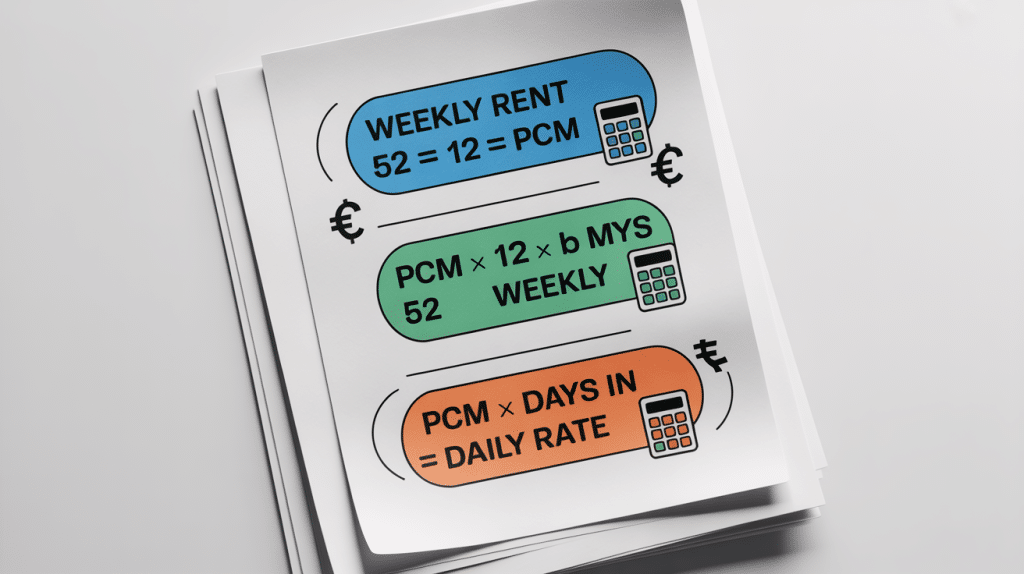
Converting weekly or annual rent into a PCM figure isn’t just a matter of multiplying or dividing by 4 or 12 with rough guesswork.
Because a year has 52 weeks but only 12 months, the maths needs an extra step, and skipping it is one of the most common ways renters under-budget.
Weekly Rent to PCM
Formula: weekly rent × 52 ÷ 12 = PCM
Take a £250 weekly rent. Multiply by 52 weeks, and you get £13,000 for the year. Divide that by 12 months and the PCM figure comes to £1,083. Multiplying £250 by four alone would under-quote the real monthly cost by roughly £83.
Annual Rent to PCM
Formula: annual rent ÷ 12 = PCM
An £18,000 annual rent divides to £ 1,500 PCM evenly. This conversion most often appears in formal tenancy agreements and longer commercial leases.
Mid-Month (Pro Rata) Rent
If you move in partway through a month, the landlord should only charge you for the days you actually occupy the property. Divide the PCM figure by the number of days in that month to get a daily rate, then multiply by the days you’ll be there.
On a £1,200 PCM tenancy in a 30-day month, the daily rate works out at £40. Moving in on the 10th means 21 days are payable, so the first month’s rent comes to £840 rather than the full £1,200.
Is PCM Rent Charged Per Person or for the Whole Property?
This is one of the most common points of confusion for anyone renting with housemates for the first time, and it trips up plenty of experienced tenants too.
The honest answer is that it depends entirely on how the listing is worded, so you have to check rather than assume.
When a listing quotes a single PCM figure for the whole property, for example, “3-bed house, £1,050 PCM,” that figure is the total rent for the property, not a per-person charge.
If three tenants are named on the tenancy agreement and split the cost evenly, each person pays £350 a month, and the group is collectively responsible for the full £1,050 if one person falls short.
Some listings, especially student and shared-house adverts, instead quote a per-person figure, sometimes written as PPPCM or “per person per calendar month.”
A room advertised at £450 PPPCM means each named tenant pays £450, and the total rent the landlord receives for the property is £450 multiplied by the number of tenants on the agreement, not £450 in total.
The safest way to avoid a costly misunderstanding is to check how many people are named on the tenancy agreement and whether the advertised PCM figure is described as “per property,” “per room,” or “per person” before you agree to anything.
If a listing is ambiguous, ask the landlord or agent directly which one it is. A five-second question is far cheaper than a rent shortfall discovered on move-in day.
What a PCM Figure Includes, and What It Doesn’t
A PCM figure covers your right to live in the property and, in most tenancies, the landlord’s responsibility for structural repairs and maintenance.
Beyond that, what’s bundled in varies from listing to listing, so treat the headline PCM number as a starting point rather than your full monthly cost.
- Electricity and gas
- Water charges
- Internet and broadband
- Council tax
- TV license, where one is needed
None of the above is usually included unless the listing explicitly says “bills included.”
Each can add anywhere from £40 to £150 per person per month, depending on the property and household size, so a “cheap” PCM figure on a bills-extra listing can end up costing more overall than a slightly higher bills-included one.
Always check the tenancy agreement itself rather than the advert, since that’s the document that legally sets out what your rent does and doesn’t cover.
PCM Rent and Affordability Checks

Letting agents and landlords use your PCM figure as the main number in a referencing or affordability check before approving a tenancy.
Many apply a rule of thumb that gross monthly income should be around two and a half to three times the PCM rent, though this is an industry convention rather than something set in law, and different agents apply it differently.
On a £1,000 PCM property, that works out to a gross income somewhere between £30,000 and £36,000 a year.
Referencing checks typically also look at credit history, employment stability and any guarantor arrangement, so the income multiple is a starting filter rather than the whole picture.
If you’re moving into a joint tenancy, most letting agents apply that affordability multiple to each named tenant’s income separately rather than to the combined household income.
That’s worth confirming before you assume a shared PCM figure automatically makes a property affordable for everyone on the agreement.
Real Example: Working Out the True Monthly Cost
A One-Bedroom City Flat
A one-bed flat listed at £1,200 PCM with a 12-month tenancy and a deposit of five weeks’ rent looks straightforward until you add up what’s due before you get the keys.
First month’s rent comes to £1,200, the deposit lands around £1,385, and a holding deposit, if the agent charges one, is capped at one week’s rent under the Tenant Fees Act 2019 rules for tenancies in England (Wales and Scotland run separate, broadly similar caps).
That’s roughly £2,500 to £2,800 due upfront, well above the £1,200 headline figure, before a single utility bill has been paid.
A Shared House Room
A room in a shared house at £650 PCM per person looks cheaper on paper, but bills aren’t included. Add roughly £100 to £150 a month for a share of gas, electricity, water and broadband, plus a possible council tax contribution if not every housemate is a full-time student, and the real monthly cost lands closer to £800 to £900.
Comparing PCM figures across listings only works if you’re comparing like for like on what’s actually included.
Frequently Asked Questions
Is PCM rent split between housemates or charged per person?
It depends on the listing. A single PCM figure for the whole property is shared; a figure labelled PPPCM or “per person” is charged to each tenant individually. Always check which one applies.
Do I pay PCM rent in advance or in arrears?
Almost always in advance. Your first month’s rent is normally due before you move in, and each following payment falls on the same date each month.
Can a landlord increase PCM rent partway through a fixed-term tenancy?
Not usually. The PCM figure in a fixed-term tenancy agreement stays the same for the term unless the contract includes a specific rent review clause.
What happens to my PCM rent once my fixed-term tenancy ends?
Without a new agreement, the tenancy usually continues on a periodic basis at the same PCM rent until either party gives valid notice to end it.
Does PCM work the same way in Scotland as in England?
Rent is still quoted PCM, but Scottish tenancies use a different legal framework and separate deposit rules, so check Scotland-specific guidance rather than assuming England’s rules apply.
What should I do if the advertised PCM doesn’t fit my budget?
Look at a smaller room, a shared house, or a bills-included listing, or discuss a guarantor with the agent. Confirm the total monthly cost, not just the PCM figure, before deciding.
The Bottom Line
PCM simply means Per Calendar Month: the fixed rent figure you pay on the same date every month, regardless of how many days that month has.
Where people get caught out isn’t the definition, it’s assuming the headline PCM figure tells the whole story.
Before you sign anything, confirm whether the PCM figure is for the whole property or per person, check what it does and doesn’t include, and add up the full moving-in cost rather than just the monthly rent.
That’s the number that actually tells you what a property will cost you, not the three letters next to the price.