
Most property owners have no idea what their land is worth when utility companies or government agencies come knocking for easement rights.
You might accept the first offer, thinking you have no choice, or worse, not realize you deserve payment at all.
I’m going to show you exactly how easement compensation works, what your property rights are worth, and how to negotiate fair payment.
This blog covers valuation methods, compensation rates for different easement types, your legal rights, and step-by-step negotiation strategies to help you secure the maximum compensation for your property.
What is Easement Compensation?
Easement compensation refers to the payment property owners receive when someone else gains legal rights to use a portion of their land.
This payment acknowledges that granting an easement can reduce the value of your property, limit future development options, or create inconvenience.
When a utility company needs to run power lines across your backyard or when a municipality requires access for sewer maintenance, you may be entitled to fair compensation.
The amount depends on factors like the easement’s size, purpose, and impact on your property’s current and future use.
Types of Easements
Not all easements are assessed at the same rate. Your compensation depends on what type of easement crosses your land and how much it affects your property use.
1. Utility Easement
Electric, gas, water, and telecom companies pay $300 to $1,500 per linear foot for overhead lines. Underground utilities are less expensive, ranging from $200 to $800 per linear foot.
Key restrictions include no building within 10-30 feet of power lines, height limits for trees and structures, and requirements for regular maintenance access.
High-voltage lines need larger restriction zones and higher pay due to safety risks.
2. Pipeline Easement
Oil and gas pipelines offer the highest rates, ranging from $5 to $25 per linear foot, plus annual payments of $50 to $500.
Higher rates reflect the risks of explosions and environmental concerns. Companies must pay extra for crop damage, lost timber, and soil issues.
3. Access Easement
Private access for landlocked properties pays $1,000-$10,000 one-time. Commercial access yields higher returns due to increased traffic.
Compensation covers lost privacy, liability risks, and property damage.
4. Sewer Easement
Municipal sewer lines pay $200-$1,000 per linear foot. Deeper lines pay less than shallow systems, requiring frequent access.
Property owners retain surface rights but are prohibited from building over sewer lines.
5. Temporary Construction Easement
Short-term easements (6-24 months) pay $500-$3,000 per acre plus restoration costs.
These allow contractors to stage equipment and store materials. Fair pay includes crop damage, soil repair, and complete restoration.
How is Easement Compensation Determined?
Professional appraisers use established methods to calculate fair compensation for easements. The process involves analyzing your property both before and after the easement is established to determine the financial impact.
Appraisers use four primary methods to determine easement compensation, each suited to different property types and situations.
| Valuation Method | How It Works | Best Used For |
|---|---|---|
| Before-and-After Method | Compares the property value before the easement vs. after the easement is granted | Most easement types, especially permanent ones |
| Market Comparison | Analyzes sales of similar properties with comparable easements | Properties in areas with frequent easement activity |
| Cost Approach | Calculates the replacement cost of lost land use or structures | Easements affecting buildings or improvements |
| Income Approach | Estimates lost rental or development income potential | Commercial properties or income-generating land |
The before-and-after method is most common because it directly measures the easement’s impact.
If your property was worth $200,000 before a utility easement and $185,000 after, your compensation would be approximately $15,000.
Factors Influencing the Value of Easement
Several key factors determine how much compensation you’ll receive for an easement on your property. Appraisers evaluate these elements to calculate fair market value:
1. Type and Purpose of Easement: A high-voltage transmission line easement typically pays more than an underground cable easement because of visual impact and safety concerns. Pipeline easements often command higher rates due to the risks of explosions and extensive land-use restrictions.
2. Duration: Permanent easements require full compensation for perpetual loss of rights. Temporary construction easements (typically 6-24 months) are less expensive but should include restoration costs and compensation for crop loss or business disruption.
3. Area Affected and Usability Reduction: A 30-foot-wide easement across prime farmland affects more value than the exact width crossing unused woodland. Appraisers calculate both the direct land area lost and the broader impact on remaining property functionality.
4. Market Value and Development Potential: Easements on land zoned for commercial development typically receive higher compensation than those on residential property.
Public vs Private Easements
Who’s asking for the easement makes a huge difference in how much leverage you have and what compensation you can expect. Know more about the aspects of public and private easements.
| Aspect | Public Easements | Private Easements |
|---|---|---|
| Compensation | Often minimal or none (sidewalks, utilities) | Full market rate negotiation |
| Authority | The government can use eminent domain | Must negotiate a voluntary agreement |
| Purpose | Public benefit (utilities, roads, drainage) | Private benefit (access, development) |
| Negotiation | Limited bargaining power | Equal bargaining position |
Knowing if you’re dealing with a public or private entity helps you set realistic expectations and choose the right negotiation strategy.
Legal Rights and Responsibilities as a Property Owner
Granting an easement doesn’t mean surrendering ownership. You still retain key rights and take on specific responsibilities. Here’s what you should know:
- Ownership & Use: You still own the land and can sell it. You may use the easement area for compatible activities (like farming or recreation) that don’t interfere with its purpose.
- Access & Control: You can set reasonable conditions on when and how the easement holder accesses your property, particularly for non-emergency situations.
- Restoration & Damage Compensation: You have the right to demand that the easement area be restored to its original condition after construction or maintenance. You’re also entitled to payment for any damage caused by their work.
- Development Rights: You can build or develop on unaffected portions of your land without interference.
- Maintenance & Liability: The easement holder is responsible for maintaining their infrastructure and carrying liability insurance. You’re responsible for basic surface upkeep (like mowing) and must avoid damaging their equipment.
WhenAre You Entitledto Easement Compensation?
Not every easement situation guarantees payment. The type of easement and how it’s created make all the difference in whether you receive money for the use of your land.
Your eligibility for compensation depends on how the easement is created:
| Easement Type | Compensation Required | Details |
|---|---|---|
| Voluntary Agreements | Yes | Fair market compensation through negotiation |
| Eminent Domain | Yes | “Just compensation” is required by law for public use |
| Partial Takings | Yes | Payment is required even when only part of the property is affected |
| Prescriptive Easements | No | Created through long-term unauthorized use; no payment is typically owed |
| Implied Easements | No | Arise from legal necessity or property circumstances; no compensation |
Remember, if someone wants to create an easement on your property, you have the right to negotiate fair compensation in most cases. Don’t accept the first offer without understanding your property’s true value.
How to Negotiate Easement Compensation?
Securing fair easement compensation isn’t just about saying yes or no; it’s about being prepared, informed, and strategic.
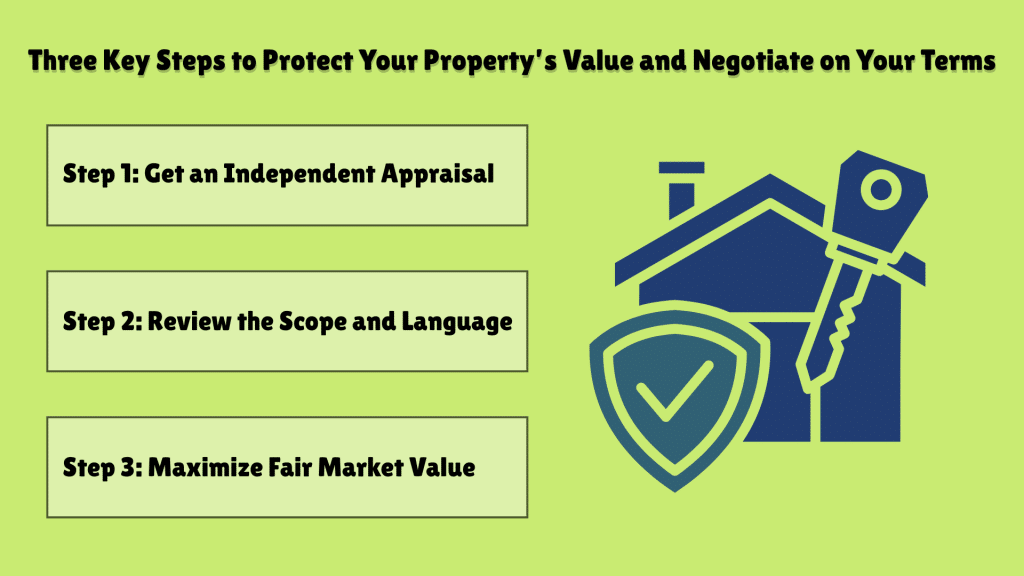
Follow these three key steps to protect your property’s value and negotiate on your terms. Following is a detailed overview of these steps:
Step 1: Get an Independent Appraisal – Hire your own certified appraiser before accepting any offer. Company appraisals often undervalue your loss, while independent appraisals provide objective market value evidence for negotiations.
Step 2: Review the Scope and Language – Examine the easement’s exact boundaries, permitted uses, and restrictions. Vague language, such as “reasonable access,” should be defined with specific terms, timeframes, and restoration requirements.
Step 3: Maximize Fair Market Value – Research comparable easement sales in your area, document any special property features that increase value, and negotiate for annual payments rather than lump sums when appropriate. Consider future development potential and demand premium rates for high-impact easements.
Final Takeaways
Getting fair easement compensation protects your property’s value and your future rights.
Remember that utility companies often start with low offers, expecting property owners to accept without question. Your land has real value, and you deserve proper payment when others use it.
Don’t rush into signing easement agreements. Take time to get independent appraisals, understand exactly what rights you’re giving up, and negotiate terms that work for you.
Whether it’s a utility line, pipeline, or access road, each easement type has standard compensation rates you can research.
What questions do you have about easement negotiations on your property?
Share your experiences in the comments below. Your situation might help other property owners facing similar decisions.
Frequently Asked Questions
What is Considered Abuse of an Easement?
Using the easement beyond its stated purpose, causing unnecessary damage, or interfering with the property owner’s remaining rights constitutes easement abuse.
Can a Property Owner Block an Easement?
No, blocking a legal easement violates the easement holder’s rights and can result in court orders and financial penalties against you.
Who is Responsible if Someone Gets Hurt on an Easement?
Typically, the easement holder carries liability insurance and assumes responsibility; however, property owners should verify this in their easement agreement to avoid any surprises.