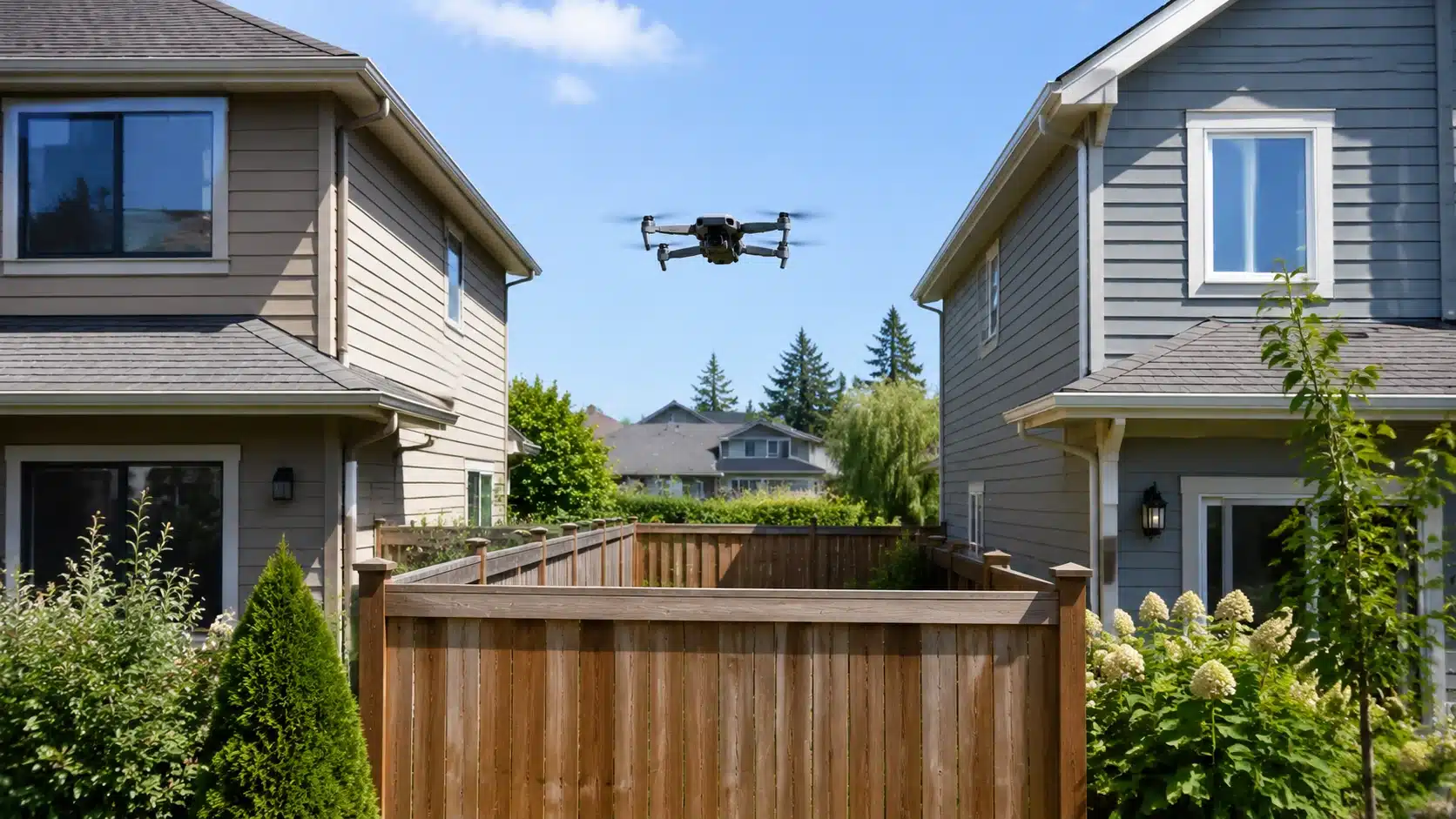

Is it illegal to fly a drone over someone’s property? Not automatically.
Yes, you usually can fly a drone over private property in the UK. No blanket law bans it.
What decides whether your flight is fine or a problem is how high you fly, how close you get, whether you linger, and whether you point a camera at people who never agreed to be filmed.
This blog explains when flying over private land is legal, when it is not, and the rules you must follow.
It also outlines your rights as a property owner if you believe a drone is being flown irresponsibly or invading your privacy.
I hear this question constantly from homeowners planning building work, garden landscaping, or a survey, and from people just unnerved by a neighbour’s new drone.
How Much Airspace Do Property Owners Control?
Property owners control only a limited slice of airspace, roughly the height needed for ordinary use and enjoyment of their land, not an unlimited column above the house.
UK law recognizes only a limited slice of airspace above your land. It extends to the height you reasonably need to use and enjoy your property, and no further. In practice, that covers things like:
- The space needed for normal use of the home and garden
- Height needed for building work, repairs, or scaffolding
- Room needed for trees, aerials, and ordinary structures
Above that reasonable-use zone, the sky becomes public airspace under CAA control. A drone crossing at a genuine height is therefore usually in public airspace, not yours.
If you live in a detached house with a good stretch of garden, that reasonable-use zone naturally covers more ground than it would for a flat with no outdoor space, but the principle is the same.
The Bernstein Case and Its Lasting Impact
The reason we talk about reasonable height at all traces back to one 1978 court decision, and it still shapes how disputes are judged today.
In Bernstein v Skyviews, a landowner sued an aerial photography company for flying over his estate to take pictures.
The court ruled that a property owner’s rights in the air reach only to the height necessary for ordinary use and enjoyment of the land. Above that line, nobody can claim the sky.
A few principles came out of it that courts still lean on:
- Property rights in airspace are limited, not infinite
- Only interference with reasonable use of the land counts
- Persistent or intrusive flying can create liability even at modest heights
- Every dispute is judged on its own specific facts
So the case cuts both ways. It protects pilots crossing overhead, and it protects homeowners from someone treating their garden like a film set.
What You Need to Know Before Flying a Drone
Airspace above the ground is not owned by whoever owns the land underneath it. That single idea explains most of the confusion.
A homeowner controls only the airspace they can reasonably use. The Civil Aviation Authority(CAA) regulates all UK airspace.
They set the rules for when and where you can fly drones. They have established specific guidelines that govern the operation of drones over private property.
All drone operators are required to follow these rules. Breaking them can result in fines or legal action. So flying across someone’s land at a sensible height, on your way somewhere else, is generally lawful.
The catch is that a lawful position in the sky does not give you a free pass.
Hover low over a back garden, circle repeatedly, or film through a bedroom window, and you can still be liable for trespass, nuisance, or a privacy breach even while technically inside legal airspace.
What the Drone Code Actually Requires
Every drone flight in the UK sits under the Drone and Model Aircraft Code, which the CAA has recently updated. These are legal requirements, not friendly suggestions, and breaking them can be a criminal offense.
Two things changed recently that many older guides still get wrong: the registration weight threshold dropped, and the fees changed. Please ignore anything that says registration only kicks in at 250 grams.
Registering Yourself and Your Drone
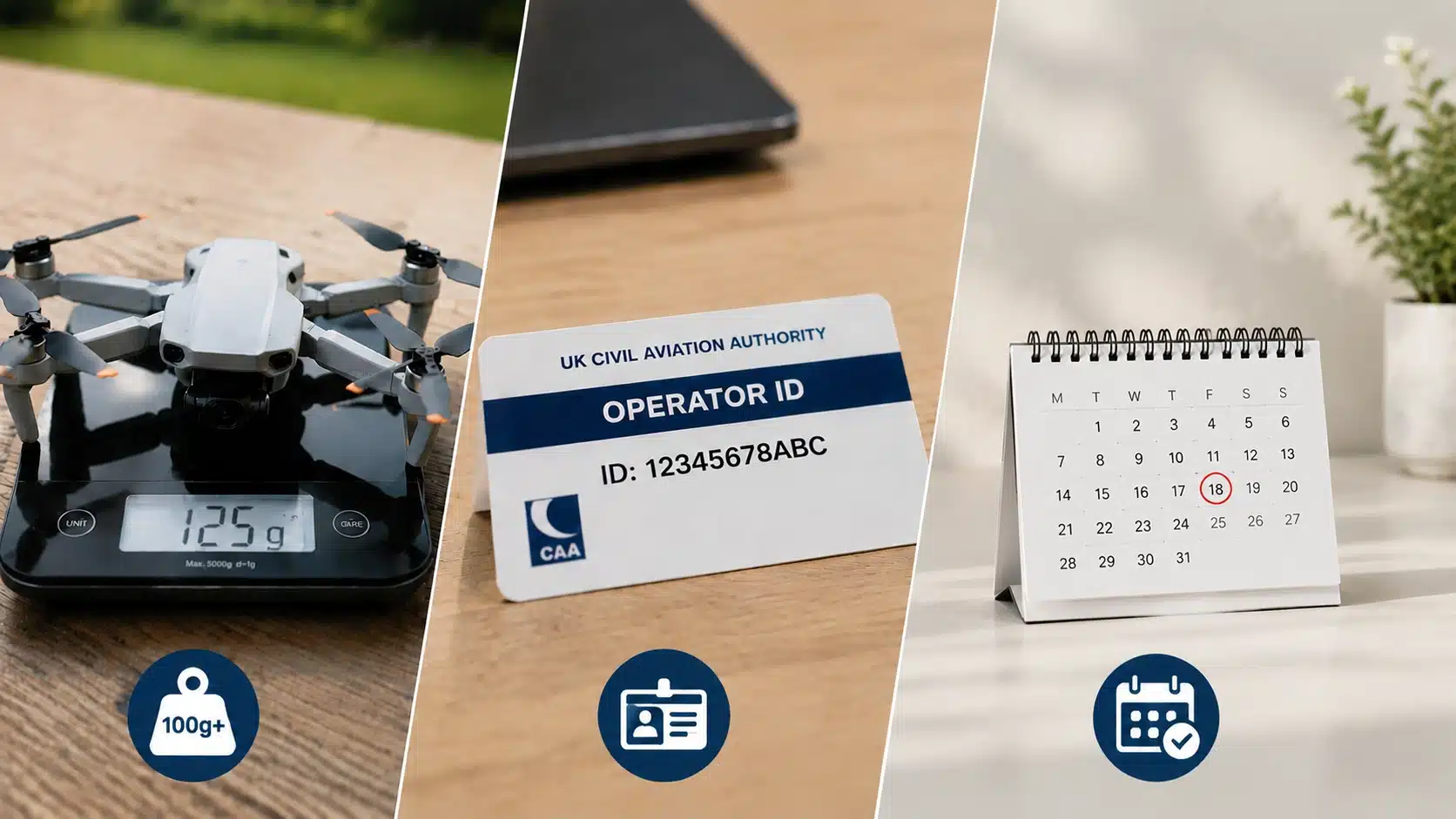
If your drone weighs 100g or more, you need a Flyer ID. You get it by passing a free online theory test through the Register Drones Service, and it lasts five years. You must be at least 13 to hold one yourself.
You also need an Operator ID if your drone weighs 100g or more and has a camera, or if it weighs 250g or more regardless of whether it has a camera.
That costs £12.34 a year, renews annually, and you must be at least 18 to hold one. The Operator ID number goes on the aircraft itself, a bit like a number plate.
Drones under 100g with no camera do not legally need either, though the CAA still recommends taking the test.
Registration Requirements:
- Drones weighing 100g or more need a Flyer ID; Operator ID kicks in at 100g with a camera, or 250g either way.
- Operators must get an operator ID
- Pilots need a Flyer ID for most drone types
- The Flyer ID is free and lasts five years; the Operator ID costs £12.34 and renews yearly.
Height, Distance, and Keeping Requirements
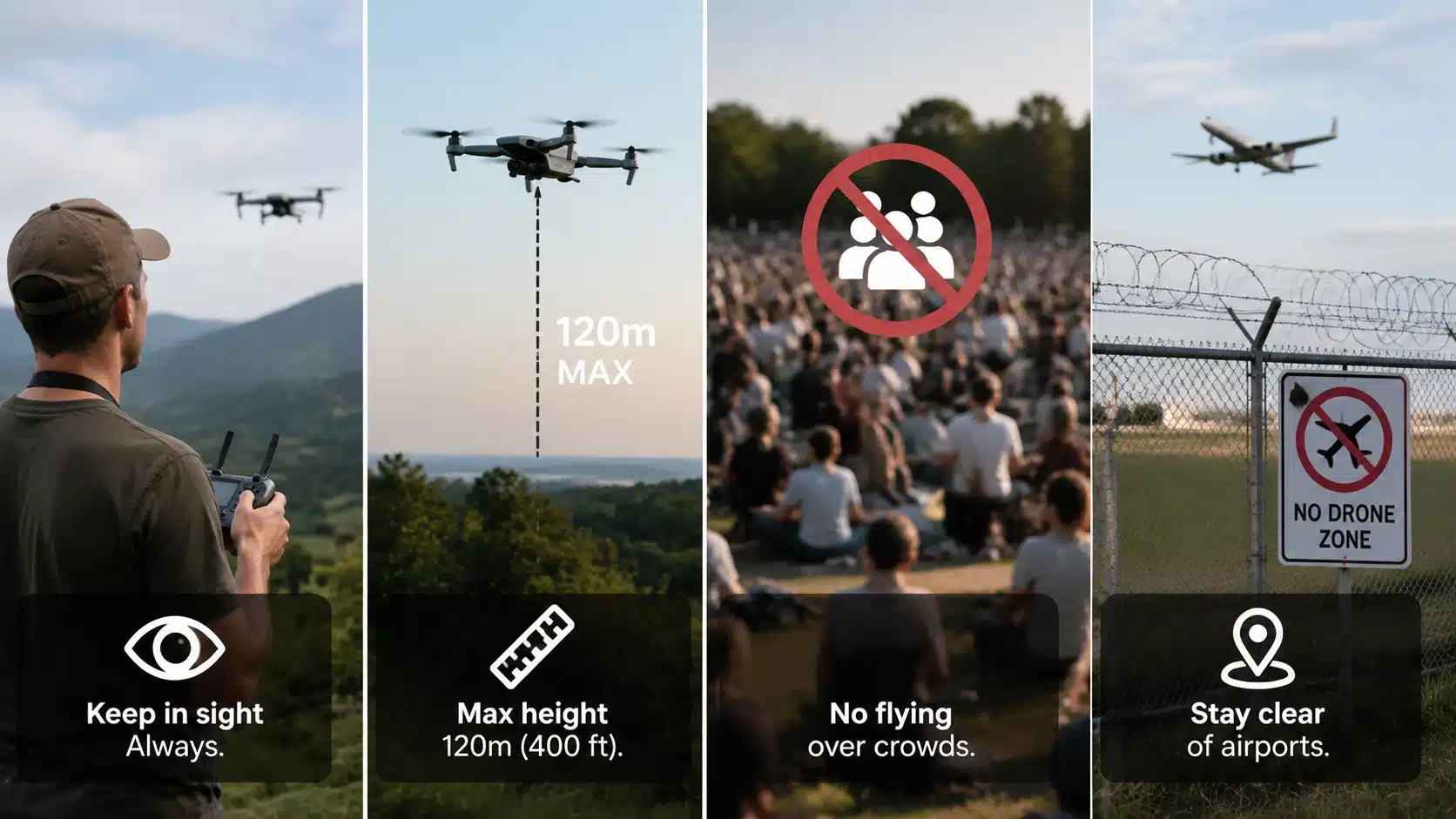
Beyond registration, a handful of core limits apply to everyone, whatever you fly.
You must keep the drone within your direct line of sight and not above 120 meters, which is roughly 400 feet. You must never fly over crowds and must stay clear of airports and their flight restriction zones.
The separation distances depend on which sub-category your drone falls into. Here is how they break down.
| Sub-category | Drone weight | Key distance rule |
|---|---|---|
| A1 (over people) | Under 250g | May briefly fly over uninvolved people, never over crowds |
| A2 (near people) | 250g to 2kg with C2 mark | Stay 50m horizontally from uninvolved people; needs an A2 certificate |
| A3 (far from people) | 250g to 25kg | Stay 150m from residential, recreational, commercial, and industrial areas |
In the A3 category, you also have to keep 50 meters from any building or person not involved in your flight.
How a Legal Drone Flight Over Private Property Can Lead to Legal Issues
A flight may be legal but still cause trespass, nuisance, or privacy issues if the drone hovers, circles, or repeatedly watches people.
| Behaviour | How it is usually treated |
|---|---|
| Flying at height on a straight path to elsewhere | Lawful airspace use |
| Passing over once without stopping or filming people | Generally acceptable |
| Hovering low over a garden and circling repeatedly | Likely nuisance or trespass |
| Returning daily and photographing after being asked to stop | Trespass, nuisance, and possible harassment |
A quick real-world contrast. A drone crossing 80 meters above a house on its way to a field, keeping its distance, is almost always fine.
A drone sitting 10 meters over the same back garden, looping around and taking photos every afternoon, is the kind of flight that ends up in a complaint or a courtroom.
Privacy Rights and Drone Surveillance
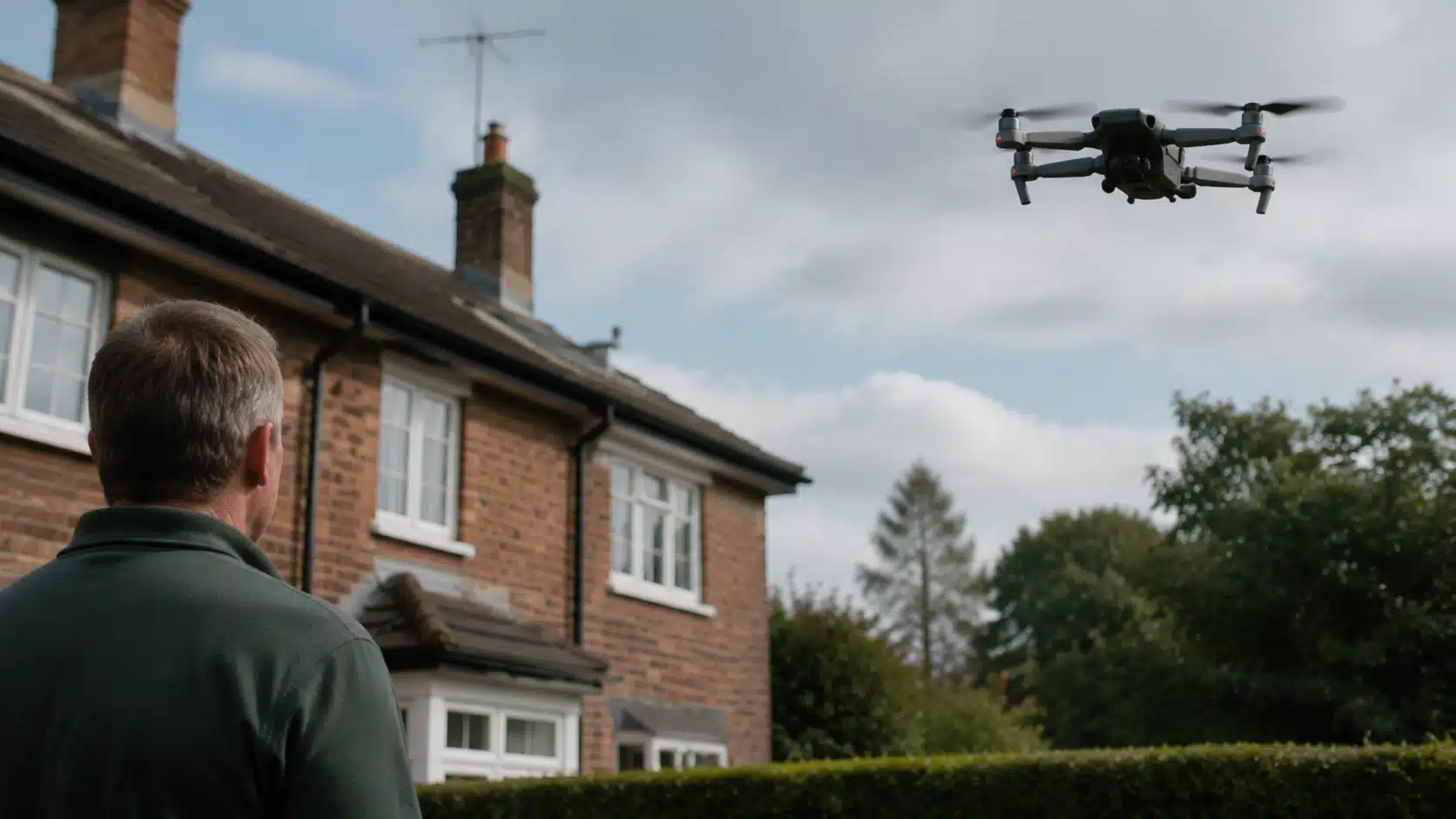
Several UK laws protect your privacy from unwanted drone surveillance. These regulations set clear boundaries on how and when drones can capture images or data over private spaces.
These acts include the “Data Protection Act 2018”, the “Human Rights Act 1998”, and the “Protection from Harassment Act 1997”.
When Drone Filming is Lawful vs Unlawful
When it comes to drone recording, understanding the difference between lawful and unlawful activities is the key issue.
The table below outlines common examples of legal drone use versus actions that may violate privacy and surveillance laws.
|
Legal Drone Recording |
Illegal Drone Surveillance |
|
Filming public areas from appropriate distances |
Recording people in private spaces without their consent |
|
Recording for personal use without targeting individuals |
Focusing cameras on windows, gardens, or other private areas |
|
Commercial work conducted with proper permissions and notifications |
Collecting personal data without a lawful basis |
|
Emergency services or official surveillance authorized by law |
Using footage to harass, intimidate, or cause distress |
|
Following all relevant privacy and data protection laws |
Continuing to record despite requests to stop |
Being aware of what is allowed and what isn’t helps prevent disputes and potential legal issues. Always prioritize responsible flying to protect privacy and maintain trust in your community.
How Do You Stop Drones from Flying Over Your House?
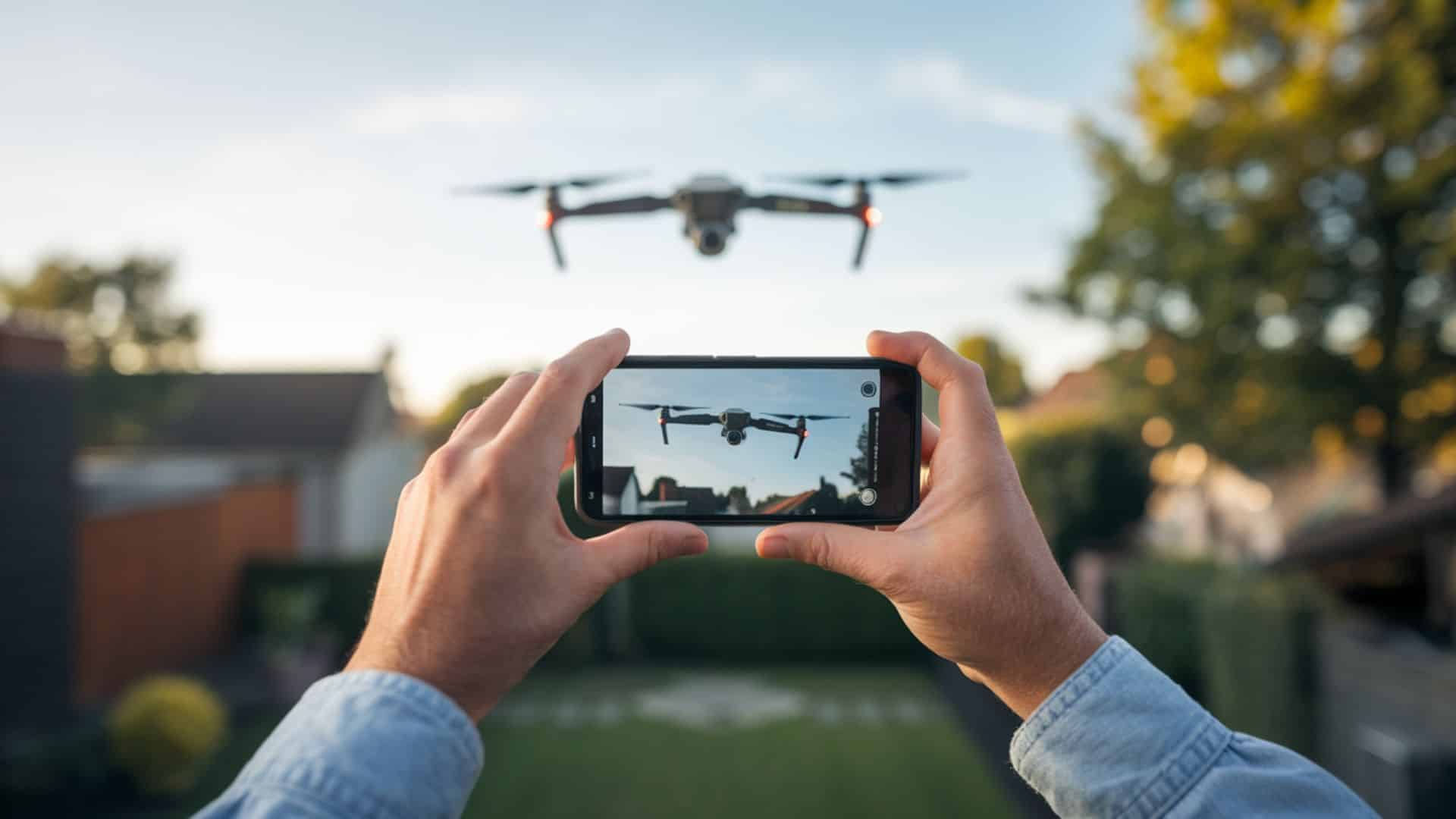
You cannot stop a drone flying at a lawful height and distance, but once it becomes intrusive, you have real options: document it, ask it to stop, and report Drone Code breaches or harassment.
Objections are strongest when the flight ignores height and distance limits or is persistent and intrusive.
You May Have Limited Options When:
- Drones follow all CAA regulations
- Flights occur at proper heights and distances
- Operators pass through rather than loiter
- No privacy violations occur
- Legitimate purposes exist (emergency services, surveys)
If you believe a drone is being used inappropriately around your property, keeping detailed records can be useful.
Documenting incidents helps protect your rights and provides important evidence if you need to take further action.
| Document Everything | Know Your Rights |
|---|---|
| Record dates, times, and duration of flights | Request the drone operator to stop filming you |
| Take photos or videos of the drone | Ask for copies of any footage showing your property |
| Note the operator’s location if visible | Report persistent surveillance to the police |
| Keep records of any distress or disruption caused | Seek legal advice for serious privacy violations |
Legal Consequences of Drone Misuse
Failing to follow drone rules may result in penalties, enforcement actions, or other legal responses. Being aware of these outcomes encourages safe and respectful drone operation for everyone.
- Trespass: Property owners can sue, with courts weighing height, duration, and interference; expect a compensation claim covering distress and legal costs if it continues.
- Nuisance: Courts can award damages for noise, disruption, or intrusion; repeated flights risk an injunction shutting them down entirely.
- Invasion of privacy: Victims can claim damages and invoke data protection law to stop surveillance; expect a court order in addition to a formal complaint.
- Harassment: Police warnings, restraining orders, or criminal charges; persistent harassment carries a risk of up to six months’ imprisonment.
- Misuse of surveillance equipment: Fines and possible imprisonment for unlawful recording; severity decides whether it stays a fine or becomes custodial.
- CAA violations: Fines from £100 to £2,500 for breaking Drone Code rules — repeated or serious breaches risk prosecution or a flying ban.
Frequently Asked Questions
Can I shoot down a drone flying over my property?
No, shooting it down is illegal in the UK regardless of what it’s doing. Report harassment to the police; report Drone Code breaches to the CAA.
Can a laser pointer take down a drone?
No, and never try it. Lasering any aircraft is a criminal offense that can blind the pilot and cause a crash.
How do I find out who owns a drone over my house?
Usually you can’t identify them directly. Note their location, record dates and times, and report persistent flights to the police.
Can my neighbor fly a drone over my garden from their own land without asking?
Yes, if flown lawfully. It only becomes trespass if they enter your land to launch, or the flight itself turns intrusive.
Does the 50m distance rule still apply if the drone flies higher above me?
Yes, the buffer is a cylinder, not a flat ring, so it scales with altitude rather than just ground distance.
Wrapping It Up
So, can you fly a drone over private property? Usually yes. You just need to respect the Drone Code, keep your height and distance right, and leave people’s private spaces alone.
The rules aren’t really about airspace. They’re about not being a problem for the people underneath you.
Register properly, keep the drone in sight, and never treat a garden or window as something to film.
If it’s your house on the receiving end, you’re not powerless. Document what’s happening and contact the CAA, the ICO, or the police if a flight crosses the line.
I’ve seen most disputes settle at the “please stop” stage.