
You spot a listing that says “chain free” and your first thought is probably: great, but what does that actually mean for me?
But don’t get too comfortable. I’ve watched chain-free deals crawl anyway, because a slow survey or a stuck mortgage application doesn’t care whether there’s a chain or not.
The label just removes one risk, not all of them.
So here’s what you actually need to know: what chain-free means, why it’s worth paying attention to, and where buyers get it wrong.
What Does Chain-Free and No Chain Mean?
A chain-free property is one where the seller doesn’t need to buy another home before completing the sale, so they aren’t waiting on a separate purchase to move out.
“No chain” can also describe the buyer’s side, such as a first-time buyer or a cash buyer who isn’t selling a property of their own.
A property chain links buyers and sellers who all depend on each other to complete their deals, while a chain-free sale breaks that link, stopping with one side alone.
For example, an owner moving abroad who isn’t buying another UK property counts as chain-free. Offers move faster since solicitors deal directly with each other, with no one else waiting above them.
If you’re weighing up whether you even need one, it’s worth reading what a solicitor actually does when you buy a house, since their role stays the same whether or not a chain is involved.
Pro Tip: Chain-free describes both the property and the seller. A property is chain-free when the seller has no onward purchase. A buyer is chain-free when they have no property to sell first.
What Is a Property Chain?
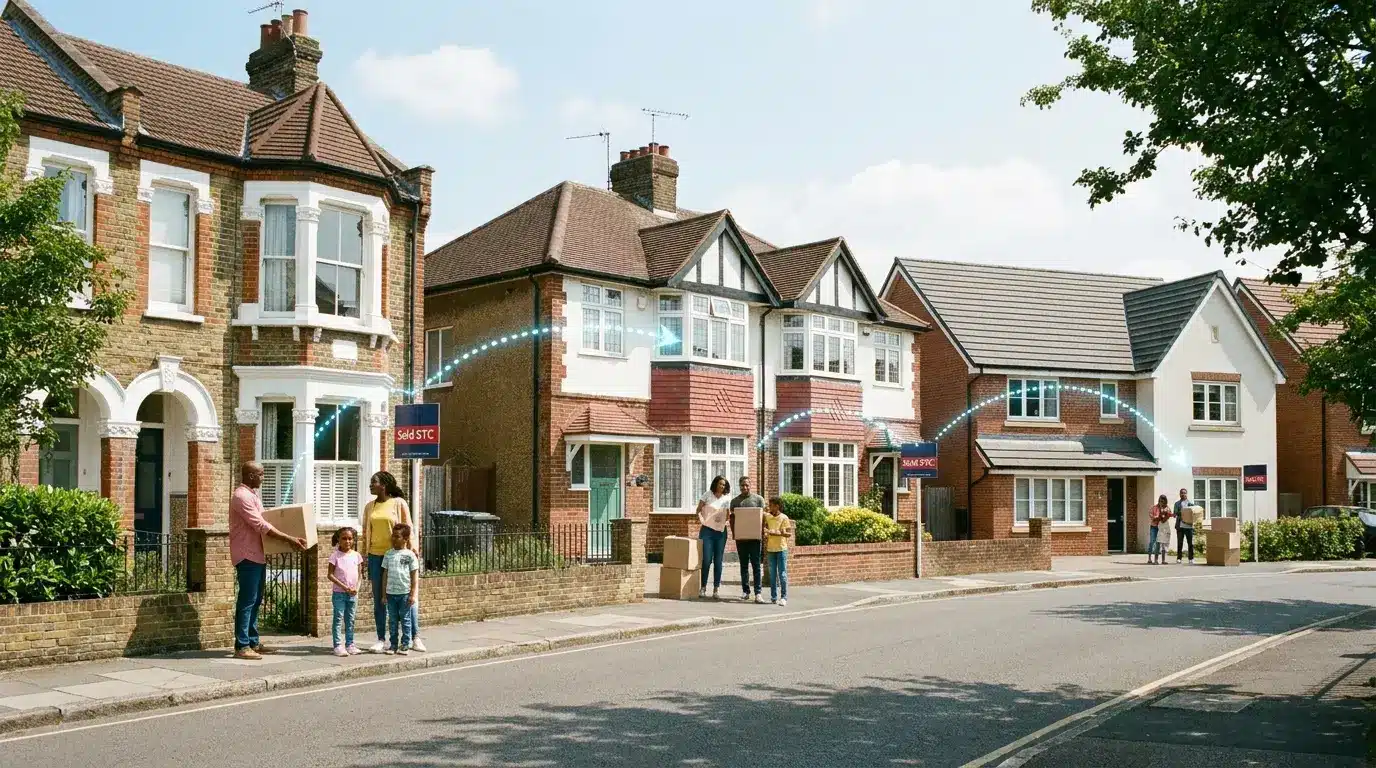
Most property purchases in the UK are part of a property chain,a series of linked buyers and sellers where each transaction depends on the one before it being completed.
A typical chain starts with a first-time buyer, continues through homeowners who are both selling their current property and buying another, and ends with a seller who has no onward purchase.
Because everyone relies on the next person to complete the task, the chain is only as strong as its weakest link. If one transaction is delayed or falls through, it can affect everyone involved.
Unfortunately, property chains don’t always hold together. Mortgage delays or rejections, issues uncovered during surveys, buyers changing their minds, legal or paperwork problems, or a sale elsewhere in the chain collapsing can all bring the process to a halt.
The longer the chain, the greater the risk, as each additional buyer or seller creates another potential point of failure.
What Does No Onward Chain Mean?
No onward chain means the seller doesn’t need to buy another property before completing the sale on the one you’re buying.
You’ll often see it used interchangeably with chain-free, but the two terms aren’t exactly the same.
No onward chain refers specifically to the seller, meaning they don’t need to buy another property before completing the sale.
Chain-free, on the other hand, can describe the buyer, the seller, or the entire transaction.
For example, if you’re a first-time buyer with no property to sell and you’re purchasing from a seller with no onward chain, the transaction is fully chain-free.
However, if you need to sell your own home first, the seller still has no onward chain, but the overall transaction isn’t chain-free.
Because estate agents often use these terms loosely, it’s always worth confirming exactly what they mean before you proceed.
What Types of Properties Are Usually Chain Free?
Not every property becomes chain-free by chance. There are clear reasons why a seller may have no onward purchase. Here are the most common types:
- New-build homes: The developer is a company, not a person. They are not buying another property. New builds are almost always chain-free.
- Probate properties: Homes sold after the owner has passed away. The estate sells the property. There is no onward purchase involved.
- Investment properties: A landlord selling a rental property is often not buying another home at the same time. Many investors sell outright.
- Vacant homes: Empty properties often have no seller needing to move out or buy somewhere new. If a listing mentions this term, it’s worth knowing exactly what vacant possession means, since it isn’t always the same as chain-free.
- Sellers moving into rented accommodation: Some sellers choose to rent a home before buying again. This makes their sale chain-free.
- Sellers relocating abroad: Someone leaving the UK for another country does not need to buy a property in the UK next.
- Retirement home moves: A seller moving into a care home or assisted living facility usually does not buy another house.
Each of these situations removes the need for an onward purchase. That is what creates the chain-free status.
Key Consideration: Just because a property type is usually chain-free does not mean it always is. Always confirm chain-free status with the estate agent before proceeding.
How Does a Chain-Free Property Sale Work?

A chain-free sale still follows the same core stages as any property purchase; it’s just that each stage moves without waiting on a linked transaction elsewhere. Here’s what that looks like in practice.
1. Making an Offer
Once an offer is accepted, both solicitors can begin work immediately since there’s no chain above or below to hold things up.
The seller doesn’t need a buyer for their next home to line up, and a chain-free buyer doesn’t need to wait for their own sale to complete, so the offer stage moves straight into the legal process without the usual delays.
2. Financing and Mortgage Approval
If the buyer needs a mortgage, the lender still carries out a full valuation and approval process.
Being chain-free doesn’t remove this step; it just means the buyer’s financing isn’t held up by anyone else’s mortgage falling through further along a chain. Cash buyers skip this step entirely, which further speeds things up.
3. Inspection and Appraisal
Surveys, valuations, and property inspections are proceeding as scheduled, keeping everything on track. Surveys, valuations, and property inspections proceed on their normal timeline.
A chain-free sale doesn’t shorten or skip these checks; it simply means the buyer can schedule and complete them without coordinating around another household’s move, though it’s still worth knowing what a property survey actually checks for before you book one.
4. Legal and Closing Process
Conveyancing, contract exchange, and completion still undergo all standard legal checks, including title searches, contract review, and final sign-off.
With only one buyer and one seller involved, solicitors communicate directly and resolve queries faster, since there’s no third or fourth party in a chain waiting on updates before the sale can close.
What Are the Benefits of Buying a Chain-Free Property?
Buying chain-free puts you in a much stronger position. Here is why.
- Lower risk of delays: No chain means no waiting on other parties’ mortgages or sales. Searches, surveys, and legal work proceed independently and faster.
- Less chance of falling through: Roughly a quarter of UK sales collapse before completion, according to Quick Move Now’s 2026 quarterly tracker, and chain-free buyers avoid exposure to strangers’ problems elsewhere in a chain.
- Easier communication: Fewer parties mean fewer people to chase. Your solicitor deals directly with theirs, so updates and paperwork move noticeably quicker.
- Stronger negotiating position: Sellers value certainty and speed from chain-free buyers, sometimes accepting a slightly lower offer for that reliability.
Are There Any Downsides to Buying Chain Free?
Chain-free properties are often easier and faster to buy, but they are not without challenges. They tend to attract more competition, which can lead to quicker decision-making and sometimes higher prices due to demand.
Sellers may also expect a faster completion, putting pressure on buyers to keep up if their mortgage or legal process slows down.
Importantly, chain-free does not mean risk-free, as issues like survey problems, title complications, or mortgage refusal can still occur. Understanding these factors helps buyers approach chain-free purchases with realistic expectations.
Chain-Free Buyer vs Cash Buyer
A chain-free buyer and a cash buyer can both make a property sale simpler, but they are not the same.
Understanding the difference can help sellers determine which type of buyer may offer a faster, more reliable sale.
| Feature | Chain Free Buyer | Cash Buyer |
|---|---|---|
| Needs a mortgage | Sometimes | No |
| Has a property to sell | No | Usually no |
| Completion speed | Fast | Often fastest |
| Seller appeal | High | Very high |
| Lender valuation required | Yes (if using mortgage) | No |
| Risk of mortgage refusal | Yes | No |
How Long Does a Chain-Free Purchase Take?
Most chain-free purchases complete in 4 to 12 weeks, depending on whether you’re paying cash or using a mortgage. There is no single answer, but the figures below give a useful guide.
| Scenario | Typical Timeframe |
|---|---|
| Chain-free, straightforward freehold | 6–10 weeks |
| Chain-free with mortgage and searches | 8–12 weeks |
| Chain-free cash buyer | 4–6 weeks |
| Standard chain (2–3 parties) | 12–16 weeks |
| Long chain (4+ parties) | 14–20+ weeks |
Several factors affect how quickly a chain-free purchase completes:
- Mortgage: Getting a mortgage in principle before you offer speeds things up. Lender processing times add weeks to the timeline. If you haven’t arranged one yet, it helps to understand what a mortgage in principle actually confirms before you start viewing.
- Conveyancing: A busy or slow solicitor can stretch the process. Instruct a solicitor as soon as your offer is accepted.
- Searches: Local authority searches can take 2 to 8 weeks, depending on the area.
- Surveys: Book your survey early. Delays in surveys delay everything that follows.
No timeline is guaranteed. But a chain-free purchase is almost always quicker and more predictable than one involving a chain.
certainty. A chain-free buyer with a mortgage is still far more appealing than someone mid-chain.
Tips for Buying or Selling a Chain-Free Property
Buying or selling a chain-free property can make the process quicker and less complicated, but careful planning is still important.
These practical tips can help both buyers and sellers avoid delays and keep the transaction moving smoothly.
For Buyers
- Respond quickly to paperwork: Slow responses from buyers are among the top reasons completions run late.
For Sellers
- Prepare your documents before listing: Have your title deeds, property information forms, and fixtures and fittings lists ready.
- Be upfront about your timeline: If you need more time to move out, say so early. Surprises cause problems.
- Market the chain-free status clearly: Put it in the listing title. Mention it in conversations with buyers. It is a real advantage to use it.
Conclusion
So, chain-free, boiled down: one fewer dependency in the chain. Fewer people, fewer moving parts, fewer ways for the whole thing to collapse halfway through.
That’s exactly why these listings get snapped up fast, and sometimes go for more than you’d expect.
Just don’t mistake fewer risks for no risk. I’ve told every first-time buyer I’ve worked with the same thing: chain-free buys you speed, not certainty.
Surveys still fail. Mortgages still get declined. Plan for both, not just the good outcome.
So next time you see chain-free on a listing, dig one layer deeper. Ask the agent what it actually means in this case. Get a solicitor lined up early. That’s the part that actually protects you.
Still not sure if a listing is genuinely chain-free? Ask the estate agent directly.
Frequently Asked Questions
Does a chain-free property always sell faster?
Not always. Speed depends on the buyer’s mortgage and solicitor too, not just the seller’s chain-free status.
How do I find chain-free properties for sale?
Check the listing details on portals like Rightmove or Zoopla, where chain-free status is usually flagged, or ask the estate agent directly.
Does chain-free mean the seller has already moved out?
Not always. It only means they have no onward purchase. They may still need time to arrange their own move out.
Can a chain-free sale still fall through after exchange?
Rarely, but yes. A buyer’s mortgage offer can be withdrawn or a legal issue can surface between exchange and completion.