

If you own your home and receive state support, you may be wondering how DWP home ownership for pensioners actually works.
The short answer is that your main home does not count against your Pension Credit. But that is not the whole story.
DWP changes may affect second homes, equity release, and rental income rules.
This blog breaks down what has changed, what stays the same, and what you should check before making any financial decisions.
Does Owning a Home Affect Your Pension Credit?
No, your main home is not counted as capital by the DWP.
This is the most important fact to know. The value of the property you live in is fully disregarded when the DWP checks whether you qualify for Pension Credit.
This means you will not be asked to sell your home. You will not be penalized for paying off your mortgage. And owning your home does not reduce your weekly Pension Credit payment.
The same protection applies to many other benefits.
Home ownership has no effect on:
- Attendance Allowance.
- Winter Fuel Payment.
- Warm Home Discount.
- Free bus pass.
- Free TV license (if you are 75 or over and claim Pension Credit).
- Council Tax Reduction.
Up to 880,000 eligible households in the UK do not claim Pension Credit, according to the Department for Work and Pensions, many because they wrongly assume owning a home rules them out. If you have not checked your eligibility recently, it is worth doing so now.
| Note: Pension Credit tops up weekly income to £238.00 for single pensioners and £363.25 for couples in 2026/27, a 4.8% rise in line with the earnings part of the Triple Lock, according to the DWP’s published 2026/27 benefit and pension rates. You can apply up to four months before reaching State Pension age, and claims are automatically backdated by up to 3 months. |
What Assets Count as Capital for DWP Benefits?
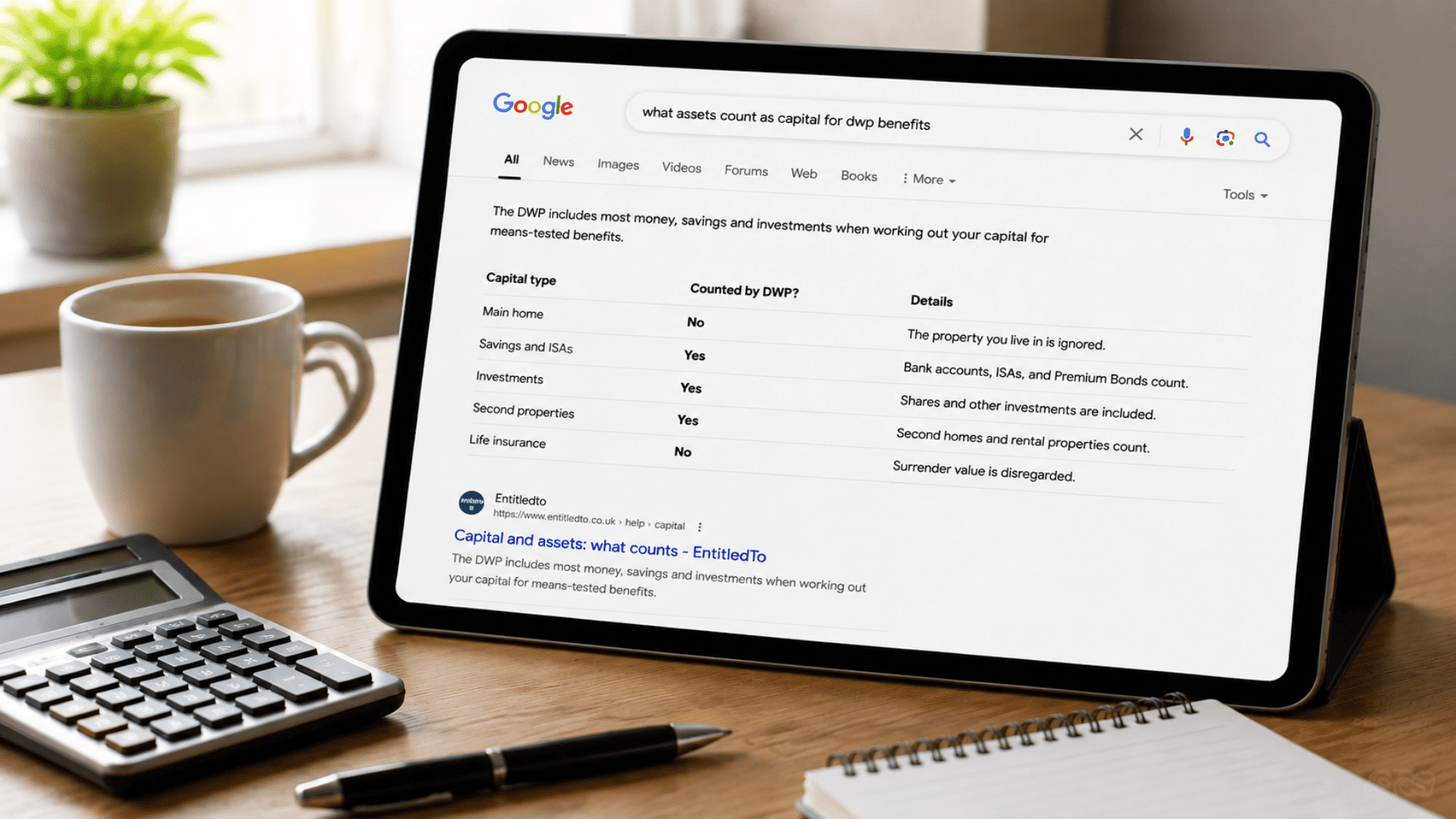
Different types of assets are treated differently by the DWP when assessing Pension Credit eligibility. The table below shows which assets are included and which are ignored.
| Capital Type | Counted by DWP? | Details |
|---|---|---|
| Main home | No | The property you live in is ignored. |
| Savings and ISAs | Yes | Bank accounts, ISAs, and Premium Bonds count. |
| Investments | Yes | Shares and other investments are included. |
| Second properties | Yes | Second homes and rental properties count. |
| Life insurance | No | Surrender value is disregarded. |
Second Homes and Rental Properties
If you own any property beyond your main home, the DWP counts it as capital.
The value used is the market value minus any outstanding mortgage debt on that property. This figure is then added to your total capital and can reduce your Pension Credit.
Rental income from any property must be declared to the DWP, and getting the basics right on renting out a property for the first time can help you avoid the reporting mistakes that lead to an overpayment recovery, where the DWP asks for money back.
Inherited property also counts. If you inherit a home that is empty or unused, it is treated as capital.
There is one exception: if a relative over State Pension age, or someone who is incapacitated, continues to live in that property, it may be disregarded indefinitely.
If you decide to sell an inherited property instead of keeping it, it is worth understanding how stamp duty on inherited property could apply during the transfer.
Equity Release and How It Affects Your Benefits
Equity release lets you access money tied up in your home while you continue living there. It is a legitimate option, but it has consequences for means-tested benefits that most people overlook.
When you release equity from your home:
- The lump sum you receive is treated as capital.
- If it pushes your total savings above £10,000, tariff income is added to your assessment.
- This can reduce your Pension Credit payment.
Regular payments received through an equity release plan may be treated as income rather than capital.
If you spend the funds quickly, they may drop below the threshold. But spending money fast just to stay eligible can trigger what is known as the deliberate deprivation of assets rule (covered in the next section).
Free, regulated guidance is available through MoneyHelper before you commit to any equity release plan.
The Deliberate Deprivation of Assets Rule
This rule catches many pensioners off guard.
If the DWP believes you transferred, gifted, or spent assets specifically to qualify for benefits, it can treat you as if you still own those assets. This is called notional capital.
Examples that can trigger this rule include:
- Giving your home to your children before making a claim.
- Transferring savings to a family member.
- Spending a large lump sum quickly just before applying.
There is no time limit. The DWP can look back years.
This does not mean you cannot plan your finances. It means you should always take professional advice before moving significant assets.
What Happens When You Sell Your Home?
If you sell your home to buy another, the DWP disregards the proceeds for up to 26 weeks, or up to 12 months for Pension Credit if you genuinely intend to buy again. The DWP has rules to make sure you are not penalized during the transition.
Key rules on sale proceeds:
- If you sell your home and plan to buy another, the proceeds are disregarded for up to 26 weeks.
- For Pension Credit and pension-age Housing Benefit, the disregard can extend to 12 months if you intend to use the money to buy a replacement home.
- You must have a genuine intention to buy; a vague hope is not enough.
- If you hold on to the money long-term as savings, it becomes assessable capital.
If you move into a care home rather than a new property, different rules apply. A benefits adviser can help you understand what to expect in that situation.
Support for Mortgage Interest
This is one of the most overlooked options for pensioners who own their home.
Support for Mortgage Interest (SMI) is a government loan that covers the interest on your outstanding mortgage.
Key facts:
- You must be receiving Pension Credit (or another qualifying benefit) to apply.
- SMI is not a grant; it is a loan secured against your property.
- It is repaid when you sell your home or transfer ownership.
- Interest is charged on the loan at a standard government rate.
Pension Credit can also include additional amounts for certain housing costs, such as ground rent and service charges, for things like lifts, communal gardens, or building maintenance.
Note: Mortgageinterest is no longer covered through Pension Credit itself. SMI replaced that. If you are still paying off a mortgage, check whether you can apply through the SMI scheme.
Shared Ownership and Joint Ownership Rules
When assessing Pension Credit, the DWP looks at your ownership share rather than automatically counting the full property value.
The rules vary depending on whether you share ownership or have relatives living in the property.
| Ownership Type | DWP Treatment | Details |
|---|---|---|
| Shared ownership | Your share counts | Only the portion you own is treated as capital. |
| Rented share | Housing cost | The rented part may qualify for support. |
| Joint ownership | Share assessed | Only your equity share is considered. |
| Qualifying relative | May be ignored | Property can be disregarded if conditions are met. |
DWP Pensioner Home Ownership Rules Changes: The 2026 Merger
One of the biggest administrative changes in years is now confirmed. From Autumn 2026, new claimants will no longer apply for Housing Benefit and Pension Credit separately. A single Pension Credit Housing Element will replace both.
What this means for pensioners who own their home:
- The core rule stays the same; your main home is still disregarded.
- The application process becomes simpler.
- New claimants will go through one system instead of two.
The DWP has secured a contract with IBM to build the digital infrastructure needed for this change. The goal is to bring more of the estimated 760,000 eligible households who currently miss out into the system.
If you are an existing claimant, your payments are not expected to be interrupted. The merger applies to new claimants from 2026 onwards.
Practical Steps to Take Right Now
Here is what you can do before the 2026 changes take effect:
- Check your eligibility: use the free Pension Credit calculator on GOV.UK.
- Gather your documents: proof of property ownership, mortgage statements, equity release letters, and rental agreements.
- Report capital changes promptly: tell the DWP about any change of £500 or more.
- Seek advice before moving large assets: contact Age UK (0800 678 1602) or Citizens Advice for free guidance.
- Apply early: you can claim Pension Credit up to four months before reaching State Pension age.
- Check for SMI: if you have an outstanding mortgage, ask the DWP or an adviser whether SMI applies to you.
Frequently Asked Questions
Does Carer’s Allowance Affect My Pension Credit?
No, Carer’s Allowance does not reduce Pension Credit directly, but claiming it can increase your Guarantee Credit through the underlying entitlement rules.
What Happens to Pension Credit If My Partner Moves into a Care Home?
You are assessed as two separate individuals rather than a couple. Each partner’s income and capital are calculated separately from that point.
Does Owning Property Abroad Affect My Pension Credit?
Yes, a property abroad is valued and counted as capital in the same way as a UK second home, and you must declare it to the DWP even if it generates no income.
What Is Changing in 2026 for Pensioners on Benefits?
Housing Benefit and Pension Credit will be merged into one system for new claimants. Your main home protection stays the same.
Wrapping It Up
DWP home ownership for pensioners comes down to one core rule: your main home stays protected, but everything else- second homes, equity release, rental income- gets counted as capital.
In my experience advising clients, the biggest mistakes happen when pensioners assume all property is treated the same way.
With the 2026 Housing Benefit and Pension Credit merger approaching, I’d encourage you to check your entitlement now rather than wait.
Use the GOV.UK Pension Credit calculator, or speak to Age UK or Citizens Advice, before making any decisions about your property.