
The TV above the fireplace is probably the most argued-about design decision in the living room. Half the internet will tell you it ruins the room. The other half will show you a gorgeous photo and say it’s the only move when wall space is tight.
I’ve been in enough real homes to know both outcomes happen, and the difference is almost never the position itself. It’s the lack of planning around it. The heat question is solvable. The neck strain problem is solvable.
And there are more approaches to this setup than most guides cover, from full concealment to making the screen look as if it were always meant to be part of the architecture. This is where to start.
Is Putting a TV Above Your Fireplace a Good Idea?
The honest case against it is worth taking seriously before you pull out a drill. The viewing angle is a real problem when the TV ends up 60 inches off the floor, and you’re watching from a sofa. Neck strain over a two-hour film is not a minor inconvenience.
There’s also the heat issue, which varies a lot depending on what kind of fireplace you have, and the loss of mantel real estate for styling.
That said, there are rooms where the option above the fireplace is the right one. Single-wall layouts where the fireplace is centered and there’s nowhere else to anchor the room are the most obvious case.
Corner sofas. Rooms where the only alternative is a TV on an awkward stand that floats unattached to anything. Before committing, ask yourself three questions. First, what type of fireplace do you have?
A wood-burning fireplace or log burner requires the most careful planning around heat and clearance, and the media wall with log burner approach, in particular, brings a separate set of considerations around flue positioning, combustible materials, and building regulations that a standard TV mount setup simply doesn’t face.
Second, can you get the TV to a sensible viewing height from your sofa, either through a tilting mount or by rethinking the mantel shelf height?
Third, are you prepared to handle the wiring properly? Surface cables running down a chimney breast will undo everything else you do well.
If you answered yes to all three, you’re in better shape than most people who just pick a wall and start drilling.
The Two Rules Every TV Above Fireplace Setup Must Follow
I’ve seen well-styled rooms completely undermined by a TV at the wrong height or a mount chosen without first checking the fireplace type. Two rules. Both non-negotiable.
Rule 1: Get the Viewing Height Right Before You Buy a Mount
The bottom of the TV screen should land no more than 12 to 18 inches above the mantel shelf, with the screen’s center sitting as close to eye level as possible from your seating position.
That’s typically 42 to 48 inches from the floor, depending on sofa height.
The single best product decision you can make if the mantel forces the TV higher than you’d like is a tilting mount that angles the screen downward toward the sofa. The MantleMount is the one most people land on.
It swings out from the wall and angles down, which solves the neck problem without requiring you to lower the whole setup.
For TV width, the rule of thumb that holds up in practice is the two-thirds-to-seven-eighths ratio: the TV’s width should fall between two-thirds and seven-eighths of the mantel’s width.
| Mantel width | Minimum TV width | Maximum TV width |
|---|---|---|
| 48 inches | 32 inches | 42 inches |
| 54 inches | 36 inches | 47 inches |
| 60 inches | 40 inches | 52 inches |
| 66 inches | 44 inches | 58 inches |
| 72 inches | 48 inches | 63 inches |
Going larger than seven-eighths makes the TV the entire wall, and the fireplace disappears. That’s a loss worth avoiding.
Rule 2: Know Your Fireplace’s Heat Profile Before Mounting
Not all fireplaces create the same risk for the TV above them. Wood-burning units and log-burner fireplaces that involve an open flue sit at the high end of that risk scale, which is why the planning conversation starts there.
| Fireplace type | Heat risk | Minimum clearance | Precaution |
|---|---|---|---|
| Wood-burning/log burner | High | 18 inches or more | Mantel heat deflector required |
| Gas fireplace | Moderate | 12 to 18 inches | Check manufacturer specs |
| Electric fireplace | Low | 8 inches acceptable | Standard mount; no deflector needed |
A solid mantel shelf does more than look good. It acts as a heat deflector, pushing rising heat out into the room rather than straight up toward the TV.
If your mantel is shallow or decorative-only, it’s worth assessing whether it’s actually doing that job.
15 TV Above Fireplace Ideas Worth Borrowing
These cover everything from a single mount change to a complete wall build. I’ve organized them by style register so you can skip straight to what fits your room.
1. White Shiplap Surround with Floating Mantel
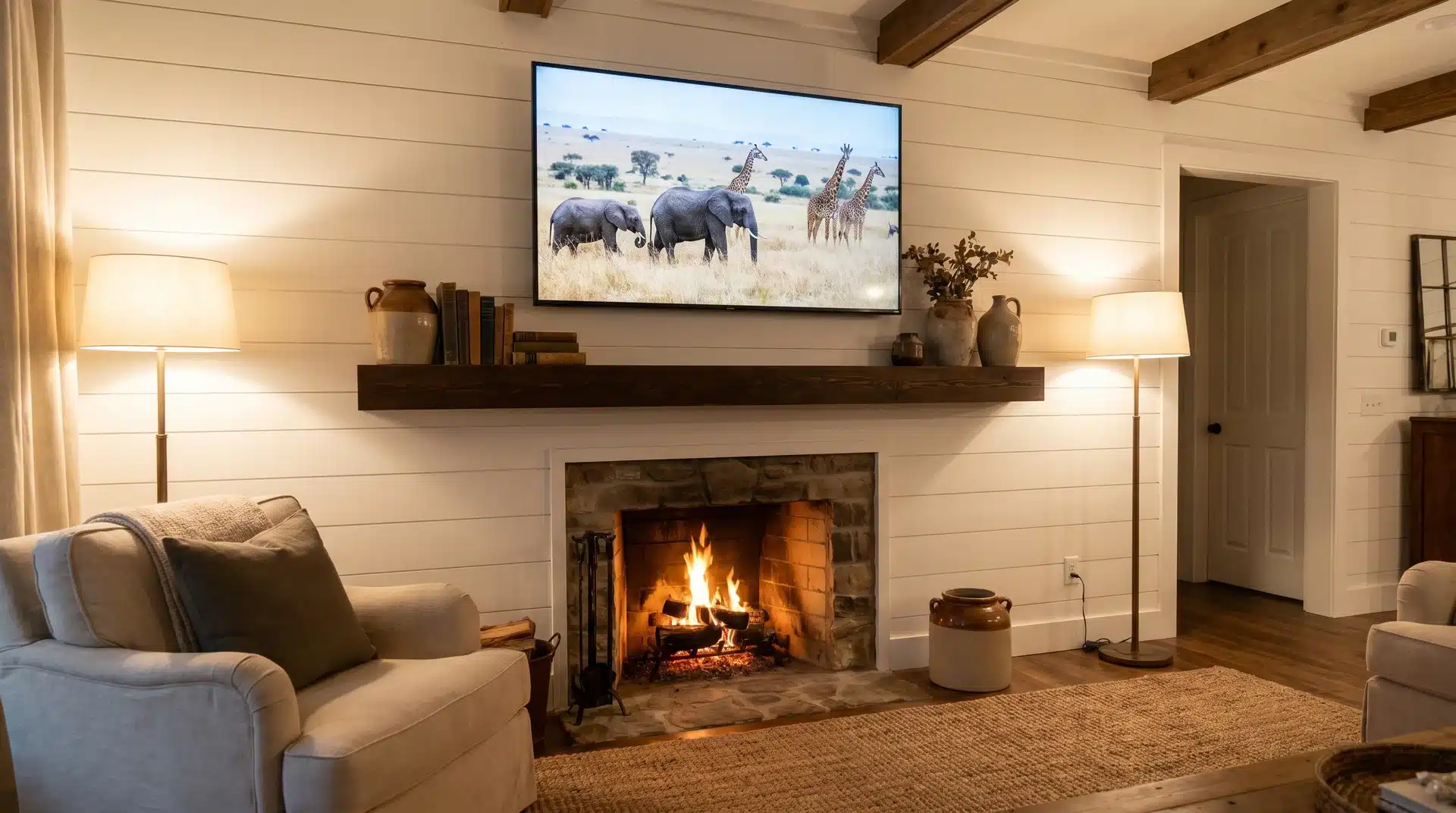
Horizontal shiplap on a chimney breast does something useful: it breaks up the wall into a pattern that frames the TV without fighting it.
The lines pull the eye across the wall rather than straight up to a black rectangle on a white background.
This works well in farmhouse and transitional interiors, and it’s one of the few setups where the TV in a wood-tone frame actually reads as art rather than a screen that’s trying to look like art.
2. Brick Chimney Breast with Recessed TV Niche
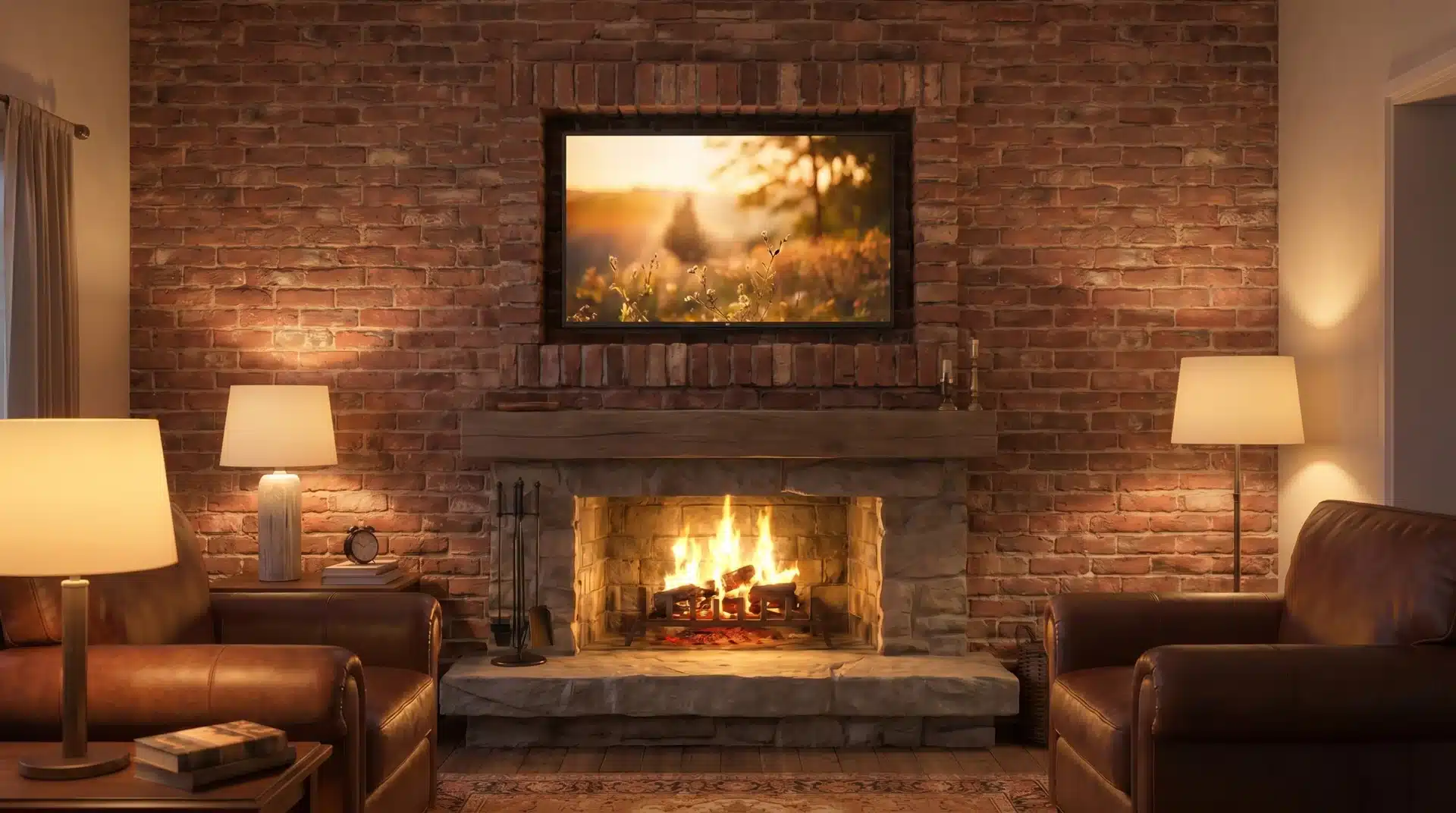
Recessing the TV into the brick face so it sits flush or nearly flush with the wall surface is architecturally cleaner than a TV that protrudes 6 inches into the room.
The brick texture visually absorbs the screen in a way that smooth, painted plaster doesn’t.
Worth noting: cutting into a brick chimney breast is not a weekend project. A structural assessment comes first.
3. Floor-to-Ceiling Stone Surround
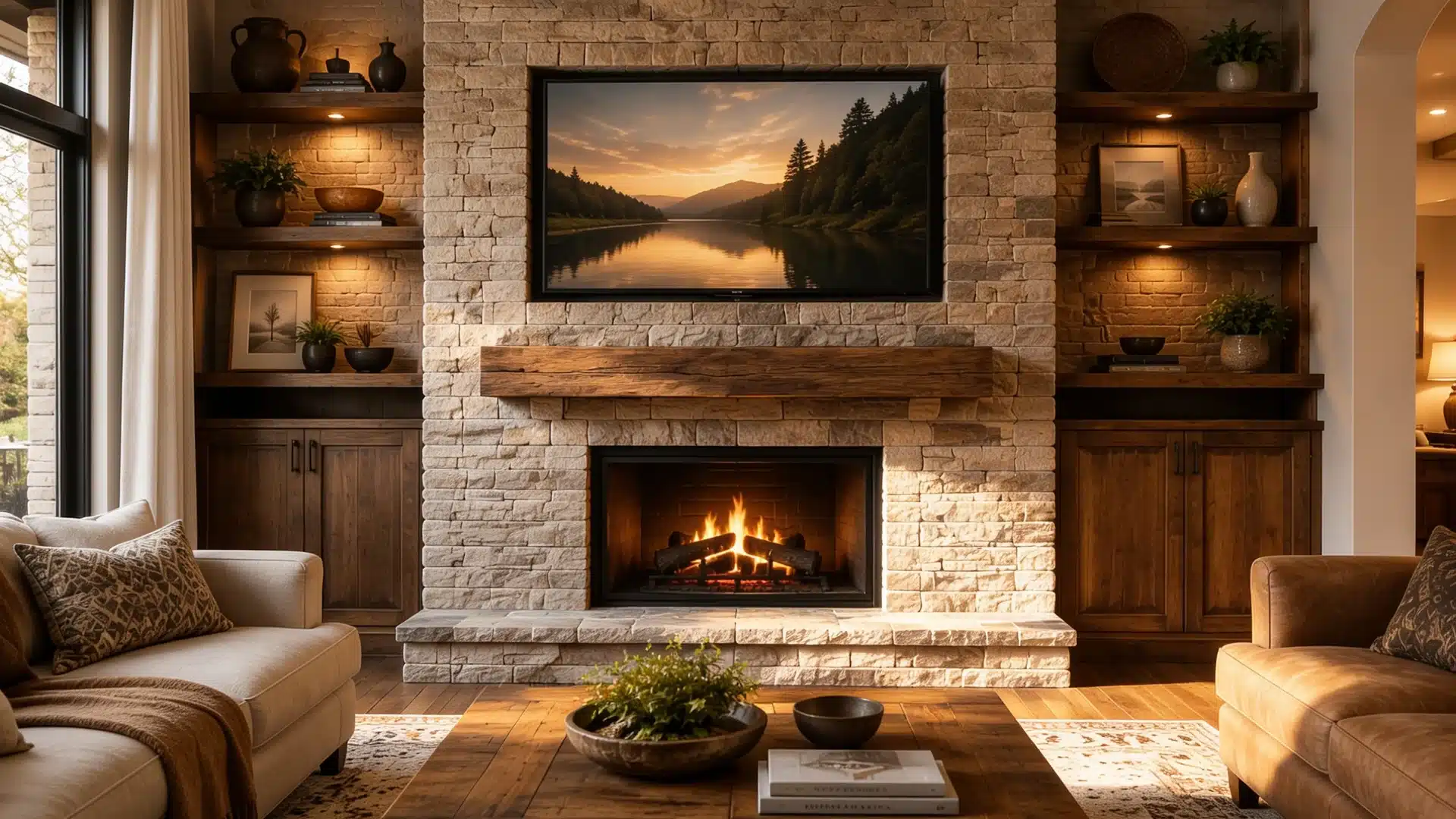
Natural stone from floor to ceiling creates a single vertical architectural feature, and the TV reads as part of that feature rather than something mounted on top of it.
The trick here is using a low-profile flat mount rather than an angled bracket. The goal is for the screen to look embedded, not attached.
4. Traditional Wood Mantel with Built-in Shelving on Either Side
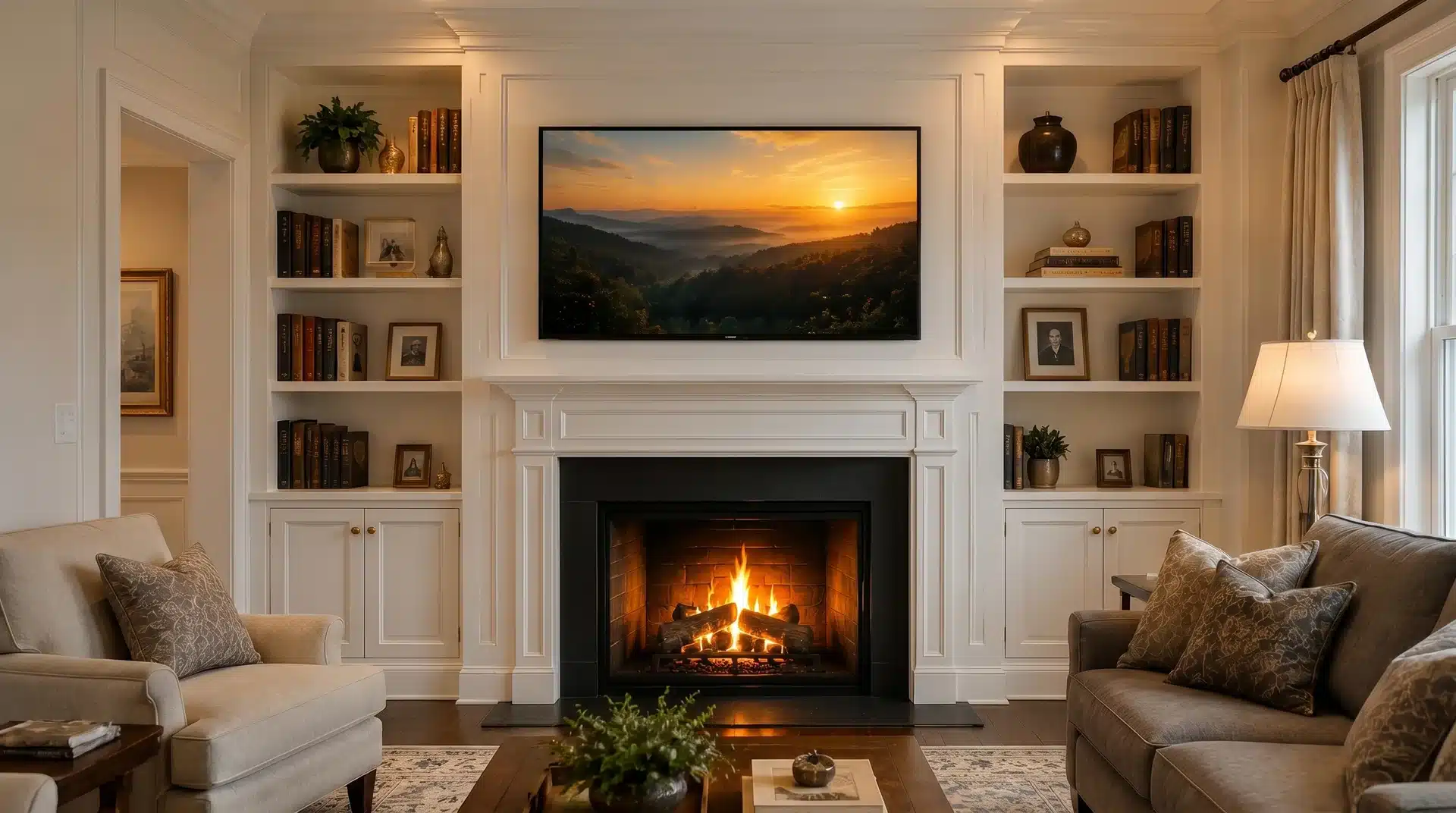
The flanking shelves are what make this work. Without them, a TV above a mantel looks like two separate ideas sharing a wall. With them, the whole thing reads as a single designed unit.
The shelf level on either side is also where you introduce lower objects to pull the eye down from the TV when it’s off.
5. Paneled Overmantel with Painted Wood Millwork
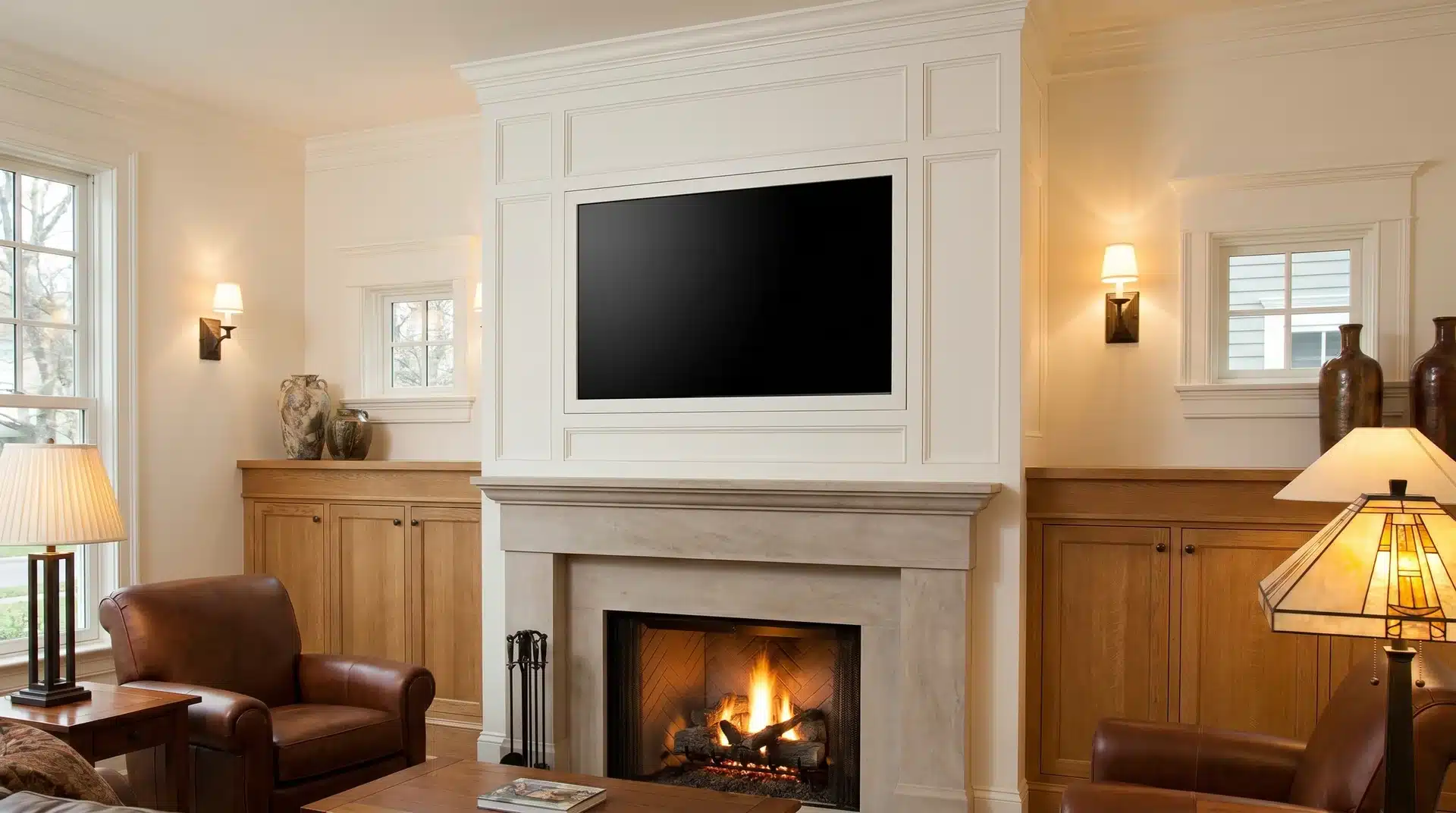
This is a more involved build, but it’s one of the most effective ways to make a TV look like it belongs on a traditional chimney breast. A frame of painted wood molding extends the visual logic of the mantel upward to meet the TV.
When the screen is off, the dark glass sits inside a panel that reads as a decorative element rather than electronics. Popular in craftsman and colonial interiors.
6. Full-Width Black Feature Wall with Recessed Firebox
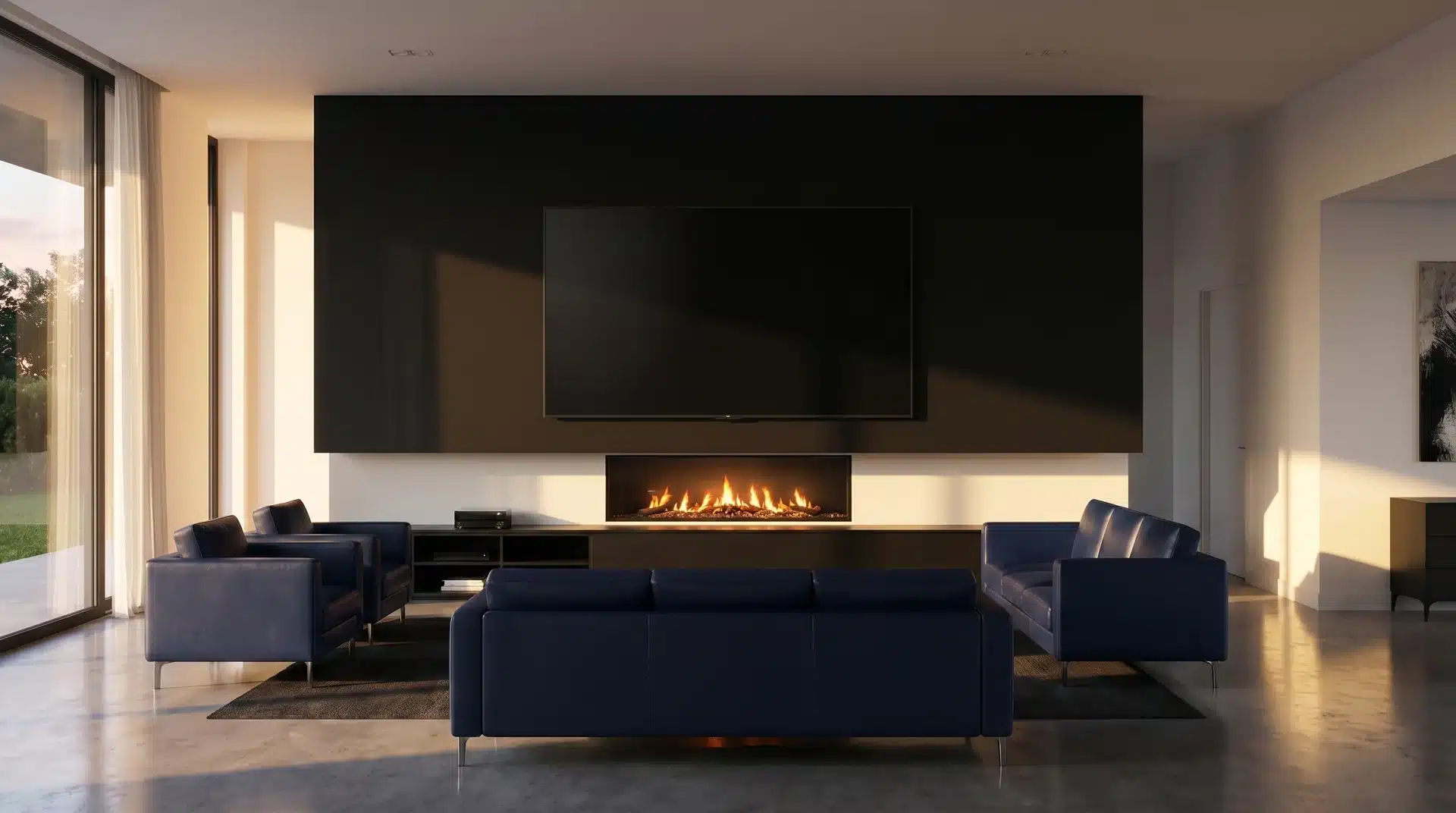
Matte black plaster or deeply saturated paint is one of the few colors that makes a TV screen disappear when it’s off. The firebox becomes the only light source on the wall when the TV isn’t on.
This approach works in open-plan spaces where you want the wall to make a dramatic statement. It doesn’t work in rooms that rely on light bouncing around.
7. Venetian Plaster Surround with Flush-Mounted TV
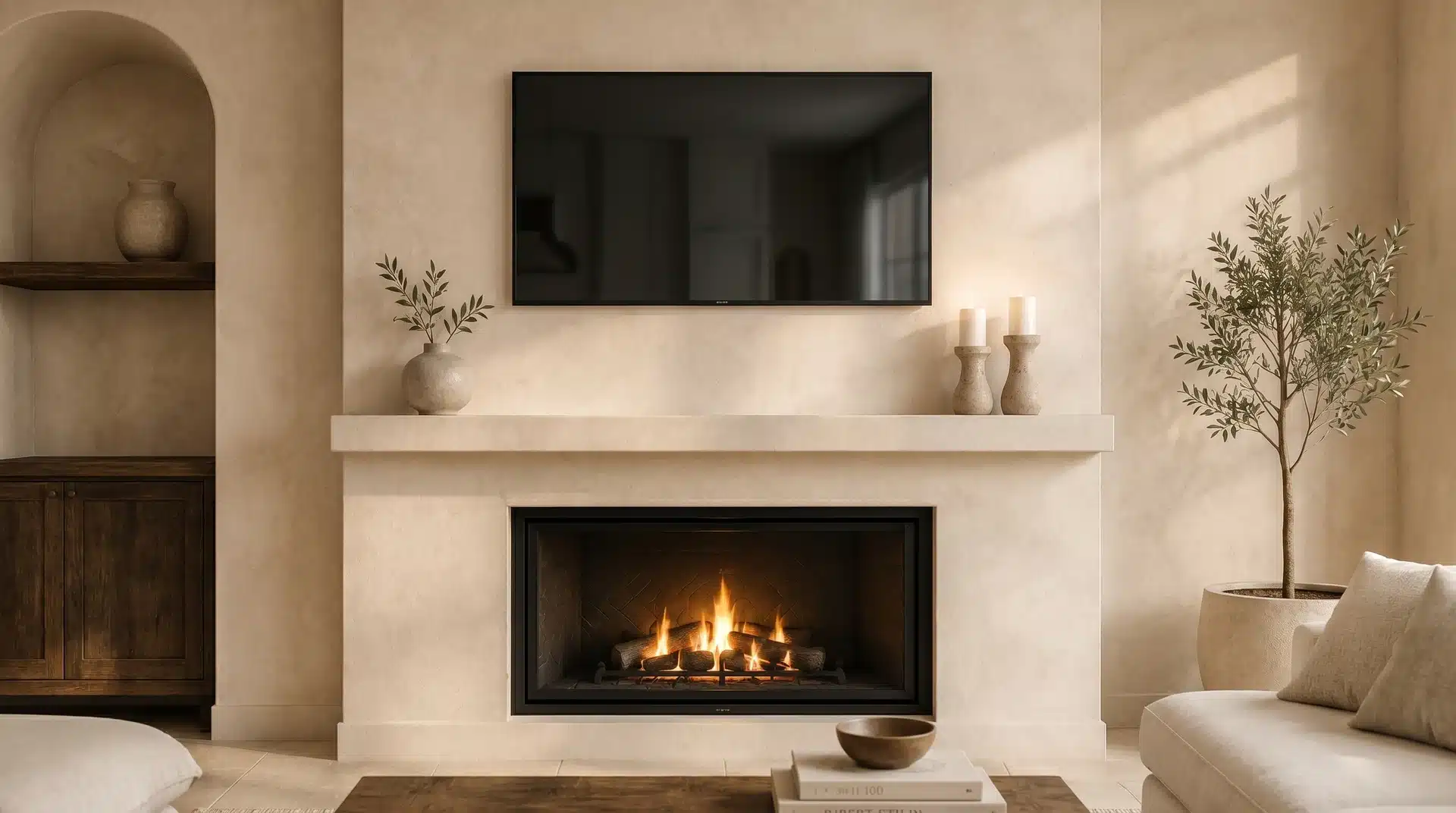
Venetian plaster creates a surface with no joints, transitions, or interruptions, so a TV set against it reads as a panel rather than a foreign object.
It works in warm colorways (cream, sand, terracotta) and cooler ones (grey, pale stone). The mount needs to be a true flush mount or the effect collapses.
8. Floating Media Console Below with Wall Mount Above
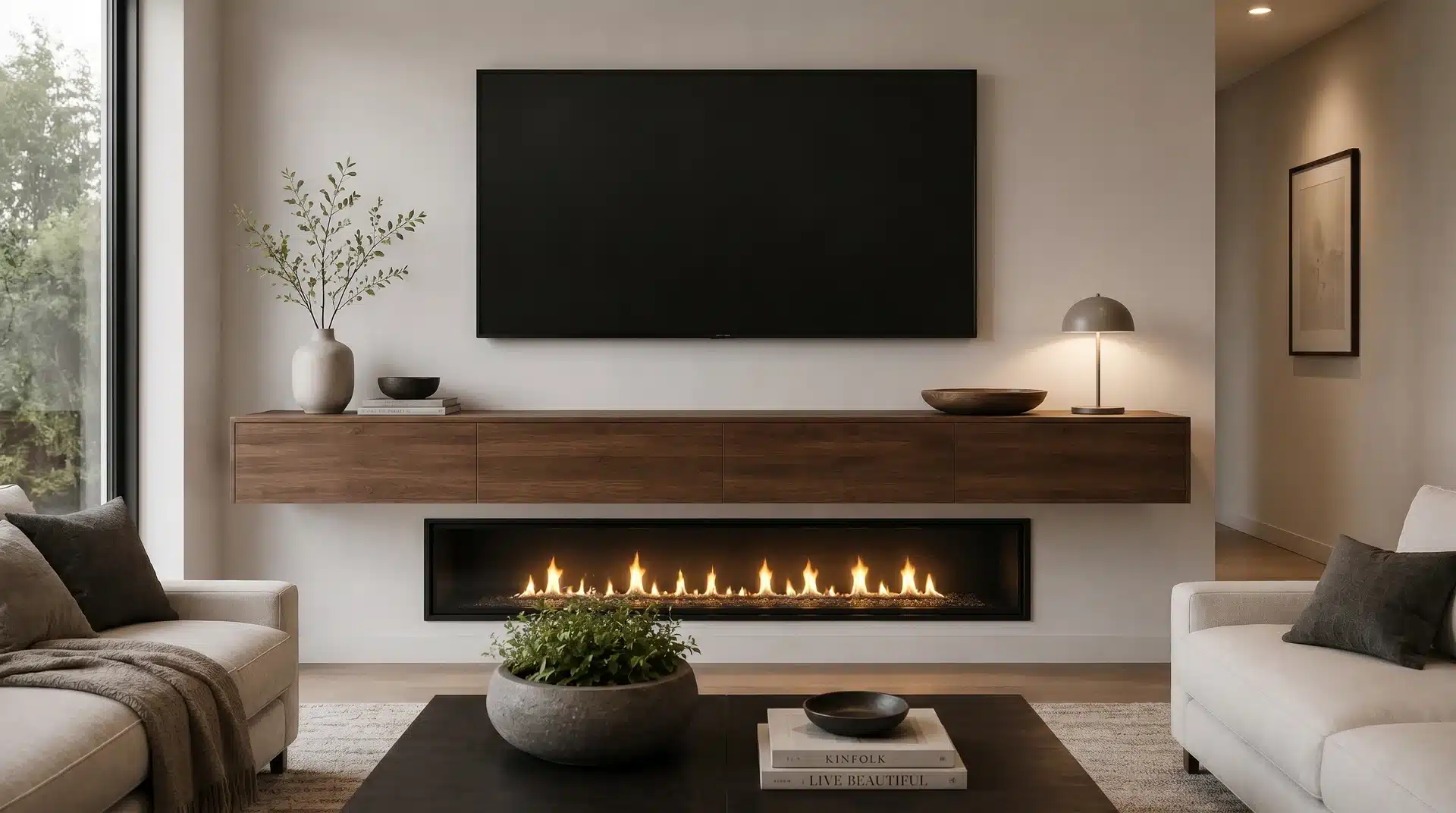
The console anchors the setup and keeps components visible and accessible. It also lowers the visual center of gravity in the room, which helps when the TV has to sit higher than ideal above the fireplace.
The proportional note: choose a console roughly the same width as the TV, not the full width of the wall, or it starts to look like a furniture showroom display.
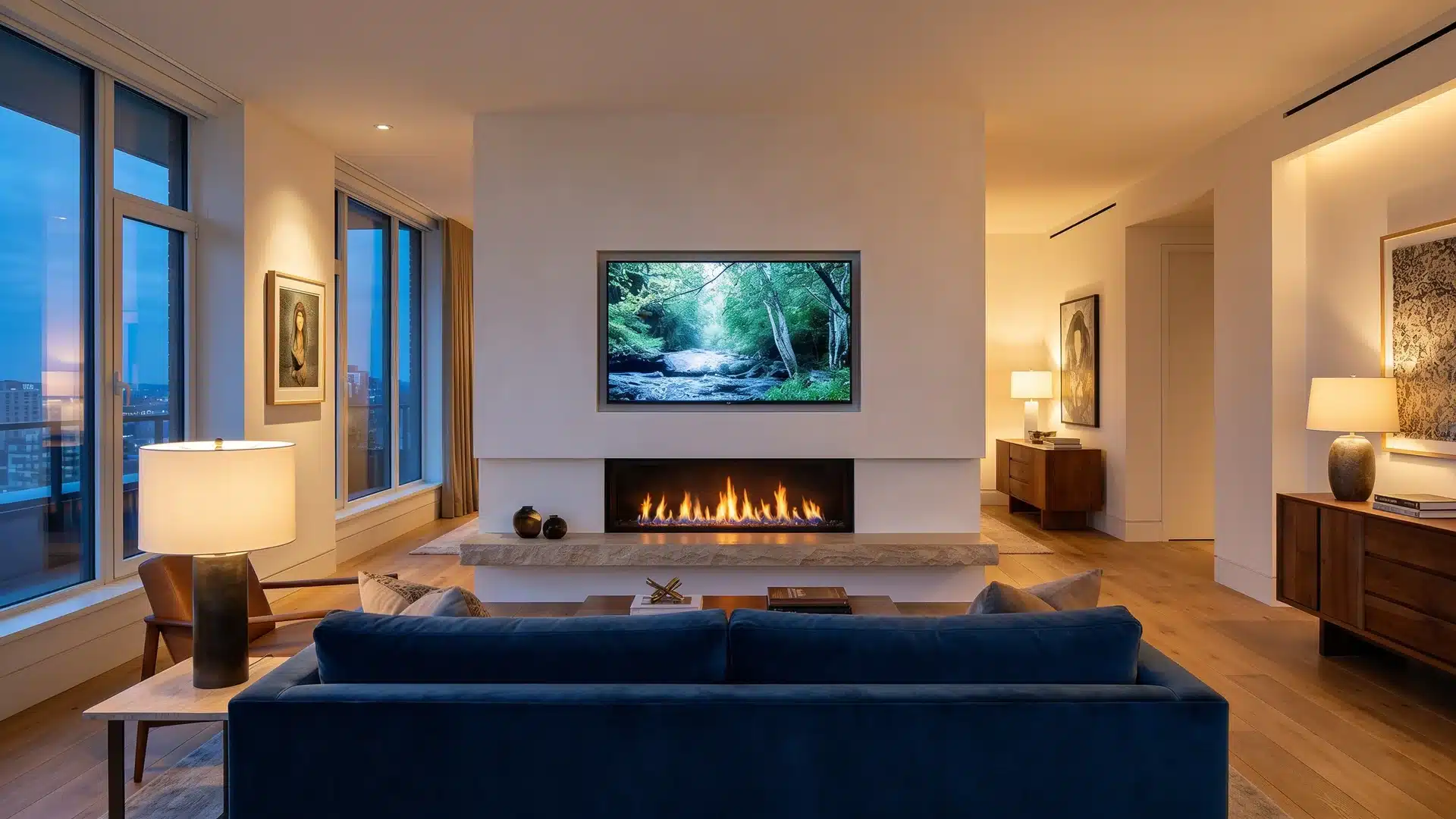
9. Frameless Linear Fireplace with Full-Panel TV Wall
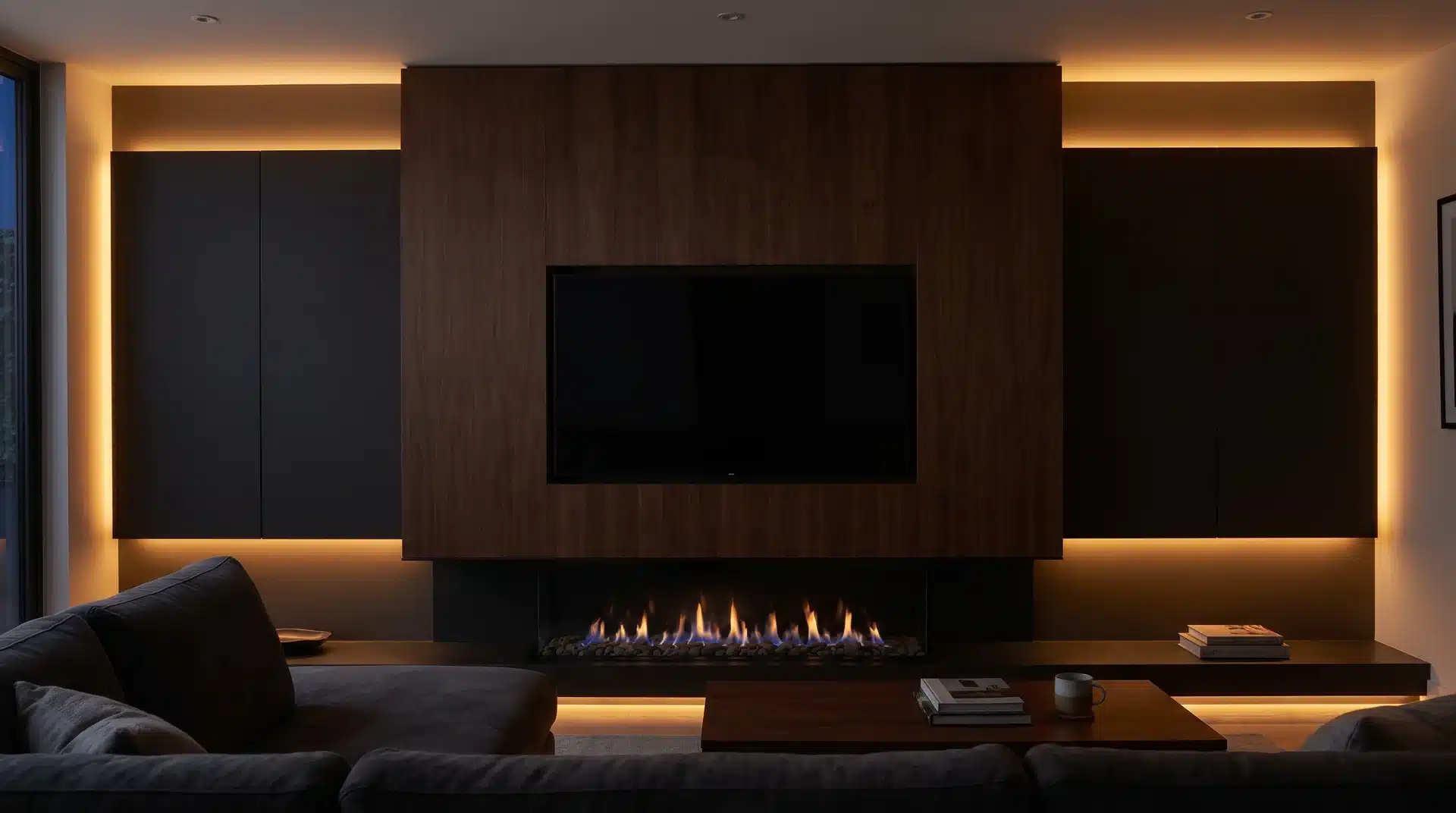
A ribbon-style insert at low level with a clean panel above it creates a hotel-lobby calm that’s hard to achieve with a traditional firebox.
LED strip lighting behind the TV panel adds depth to the wall without competing with the flame. This is the setup that photographs best and is also the most expensive to get right.
10. Concrete Surround with Open Pipe Shelving
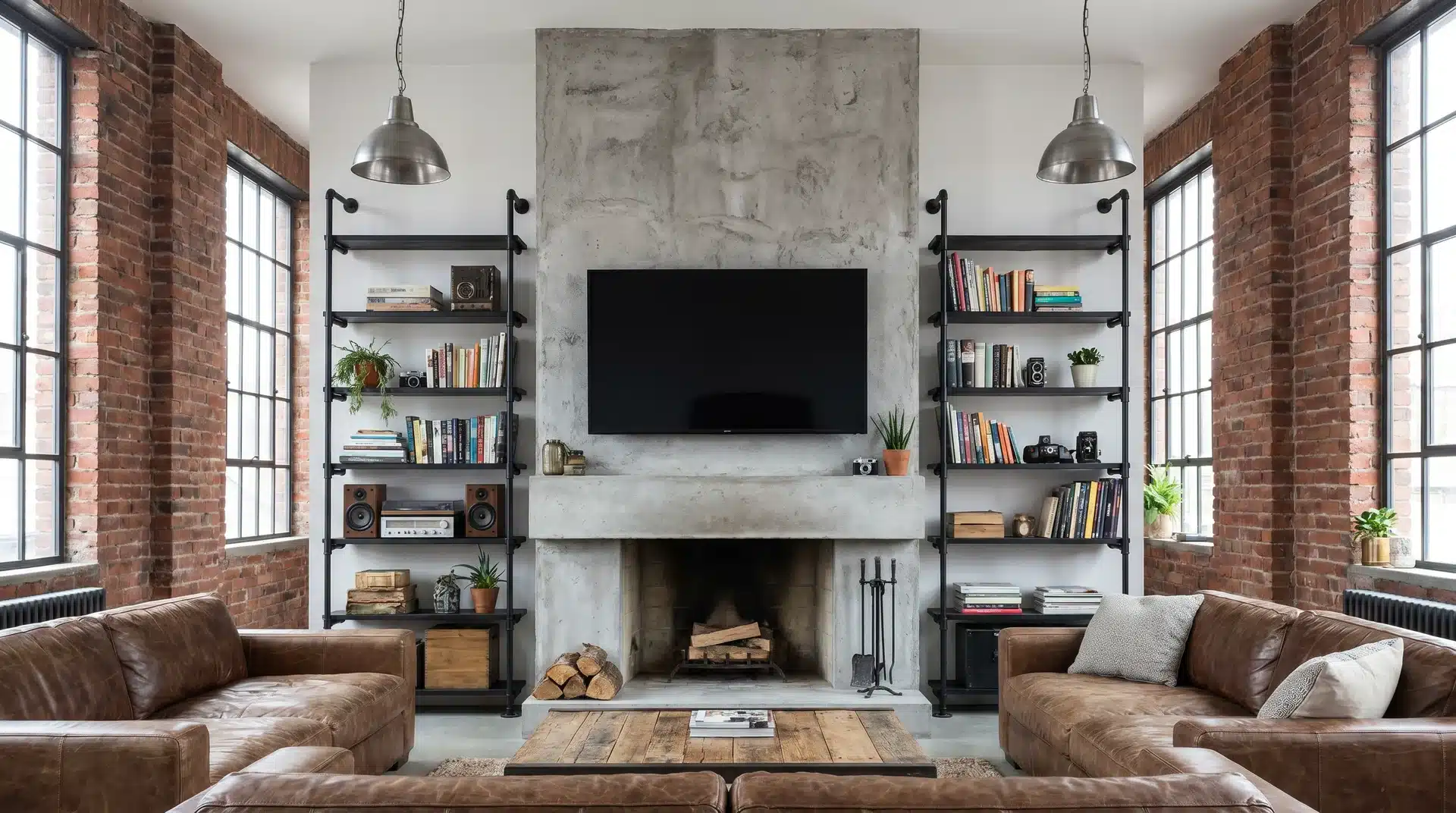
Poured or cast concrete around the firebox grounds the wall in an industrial register that suits loft and warehouse conversions. Open steel pipe shelving on either side handles media clutter without covering the texture of the concrete.
It’s one of the more honest material combinations available: nothing here is pretending to be something it isn’t.
11. Whitewashed Brick with Distressed Wood Mantel
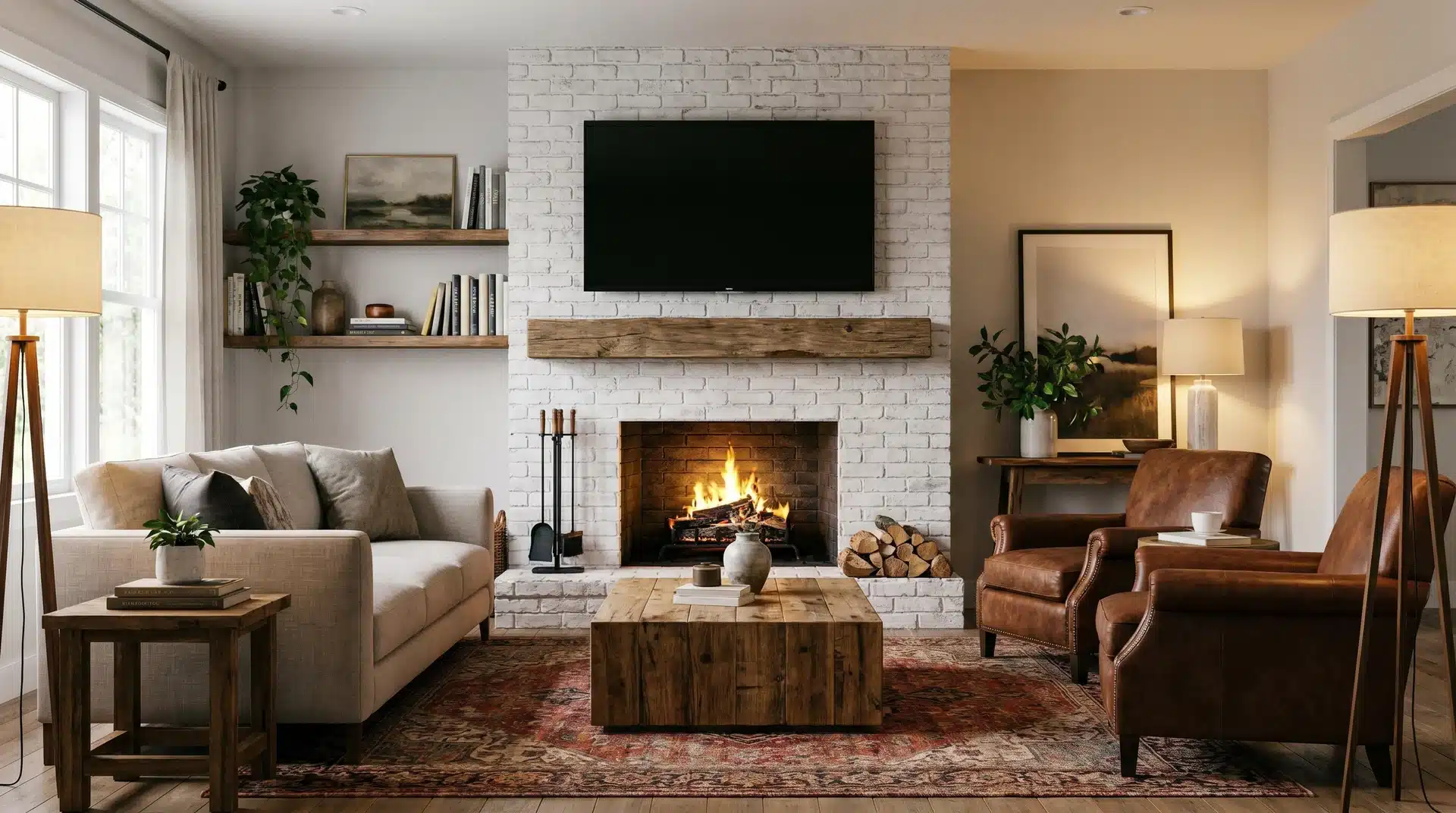
Painting or limewashing original brick lightens the room without killing the texture. Paired with a reclaimed or distressed-wood mantel, it retains the warmth of a rustic setup while feeling lighter than a full dark brick mantel.
It’s a combination that ages well precisely because neither material is trying to look new, which puts it in the same category as the living room log burner ideas that tend to outlast the trends they were styled around.
12. Stacked Stone with Log Basket Niches on Either Side
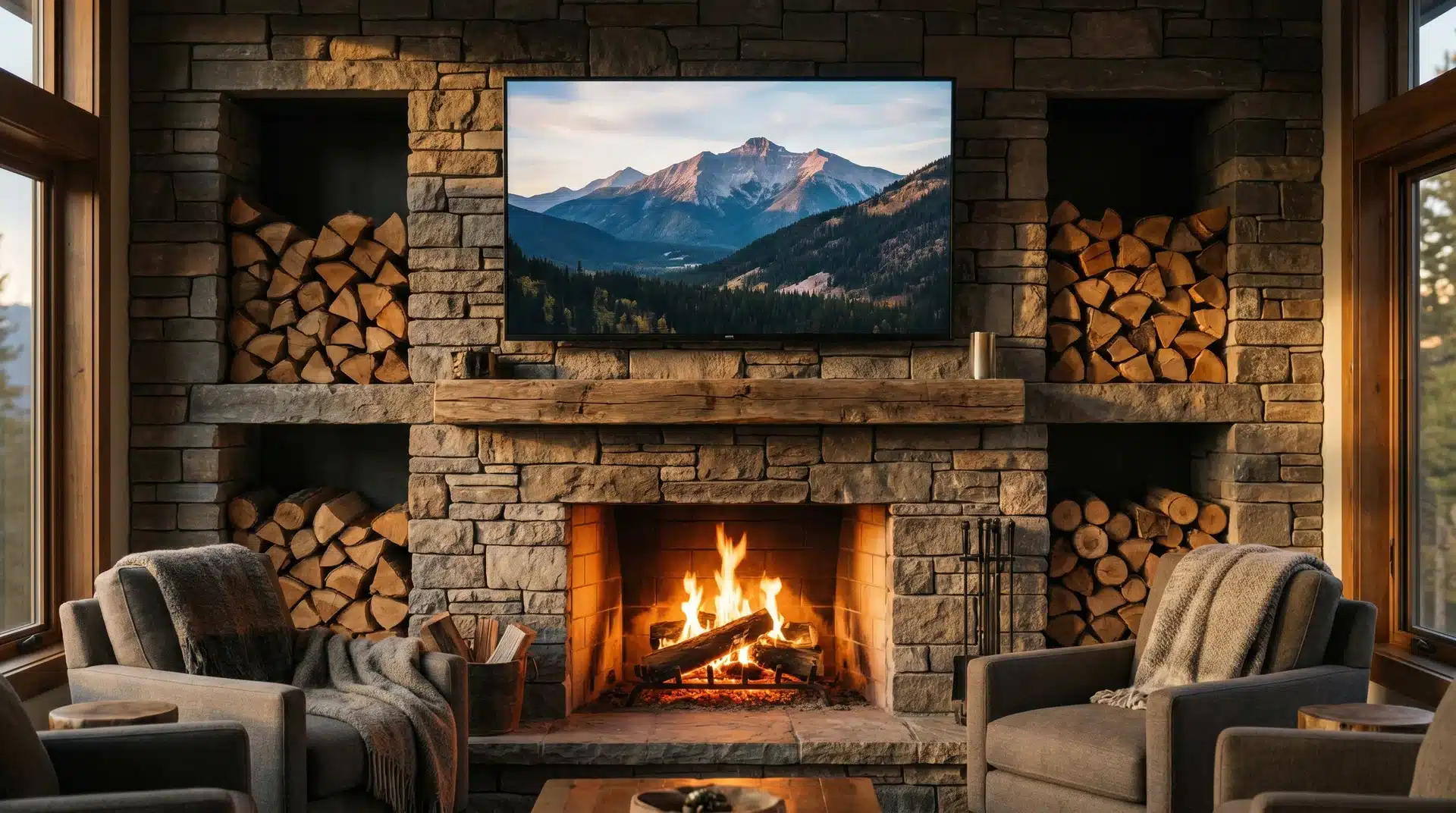
The flanking niches have to be symmetrical. Mismatched sizes read as a construction error rather than a design choice.
When they’re done right, the log storage becomes decorative, the symmetry frames the firebox and TV as a single unit, and the stacked stone wall has enough texture to hold its own against the screen.
13. Wooden Beam Mantel on a Plaster Breast
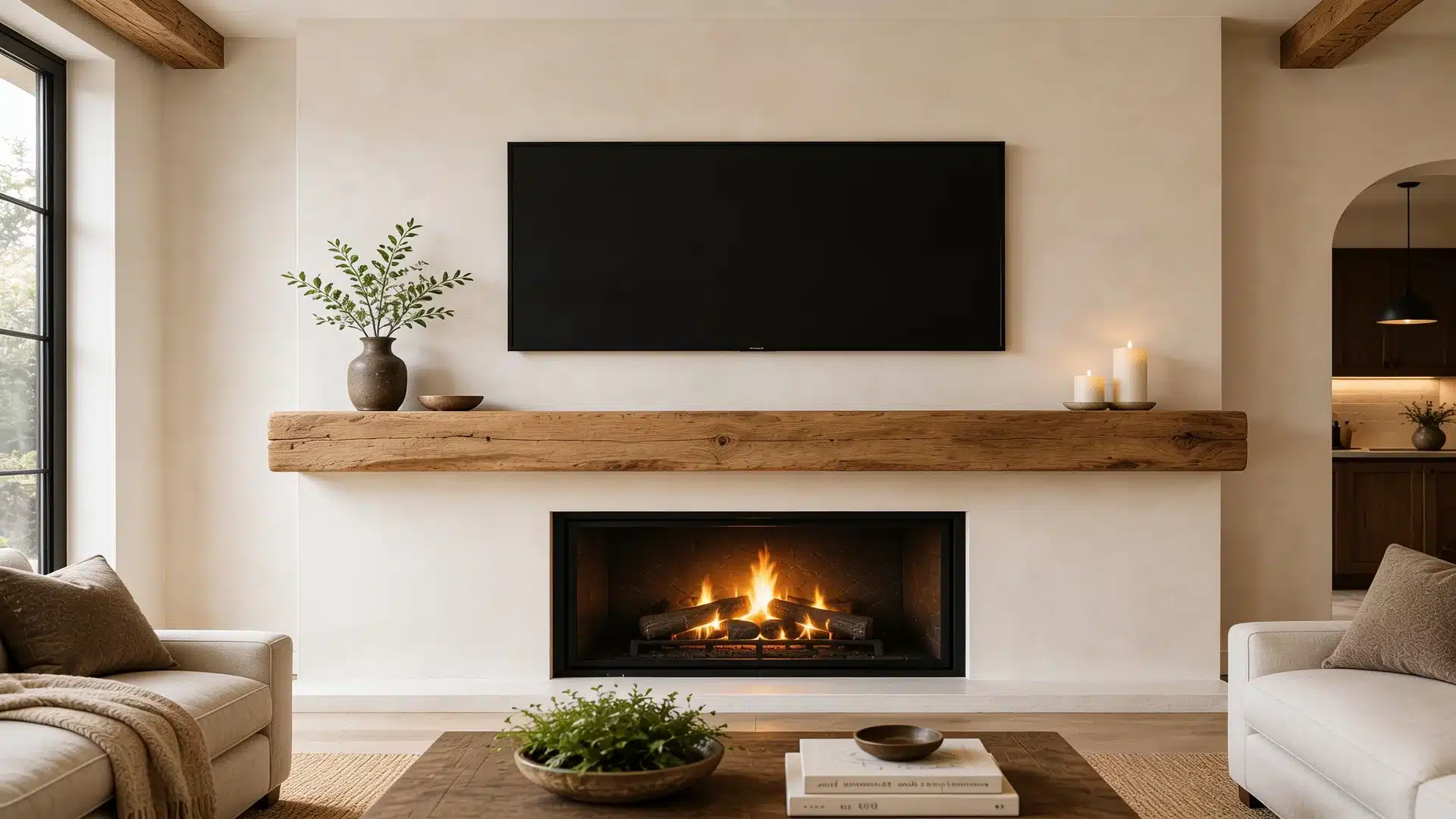
A single chunky beam in oak or elm as the mantel against smooth plaster is one of the more effective material contrasts available in residential design.
The beam does what a traditional molded mantel does: draws the eye to a horizontal line at mid-wall, but it does it with raw material rather than finish carpentry.
The TV needs enough clearance above the beam to avoid looking stacked directly on top of it.
14. Barnwood Shiplap Wall with Sliding Barn Door TV Cover
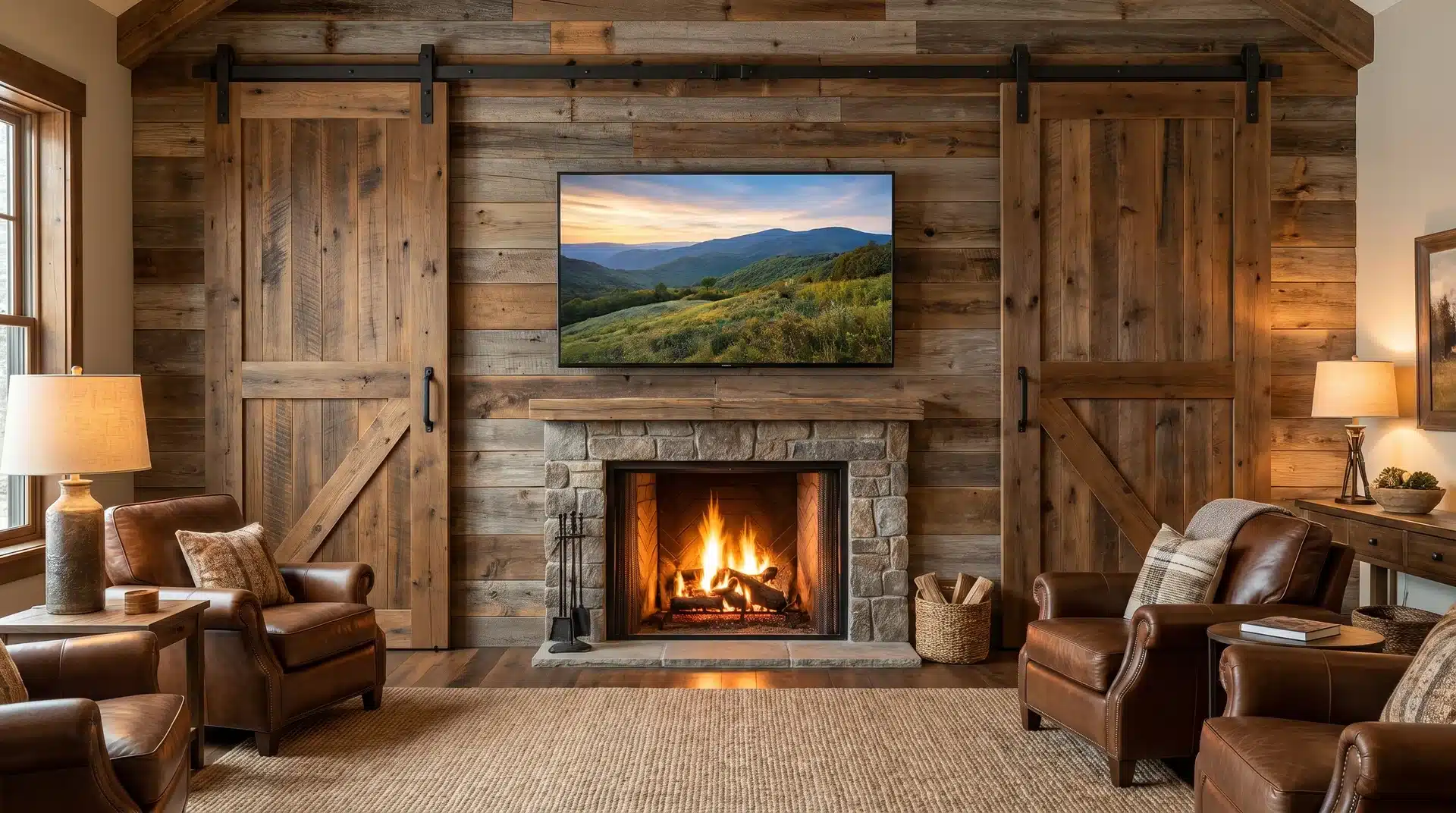
This is the idea that comes up in conversation all the time but rarely gets shown with enough detail to be actually useful. Barn doors hung on a track above the fireplace opening slide out to cover the TV when it’s not in use.
Close them to create a styled wall; open them to view. The doors can be finished in barnwood, painted, or even upholstered.
Two things to plan for before starting: the wall needs enough horizontal space on either side of the TV for the doors to slide clear, and the track and hardware need to be installed into solid framing, not just drywall.
This is a professional install if you want it to feel solid.
15. Bifold Cabinet Doors Flanking the Fireplace
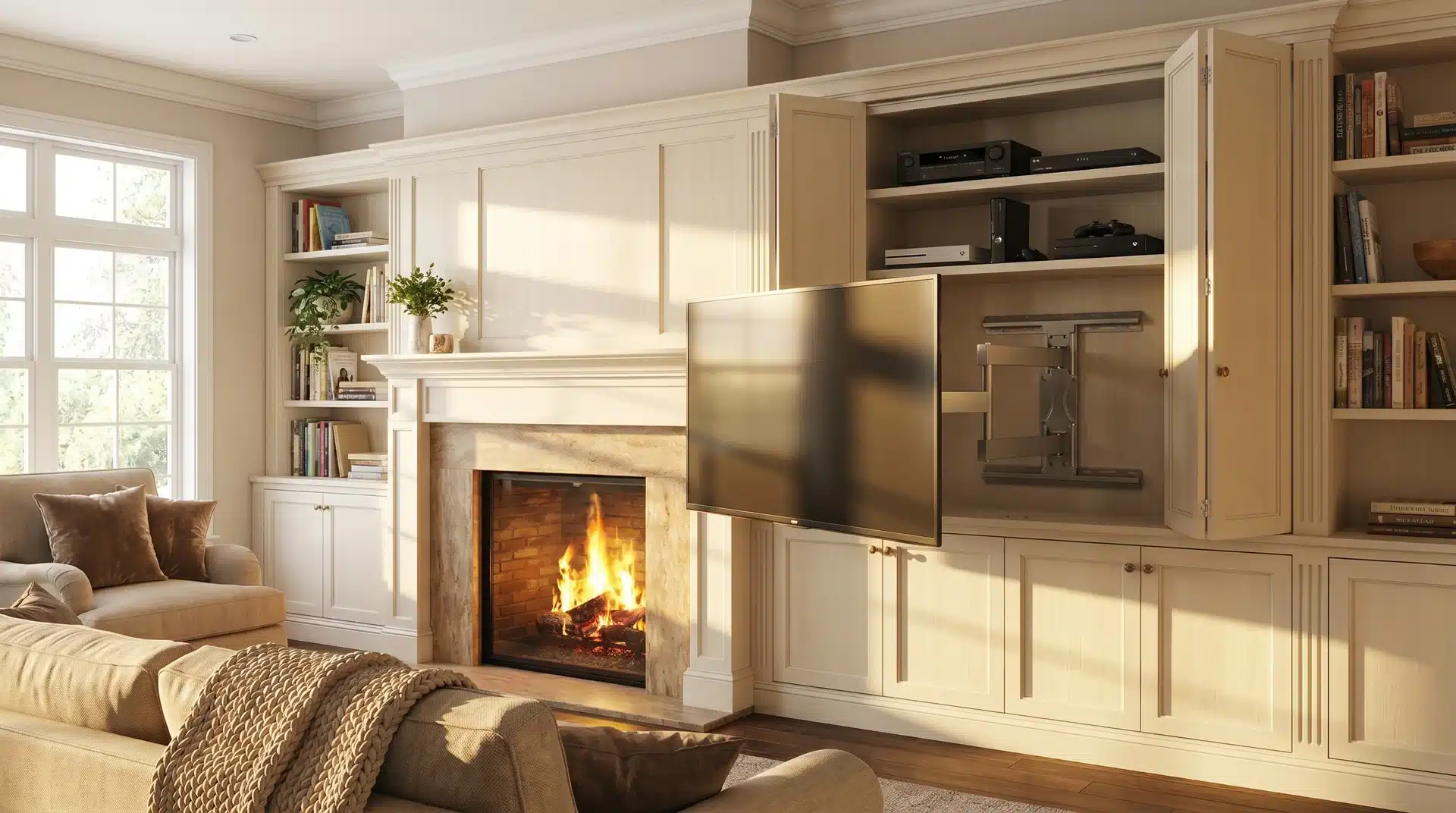
Custom-built cabinets on either side of the fireplace, with the TV housed in one section behind bifold doors, provide full media storage and a room that looks like it has no screens when the doors are closed.
The TV sits on a pull-out swivel mount inside the cabinet so it can angle toward the seating when open.
The cabinet faces can be painted to match the room, paneled to match existing built-ins, or faced in the same material as the chimney breast for a fully integrated look.
How to Style the Mantel when a TV is Above it
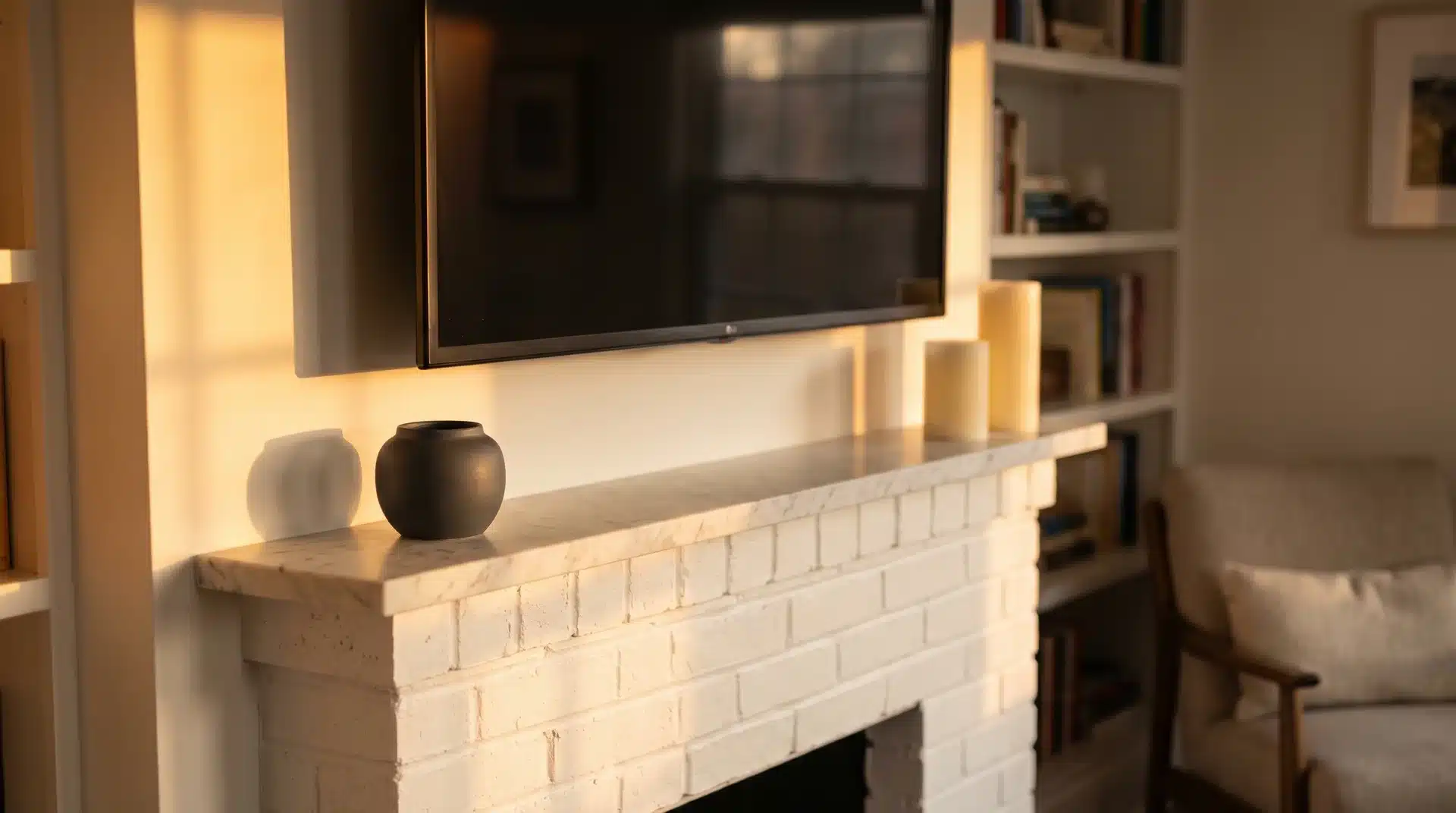
The mantel doesn’t stop being useful just because there’s a screen above it. What changes is the logic of how you use it.
The practical rule: keep objects low. Anything tall on the mantel will visually merge with the TV frame, making the whole wall look cluttered. Candles, small stacked books, a low vessel, a flat piece of stone or ceramic.
Objects that sit at roughly half the mantel’s depth rather than reaching up toward the screen. Symmetry tends to work better here than asymmetry.
When the TV is off, the eye needs something to land on at the mantel level, and a balanced arrangement gives it that without competing with the screen. When the TV is on, nobody’s looking at the mantel anyway.
One thing I’ve come to appreciate about this setup: because the TV visually dominates the wall, the mantel becomes a space for seasonal personality that you can change out every few months without touching anything on the wall.
That’s actually a better styling cadence than most mantels get in rooms without TVs above them.
What to avoid: mirrors, framed photos, and anything with a reflective surface at mantel level. Glare from the screen will hit those objects, and the room will look busier than it is.
What Size TV Works Best Above a Fireplace?
The two-thirds-to-seven-eighths rule applies to width proportions. For viewing distance, there’s a simple formula that holds up reasonably well: divide the TV’s diagonal measurement in inches by 0.84 to get the recommended minimum viewing distance in inches.
| TV size (diagonal) | Min. viewing distance |
|---|---|
| 43 inches | 51 inches (4.3 ft) |
| 55 inches | 65 inches (5.4 ft) |
| 65 inches | 77 inches (6.4 ft) |
| 75 inches | 89 inches (7.4 ft) |
Going too large is the more common mistake. A 75-inch TV above a standard fireplace in a 12-foot-deep room starts to fill the wall, eliminating the fireplace as a separate element. The whole point of combining these two things is that both should remain visible.
Conclusion
The room you live in every day is not a showroom. What works in a photo doesn’t always work at 9 pm on a Tuesday when the fire is on and someone’s watching a film from the sofa.
Lead with the practical questions first: fireplace type, viewing distance, what you want the wall to look like when it’s off.
The hidden TV ideas in this list are the right starting point for anyone who wants the screen to disappear when not in use.
The built-in and architectural approaches work better for rooms where the TV is on most evenings, and the goal is to make it look like it belongs there. Pick the approach that fits the room you actually live in.
Frequently Asked Questions
What Type of Mount is Best for a TV above a Fireplace?
A pull-down mount like the MantelMount is the strongest option. It drops the screen to eye level for viewing and retracts when not in use, solving the height problem without structural changes.
Will Smoke from a Wood-Burning Fireplace Damage a TV Above it?
Yes, Over Time. Even with Proper Ventilation, Smoke and fine particulates from wood-burning fireplaces can coat internal TV components and reduce their lifespan. Gas or Electric Fireplaces Carry Far Less Risk.
Does Mounting a TV Above a Fireplace Affect Its Resale Value?
A Well-Executed Integrated Media Wall can increase a Home’s Appeal. However, a Poorly Mounted Tv with Visible Cabling or a Mismatched Surround can Work Against a Room’s Perceived Value During a Sale.
Can You Mount a TV Above a Fireplace on a Solid Masonry Wall?
Yes, but you cannot route cables internally through solid masonry. The standard workaround is to use external conduit painted to match the wall surface, or to route cables through a cavity beside the fireplace instead.