

Buying a house should feel exciting; one phrase in your contract can cause real stress: vacant possession.
In short, the seller must hand over the property completely empty. No tenants. No leftover furniture and no one with a legal right to stay.
This term shows up in almost every UK property sale. Yet many buyers only learn what it means after a problem appears.
Maybe a tenant refuses to leave, or the seller forgot to remove old furniture.
This guide breaks down vacant possession in easy terms, and You’ll learn what it looks like in real life, why it matters, and how.
What Does Vacant Possession Mean?
Vacant possession means a property is handed over empty, with no tenants, no personal belongings, and no legal claims standing in the way.
The buyer or new occupier gets full and immediate use of the property from the moment of completion.
In simple terms, vacant possession requires three things:
- No people: The seller, tenants, squatters, lodgers, or anyone else with no legal right to remain must be gone.
- No belongings: Furniture, rubbish, and personal items not included in the sale must be cleared out.
- No legal impediment: Any tenancy, license, or third-party claim to the property must be properly ended.
This obligation applies to most UK property sales by default. Unless a contract clearly states the sale is subject to an existing tenancy, buyers can expect vacant possession as standard.
The concept also applies beyond house sales. It comes up when a lease ends, when land changes hands, and even in commercial property deals.
Wherever occupation transfers from one party to another, vacant possession usually applies.
What Does Vacant Possession Actually Look Like?

Vacant possession looks like an empty property, handed over with full access and no one else’s belongings inside. Legal definitions can feel dry, so real examples make this easier to picture.
When Vacant Possession Works
The de minimis rule allows small, low-value items to be left behind. A garden hose, a tin of paint, or a forgotten doormat won’t usually count as a breach.
Courts look at whether an item stops the buyer from properly using the property, not whether the house is spotless.
Here’s an example: Sarah buys a three-bedroom house, and on completion day, the previous owners have fully moved out.
Their furniture is gone; the keys, garage remote, and alarm code have all been handed over.
Sarah notices a garden hose left coiled by the back door and a half-used tin of paint in the shed. Neither item stops her from moving in.
Under the de minimis rule, these small leftovers don’t count as a breach.
Sarah walks in and starts living there the same day; that’s vacant possession working the way it should.
When Vacant Possession Fails
A license to occupy is different from a formal lease, but it still counts under vacant possession rules.
Someone living in a property under an informal arrangement, even without a written tenancy, can still block the buyer’s right to possession.
Case law confirms this. In Beard v Porter (1948), the court held that a person occupying under a valid license constitutes a breach, just as a formal tenant would.
For example, James buys a flat, and on moving day, the previous tenant is still living there. Boxes fill the hallway, and the tenant has no plans to leave that week.
The tenant never signed a formal lease. But under the license-to-occupy principle, this doesn’t matter.
Their continued presence still blocks James’s legal right to the property.
This is a clear failure to give vacant possession. James cannot occupy or use his own flat, and he now has grounds to delay completion or pursue damages for the breach.
Why Vacant Possession Matters in Property Transactions
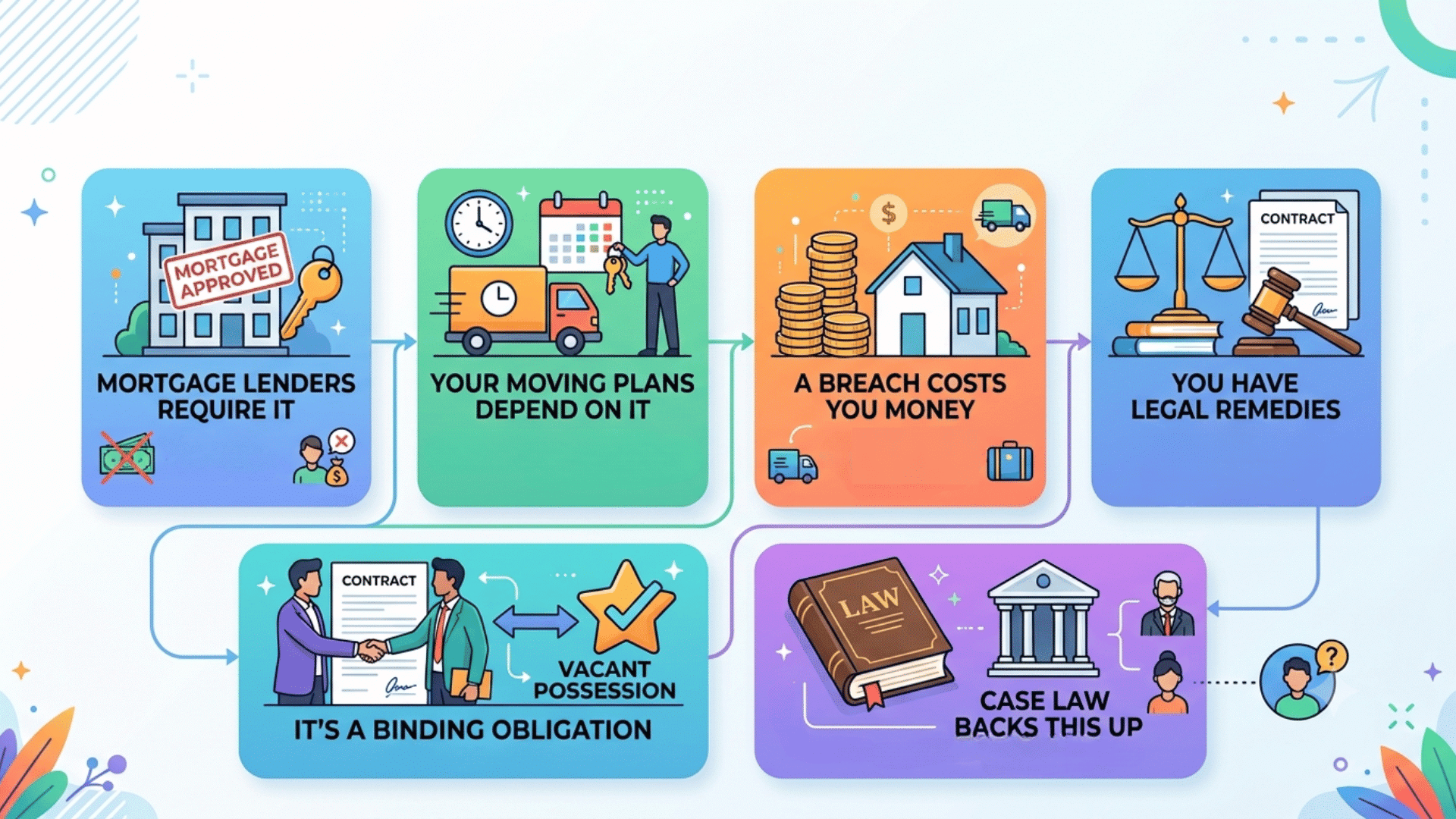
Vacant possession determines whether a buyer can actually use the property they just paid for, and a breach can turn a straightforward purchase into a legal and financial headache.
- Mortgage lenders require it: Most residential lenders won’t release funds if tenants or squatters remain in the property.
- Your moving plans depend on it: Removal vans, renovation start dates, school terms, and job start dates all hinge on a fixed completion date.
- A breach costs you money: You could face extra storage costs, temporary accommodation, and removal costs paid twice.
- You have legal remedies: You can delay completion, rescind the contract and reclaim your deposit, apply for specific performance, or claim damages.
- It’s a binding obligation, not a suggestion: Once a contract states vacant possession will be given, the seller carries real legal responsibility to deliver it.
- Case law backs this up: In Beard v Porter (1948), the court confirmed that even a person occupying under a valid tenancy or license at completion counts as a breach.
When Is Vacant Possession Required?
Vacant possession is required whenever a contract says so, either directly or by default. Most standard property sales automatically fall into this category.
1. Residential property sale: Almost always requires vacant possession. Buyers expect to move in without dealing with someone else’s tenant or belongings. If a contract doesn’t mention tenancy at all, the default assumption is that vacant possession applies.
2. Lease endings: It also triggers this requirement. When a commercial or residential lease ends, the tenant must give vacant possession back to the landlord. This means removing all people, belongings, and fittings that aren’t part of the property itself.
3. Landlords selling with vacant possession face a specific legal route in England: Since the Renters’ Rights Act 2025 abolished Section 21 “no-fault” evictions from May 2026, a landlord who wants to sell a tenanted property with vacant possession must use Ground 1A under the Housing Act 1988 instead. This mandatory ground requires at least 4 months’ notice and can’t be used until the tenancy has run for 12 months.
4. Auction sales: They often specify vacant possession clearly in the listing, since buyers need certainty before bidding.
Vacant possession is generally not required in these cases:
- The property is being sold with tenants in place, and the contract states this clearly
- A sitting tenant has statutory rights that survive the sale
- Both parties agree in writing that possession will transfer later
Vacant Possession vs Property Sold With Tenants in Place
These two situations lead to very different outcomes for a buyer. Here’s how they compare side by side.
| Factor | Vacant Possession | Sold With Tenants in Place |
|---|---|---|
| Who occupies the property at completion? | No one. Fully empty | The existing tenant remains |
| When the buyer can move in | Immediately | Only after the tenancy ends |
| Buyer’s control over the property | Full and immediate | Limited by tenant’s rights |
| Rental income | None until the buyer lets it out. | Buyer may inherit rent from day one. |
| Legal complexity | Lower | Higher, due to tenancy law |
| Best suited for | Owner-occupiers, buyers wanting quick move-in | Investors seeking rental income |
| Mortgage approval | Usually straightforward | Some lenders apply stricter rules |
| Price impact | Often sells closer to market value | May sell at a discount |
Buying with vacant possession suits someone who wants to live in the property right away.
Buying with tenants in place suits an investor who wants rental income from day one, without a void period.
What Happens If Vacant Possession Is Not Provided?
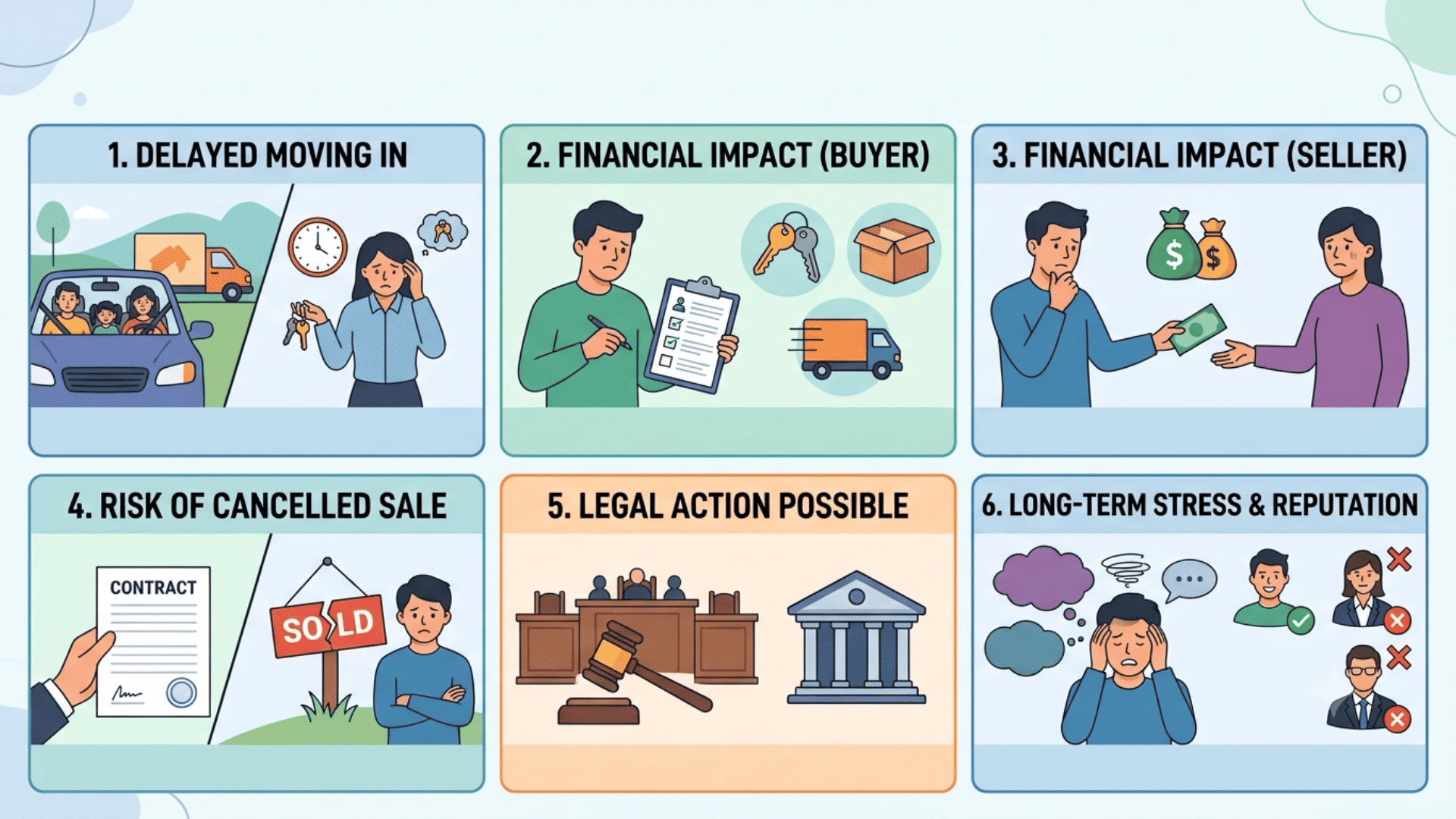
A failure to provide vacant possession affects both parties differently. Buyers often face immediate disruption, while sellers may incur financial losses and legal consequences.
| Aspect | For the Buyer | For the Seller |
|---|---|---|
| Immediate Problem | Cannot move into the property; removal vans may sit idle | Faces immediate financial and legal liability |
| Financial Impact | May pay for temporary accommodation, storage, and double removal costs | May owe damages for the buyer’s additional expenses |
| If the Issue Continues | Can delay completion or rescind the contract | May lose the sale and have to relist the property |
| Legal Options | Can seek specific performance or claim damages | May face court proceedings, especially in commercial transactions |
| Long-Term Impact | Disrupted moving plans and added stress | Reputational damage with estate agents, solicitors, and future buyers |
How Buyers Can Check Vacant Possession Before Completion
Buyers shouldn’t wait until moving day to find out something has gone wrong. A few checks make a real difference.
- Read the contract wording carefully.
- Ask your solicitor to confirm tenancy status.
- Arrange a pre-completion inspection.
- Request written confirmation of removal.
- Check for signs of ongoing occupation.
A short delay to confirm these details is far cheaper than a dispute after completion.
Common Misunderstandings About Vacant Possession
Several myths about vacant possession catch buyers off guard. Clearing these up early avoids confusion later.
1. Leaving a few items behind is always a breach.
Courts generally allow minor, low-value clutter under the de minimis rule. The real test is whether the items stop the buyer from properly using the property.
2. Vacant possession only applies to house sales.
It also applies to lease endings, commercial property, and even auction sales. Any transaction involving a transfer of occupation can include this requirement.
3. A tenant with an informal agreement doesn’t count.
Even someone without a formal lease can block vacant possession if they have a valid license to occupy. Case law confirms this applies regardless of how informal the arrangement seems.
4. The buyer must accept the property in whatever condition it is in.
Buyers have real legal remedies if vacant possession isn’t given. They are not required to simply accept a delayed or incomplete handover.
5. Vacant possession and an empty-looking property are the same thing.
A property can look empty but still have legal occupiers, active tenancies, or unresolved third-party rights. Appearance alone isn’t proof.
Conclusion
Vacant possession simply means the property is empty, cleared, and ready for the buyer to use straight away. No tenants. No leftover belongings. No legal claims standing in the way.
Getting this wrong can cost buyers time, money, and stress. That’s why contract wording deserves a close read, not a quick skim.
Before you exchange contracts, always confirm whether the sale includes vacant possession or is subject to an existing tenancy.
Ask your solicitor directly, get it in writing, and check again as completion approaches. A few minutes of caution now can save weeks of hassle later.
Frequently Asked Questions FAQs
Can the Seller Stay in The Property After Completion?
No. Staying without a separate written license constitutes a breach of vacant possession, even if the buyer initially agrees informally.
Does Vacant Possession Apply to New-Build Homes?
Yes. New-build homes must be handed over empty and ready to occupy on the legal completion date, just like resale properties.
Do Cash Buyers Still Need Vacant Possession?
Usually, yes. Vacant possession remains the standard expectation, though cash buyers have more room to negotiate flexible move-in terms.
Does the Seller’s Address Registration Affect Vacant Possession?
No. What matters is physical occupation and legal rights, not where the seller’s post or registration still lists them.