
Mortgage costs have risen sharply in recent years. UK homeowners are searching for smarter ways to reduce interest without locking away their savings. An offset mortgage offers exactly that solution.
Your savings link directly to your home loan. Your lender then charges interest only on the difference between the two balances. Your money stays fully accessible whenever you need it.
This post covers what an offset mortgage is and how it works, step by step. You will find the types available, the real pros and cons, and a worked UK savings example.
It also covers FSCS savings protection, break-even thresholds, and a clear verdict on who this product suits. If you want to know whether an offset mortgage could lower your interest bill, start here.
What Is an Offset Mortgage?
An offset mortgage is a home loan linked to one or more savings accounts. Your lender charges interest only on the difference between the two balances. Your savings are not locked in. You can withdraw them at any time. The more you keep saved, the less interest you will pay.
Say you have a £200,000 mortgage. You hold £30,000 in a linked savings account. Your lender charges interest on £170,000, not the full £200,000. That gap adds up significantly over a 25-year term.
Your linked savings account earns no interest in this arrangement. The benefit comes instead as reduced mortgage interest. For higher-rate taxpayers, this is more tax-efficient. Savings interest is taxable income in the UK. The savings on mortgage interest are not.
Offset mortgages are a mainstream product in the UK and Australia. They are not available in the US. The Financial Conduct Authority’s Mortgage Lending and Administration Return recorded 830,000 offset mortgages in the UK in December 2022, representing 7% of all UK mortgages. For independent guidance on how offset products are regulated in the UK, MoneyHelper is a useful starting point.
If you want to understand how current UK rates affect your monthly mortgage cost, our breakdown of what a higher-rate mortgage costs each month walks through the payment figures in detail.
How an Offset Mortgage Works
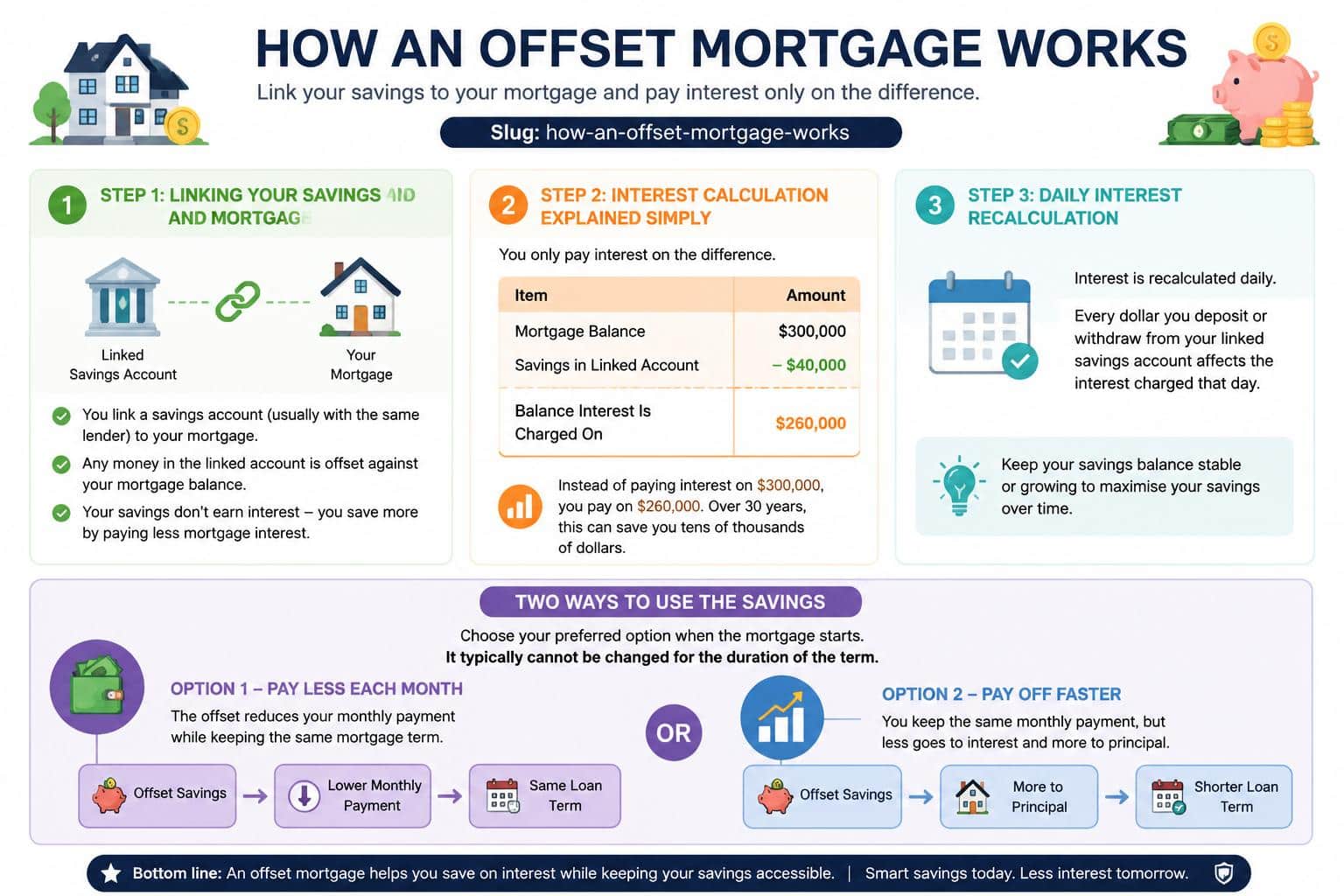
Each pound in your linked savings account reduces the mortgage balance your lender uses to calculate interest. The calculation runs daily at most lenders. Deposits lower your interest cost that same day. Withdrawals increase it. The result is a direct connection between your saving habits and your monthly mortgage cost.
Step 1: Link Your Savings Account
When you set up the mortgage, you open a linked savings account with the same lender. Any money you deposit there reduces your mortgage balance for interest purposes right away.
The linked account is usually a standard savings account held at the same bank or building society. Some lenders let you connect multiple accounts. In a family offset arrangement, a parent or grandparent can also link their own savings. More on this in the types section below.
Step 2: How the Interest Calculation Works
The maths behind an offset mortgage is simple. Your lender subtracts your linked savings from your mortgage balance. Interest is charged only on the remaining amount. Nothing more, nothing less.
| Item | Amount |
|---|---|
| Mortgage balance | £200,000 |
| Savings in a linked account | £30,000 |
| Balance interest is charged on | £170,000 |
At a rate of 4.5%, saving interest on £30,000 saves you £1,350 in year one. Over a 25-year term, that saving compounds as your balance grows or holds steady.
Lenders typically run this calculation daily. The average daily balance in your savings account is what counts. A steady, high balance delivers far more benefit than a fluctuating one.
Step 3: Choose Your Outcome
When you first set up the mortgage, you pick one of two options. You can lower your monthly payment or keep it the same and pay off the loan faster.
- Lower monthly payments: The offset reduces you monthly payments. Your loan term stays the same.
- Shorter loan term: You keep payments the same. More of each payment goes toward the principal. You clear the debt sooner.
You pick your preferred option at the start. It typically cannot be changed during the fixed-rate term.
Types of Offset Mortgages
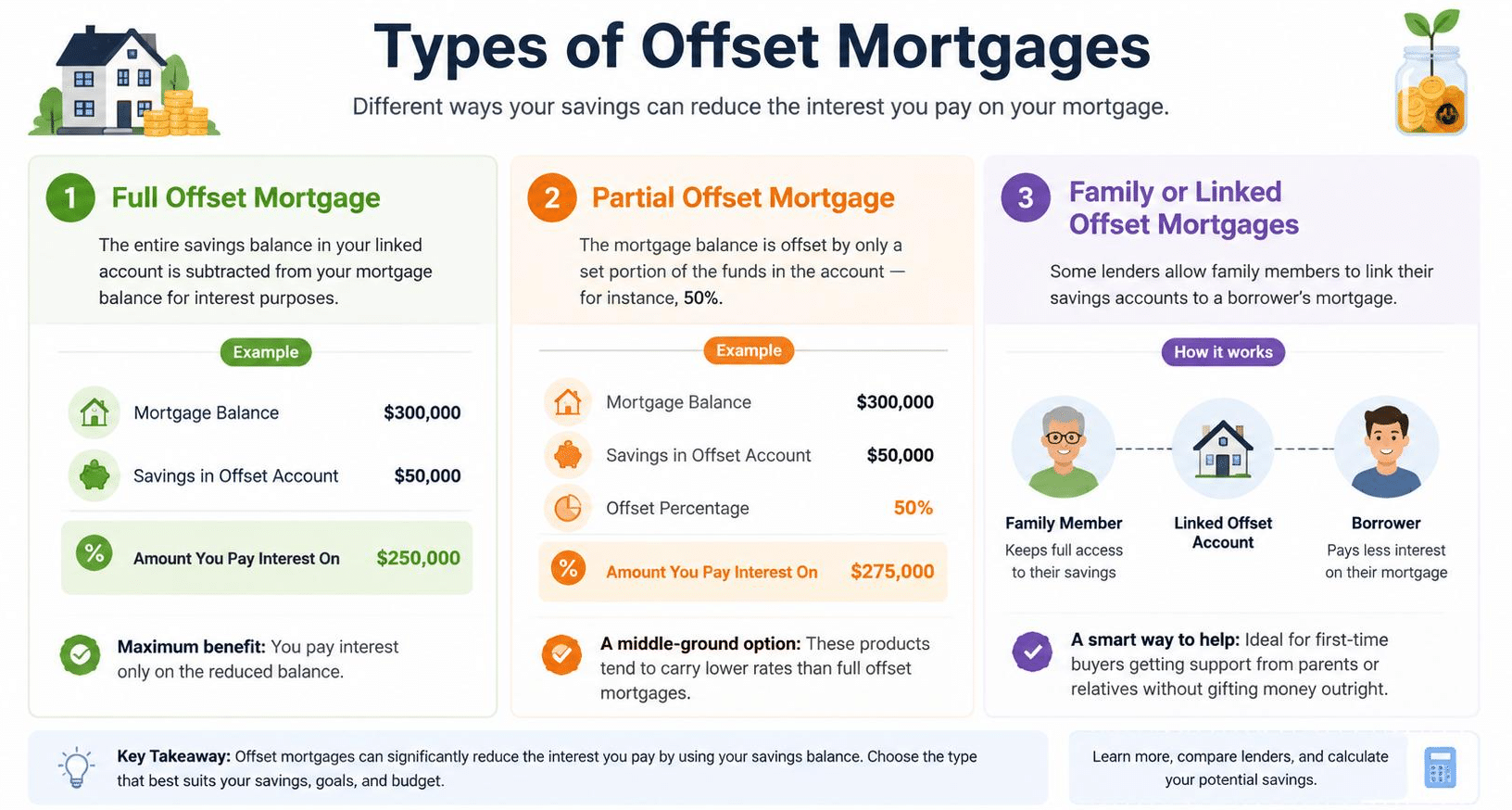
Not all offset deals work the same way. The amount of savings that counts toward reducing interest varies by product type. Who can link their accounts also varies. There are three main types to know. Understanding the differences helps you choose the deal that fits your savings level and situation.
1. Full Offset Mortgage
The entire savings balance offsets your mortgage. If you have £50,000 saved and owe £300,000, you pay interest on £250,000. This type delivers the maximum possible reduction in interest costs.
This is the most common type in the UK. It works best when you hold a consistently high savings balance relative to your mortgage.
2. Partial Offset Mortgage
Only a set percentage of your savings offsets the mortgage. On a 50% deal with £30,000 saved, only £15,000 reduces your balance. Partial offset products often carry lower headline rates.
These products can work for borrowers who do not maintain a large savings balance. The lower rate may reduce the benefit gap. Always run the numbers against your specific figures before you decide.
3. Family or Linked Offset Mortgages
A parent or grandparent links their savings to your mortgage. Their money reduces your interest cost. They keep full access to their funds and can withdraw them at any point.
This is sometimes called the Bank of Mum and Dad offset. It helps first-time buyers reduce interest costs without a gift or an ownership transfer. The family member’s money stays in their account at all times. If they need it back, they can withdraw it.
It works particularly well when a parent holds a large sum in a low-interest account. Their savings do more work linked to your mortgage than they would in a standard savings product.
Offset Mortgages Pros and Cons
Every mortgage product has trade-offs. An offset mortgage reduces your interest bill and keeps your savings fully accessible at all times. But it also comes with a higher headline rate and a need for financial discipline. Here is an honest look at what you gain and what you give up.
The main advantages:
- Lower interest payments: Your savings reduce the principal on which interest is charged. With £40,000 in savings on a £250,000 mortgage, you pay interest on £210,000.
- Full access to savings: You can withdraw funds at any time with no penalties. Your savings act as both an emergency fund and an interest-reduction tool.
- Tax efficiency: Your linked savings earn no interest, so no savings tax applies. The UK personal savings allowance drops to £500 per year for higher-rate taxpayers. A consistent offset protects you from breaching that limit.
- Faster repayment: If you keep payments the same while offsetting, more goes toward the principal each month. Your loan term shortens over time.
- Family support option: Relatives can link their savings to help you without transferring money outright.
The main limitations:
- Higher headline rate: Offset deals cost more than standard mortgages. UK two-year fixed offset deals are currently priced at around 5%, while standard two-year fixed deals sit near 4.7% (SPF Private Clients, 2024).
- No savings interest earned: Your linked savings generate no explicit return in your account.
- Requires discipline: Frequent withdrawals lower your average daily balance and shrink the benefit.
- Limited lender choice: Fewer UK lenders offer offset products than standard repayment mortgages.
- Opportunity cost: Money in the offset earns nothing. The same sum in a cash ISA or high-yield account might earn more, depending on current rates.
How Much Can You Save with an Offset Mortgage?
Your total saving depends on four key factors: the size of your savings relative to the mortgage, how stable your balance stays over time, the rate gap between offset and standard products, and how long you hold the loan. A worked UK example makes this clearer than any general rule.
| Scenario | Mortgage | Savings | Rate | Interest Saved (5 years) |
|---|---|---|---|---|
| SPF Private Clients estimate | £250,000 | £50,000 | 4.85% | £12,052 |
| 20% savings ratio | £200,000 | £40,000 | 4.5% | ~£9,000 |
| 10% savings ratio | £200,000 | £20,000 | 4.5% | ~£4,500 |
A 20% savings-to-loan ratio delivers roughly twice the savings of a 10% ratio on the same loan. The higher your balance relative to the mortgage, the greater the benefit.
David Hollingworth of L&C Mortgages notes that offset mortgages work well for borrowers who hold 5% to 10% of their mortgage balance in savings, or those who receive regular large bonuses but may need access to those funds later. Below 5%, a standard deal at a lower rate often costs less overall.
Pro tip: Route your monthly salary into your linked savings account. Even if you spend most of it during the month, the higher daily average balance reduces your interest. The savings are small each day but add up significantly over the year.
Is an Offset Mortgage Worth It? The Break-Even Point
An offset mortgage carries a higher headline rate than a standard repayment deal. That rate premium is the price you pay for the flexibility and interest savings the product provides. The benefit only outweighs the total cost once your savings balance is consistently large enough to make a real difference.
Here is how to check the maths for your situation:
- Work out the annual cost of the rate premium (e.g., 0.3% extra on a £200,000 mortgage = £600 per year).
- Work out the annual interest saving from your offset (e.g. 4.5% on a £30,000 savings balance = £1,350).
- If the savings exceed the premium cost, the offset deal works in your favor.
The offset starts to make clear financial sense when savings consistently cover 15% to 20% of the loan balance. Below that level, a standard deal at a lower rate may cost less over the term.
Higher-rate taxpayers reach this break-even point faster. Their savings interest would be taxed above the £500 personal savings allowance. The offset removes that tax liability entirely, thereby increasing the effective savings.
What Happens to Your Savings If Your Lender Fails?
This is a question offset borrowers rarely ask until it is too late to act. Your savings in a linked offset account are not protected the same way as a standard savings deposit. The answer depends on how your lender structures the offset account. There are two types to know.
Type 1 Offset Account (separate Savings Account)
Your savings sit in a separate account, linked but held independently. If your lender fails, the Financial Services Compensation Scheme (FSCS) covers your savings up to £120,000 per eligible person, per authorized firm.
This limit rose from £85,000 to £120,000 on 1 December 2025. Any savings above that limit would be applied to your remaining mortgage balance instead.
Type 2 Offset Account (combined Account)
Your savings and mortgage are held as a single combined facility, operated like a large overdraft. If your lender fails, your savings may not receive separate FSCS protection. They reduce the mortgage debt, with no separate payout to you.
Before you commit to any offset product, ask your lender specifically whether your linked savings are held as a separate deposit account or merged into the mortgage facility.
For current FSCS protection rules and limits, visit fscs.org.uk directly.
Offset Mortgage vs Standard Mortgage
A standard repayment mortgage and an offset mortgage are not directly comparable on headline rate alone. To get the true cost picture, you need to factor in your savings balance, the rate premium, and your current tax position. This comparison table sets out the key structural differences between the two.
| Feature | Offset Mortgage | Standard Repayment Mortgage |
|---|---|---|
| Interest calculation | On mortgage minus linked savings | On full loan balance |
| Savings access | Fully accessible at any time | Savings held separately |
| Savings interest earned | None (benefit is lower mortgage interest) | Earned and taxable |
| Headline rate | Usually slightly higher | Usually lower |
| Flexibility | High | Medium |
| Lender choice | Fewer lenders | Widely available |
| Best suited to | High savers, higher-rate taxpayers | Borrowers focused on the lowest rate |
An offset mortgage is not automatically cheaper. Its value depends entirely on whether the benefit of your savings outweighs the premium on the rate, given your actual balance and tax position.
One more factor to consider: using your savings as a larger deposit may cut your loan-to-value (LTV) ratio below 60% or 75%. That LTV reduction can give you access to a lower standard rate that entirely beats the offset benefit. Compare both routes before you decide.
Offset Mortgage vs Overpaying Your Mortgage
Overpaying your mortgage and using an offset account both reduce the interest you pay over time. The key difference is access. Overpayments are permanent. Once you make them, that money sits in the loan, and you cannot easily recover it. An offset keeps your savings fully liquid at all times.
- Overpaying reduces the principal permanently. Saves interest immediately and in a guaranteed way. No access to the money later. Best for borrowers with no foreseeable need for the funds.
- Offset: Reduces interest as long as savings stay in the account. Fully accessible. Best for borrowers who want to reduce interest costs without giving up cash access.
If your income has seasonal swings, or your business may need a cash injection at short notice, the offset structure suits you better. If your income is stable and you are unlikely to need access to the savings, overpaying can deliver a better guaranteed result.
For more on managing mortgage costs through your property equity, our guide to releasing equity through remortgaging covers the available options.
Real-Life Example Scenario
This is a concrete illustration of how an offset mortgage can play out:
Borrower Profile:
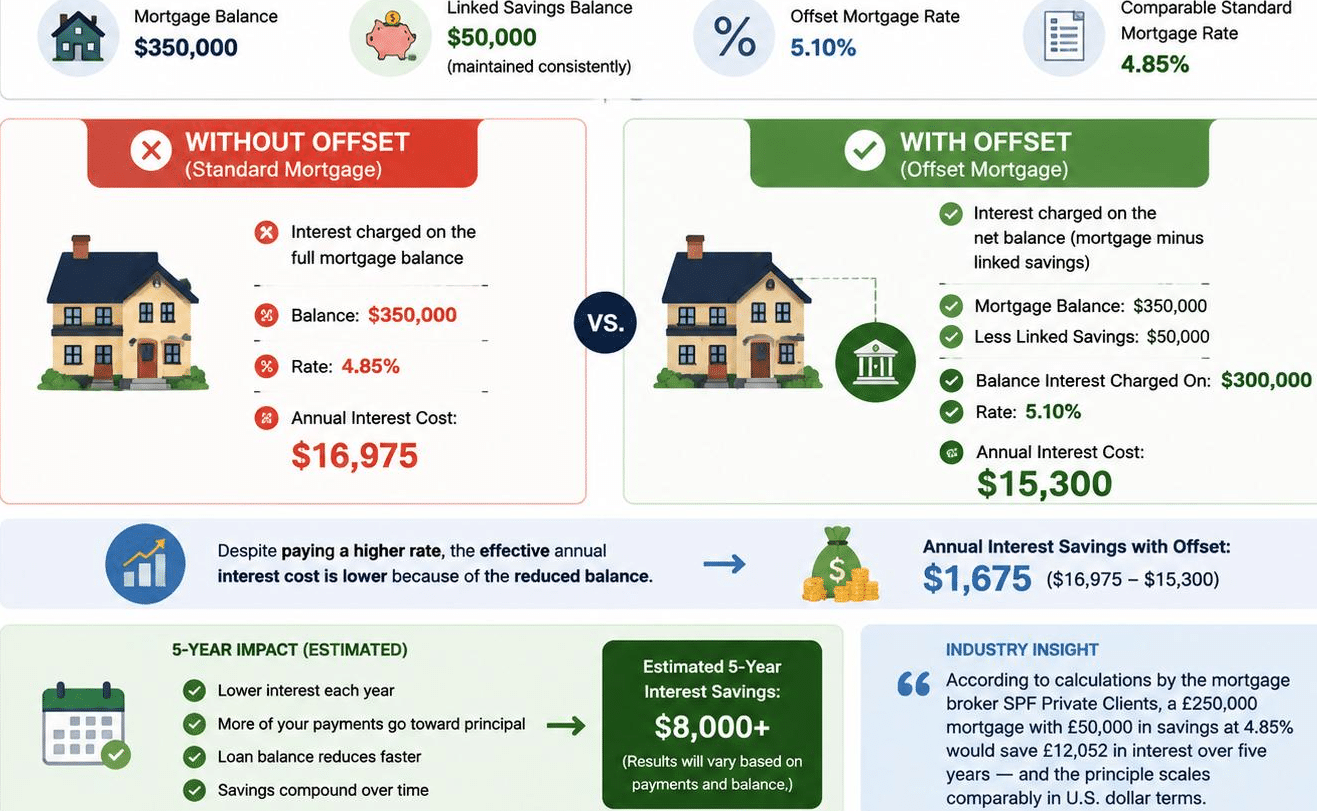
- Mortgage Balance: $350,000
- Linked Savings Balance: $50,000 (maintained consistently)
- Offset Mortgage Rate: 5.1%
- Comparable Standard Mortgage Rate: 4.85%
Without Offset: Interest is charged on the full $350,000 at 4.85% annual interest, approximately $16,975.
With Offset: Interest is charged on $300,000 at 5.1% annual interest, approximately $15,300.
Despite paying a higher rate, the effective annual interest cost is lower because of the reduced balance. Over five years, the savings compound further as the principal is paid down faster.
According to calculations by the mortgage broker SPF Private Clients, a £250,000 mortgage with £50,000 in savings at 4.85% would save £12,052 in interest over five years, and the principal scales comparably in U.S. dollar terms.
Disclaimer: This article is for informational purposes only. It does not constitute financial or mortgage advice. Always consult a qualified mortgage adviser or independent financial professional before making any borrowing decisions. FSCS protection limits are subject to change. Visit fscs.org.uk for the most current figures and eligibility rules.
Conclusion
An offset mortgage is not right for every borrower. For the right person, it is one of the most flexible options in the UK mortgage market. It reduces your interest bill, keeps your savings accessible, and shortens the time it takes you to clear your home loan.
The key question is whether your savings are large enough to outweigh the higher rate. For higher-rate taxpayers and strong savers in the UK, the answer is often yes.
Before you commit, compare a real offset mortgage deal against a standard mortgage using your actual savings figures. A fee-only mortgage broker can model this comparison for your specific situation.
If you are planning to purchase a property in the UK, getting this calculation right could save you many thousands.
Frequently Asked Questions
Is an Offset Mortgage a Good Idea for First-Time Buyers?
It can be, particularly if a family member links their savings. Without that support, first-time buyers rarely hold enough savings to outweigh the higher rate on their own.
How Much Can You Save with An Offset Mortgage?
Offset accounts are an excellent way to reduce your mortgage interest, but they often come with higher interest rates, ongoing account fees, minimum balance requirements, and limited flexibility.
How Much Money Should I Keep in An Offset Account?
Make sure the balance in your offset never exceeds the balance on your home loan. If you do, you won’t get any benefit from the excess, and it would be better to transfer that to a standard high-interest savings account.
What Happens at The End of An Offset Mortgage?
At the end of an offset mortgage, if your savings match or exceed your balance, interest drops to zero. Your repayments then go fully toward the principal, speeding up repayment.