
If you have spent months researching mortgage rates, saving for a deposit, and comparing lenders, you are already more prepared than most.
Then you sit down at your solicitor’s desk, get handed a two-page document you have never seen before, and sign it without a second glance.
That document is the mortgage deed.
And in my experience, it is the one piece of property paperwork that receives the least attention but carries some of the biggest legal consequences.
Before you get to that table, you need to know what this document actually does, what it contains, and what to look out for.
That is exactly what this post covers.
What Is a Mortgage Deed?
A mortgage deed is a legally binding contract between you and your lender that formally secures your home loan against your property.
The moment it is signed, witnessed, and registered, your lender holds a legal charge over your home.
That legal charge means one thing plainly: if you stop making repayments, the lender has the right to repossess the property and sell it to recover the outstanding debt.
This is not a threat or a technicality tucked away in the small print. It is the entire purpose of the document.
A mortgage deed must be signed by the borrower, witnessed by an independent adult, and registered with HM Land Registry before it becomes legally enforceable.
Without proper registration, the lender’s ability to act on a default is legally limited.
What Does a Mortgage Deed Contain?
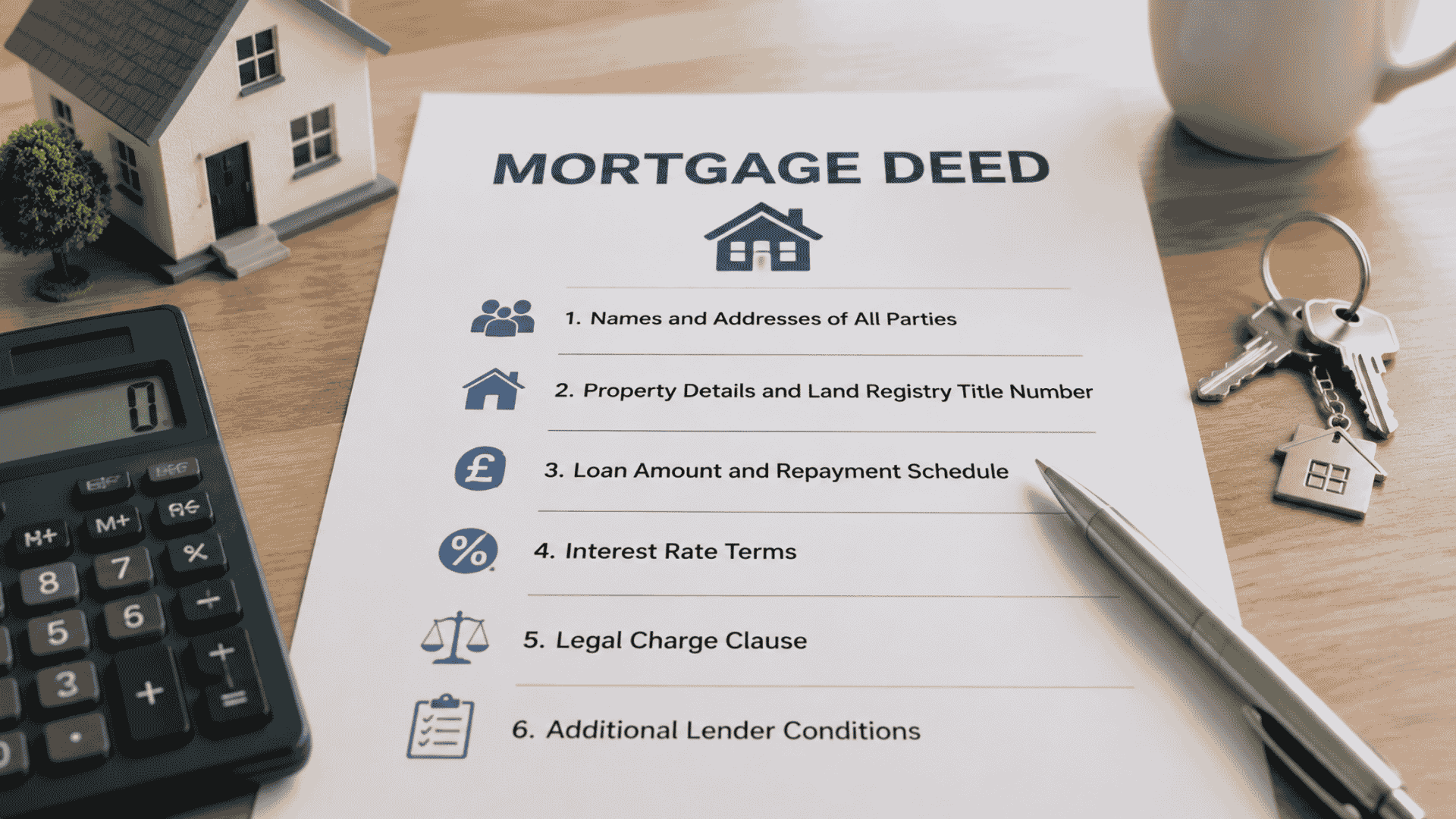
The document follows a standard structure, though individual lenders may include specific clauses alongside the standard terms.
Before signing, your solicitor should walk you through each section in plain language.
Here is what you will find inside:
1. Names and Addresses of All Parties
- The deed identifies you as the mortgagor and your lender as the mortgagee
- Joint mortgage applicants are all named individually on the deed
- Any misspelling in a name or address must be corrected before signing
- The lender’s registered business address is also recorded for legal reference
2. Property Details and Land Registry Title Number
- The full address of the property being purchased is stated clearly
- A unique Land Registry title number is assigned to identify the property
- An error in the title number can result in the charge being registered to the wrong address
- Your solicitor cross-checks this against the official title register before submission
3. Loan Amount and Repayment Schedule
- The total amount borrowed from the lender is set out in full
- The repayment term, typically 25 or 30 years, is confirmed in this section
- Monthly installment figures are referenced or linked to the mortgage conditions document
- These figures must match your formal mortgage offer exactly before you sign
4. Interest Rate Terms
- Your current interest rate is recorded, whether fixed or variable
- The end date of any introductory rate period is noted
- The deed may also state the rate your mortgage reverts to after the initial period
- Any future rate changes are governed by the conditions attached to the deed
5. Legal Charge Clause
- This clause grants the lender a legal right over your property as security for the loan
- It authorizes the lender to take possession of and sell the property if repayments are not met
- The charge is registered at HM Land Registry and becomes a matter of public record
- This section is sometimes referred to simply as the legal charge itself
6. Additional Lender Conditions
- Some lenders include restrictions on subletting or making structural alterations to the property
- Obligations around maintaining building insurance are often written into this section
- Conditions vary between lenders and are not always flagged prominently in the document
- Your solicitor should explain any clause here that goes beyond the standard terms
How a Mortgage Deed Works from Start to Finish

The process is more straightforward than it sounds, but the sequence matters.
Once your lender has assessed your application and issued a formal mortgage offer, your solicitor will receive the mortgage deed as part of the conveyancing pack.
They review it, prepare a summary report for you, and send both documents for your attention.
Signing usually happens a few days before the exchange of contracts.
At that point, you are close to the legal point of no return, so reading the deed carefully before this stage is important.
You sign it in front of an independent witness, who must be an adult and cannot be anyone named on the deed or an immediate family member.
The signed deed goes back to your solicitor, who submits it to HM Land Registry.
Once registered, the lender’s charge appears on your property’s title register, and recording the deed becomes part of the permanent public record.
What Does a House Deed Look Like?
Understanding the mortgage deed is one part of the picture. The other is knowing what a house deed looks like and how it sits alongside the mortgage deed in property transactions.
A house deed, also known as a title deed or property deed, is the document that records legal ownership of a property.
Where the mortgage deed records the lender’s charge, the house deed records your name as the registered owner at HM Land Registry.
Both exist on the same title register but serve entirely different functions.
If you are going through the home-buying process and want to understand the difference between what you own and what you owe, knowing what a house deed looks like, along with this post, will give you a much clearer picture.
Mortgage Deed vs Deed of Trust: The Difference that Matters
This distinction often comes up when buyers are researching property law across the UK and US markets, and it is worth clarifying.
A mortgage deed involves two parties: you and the lender. If you default, the lender pursues repossession through court proceedings, which is a slower, judicial process in most cases.
A deed of trust involves three parties: you, the lender, and a third-party trustee.
| Feature | Mortgage Deed | Deed of Trust |
|---|---|---|
| Parties involved | Two (borrower + lender) | Three (borrower + lender + trustee) |
| Title held by | Lender | Trustee |
| Foreclosure process | Usually judicial | Usually non-judicial |
| Process speed | Slower | Faster |
| Borrower’s response time | More | Less |
| Common in | UK, some US states | Western US states |
In the UK, mortgage deeds are the standard instrument used by all regulated lenders.
Deeds of trust are not used in UK residential property transactions.
Mortgage Deed, Title Deed, and Mortgage Offer: The Difference
These three terms get mixed up more often than they should, and the confusion can cause real problems during the buying process. Here is how they differ.
Mortgage Deed
- Secures your home loan against the property and gives the lender a legal charge.
- Created at the point you take out a mortgage and registered at HM Land Registry.
- Makes the entire borrowing arrangement legally binding
Title Deed
- Proof that you own the property, with your name recorded on the land register.
- Has no connection to the loan itself.
- The mortgage creates a charge on the title, but both documents remain separate.
Mortgage Offer
- A letter from the lender confirming their willingness to lend under specific conditions.
- A statement of intent only, not a legal charge.
- You can walk away at this stage without any legal consequences.
Think of it this way: the mortgage offer is the proposal, the mortgage deed is the commitment, and the title deed is proof of ownership.
Types of Mortgage Deeds You Should Know
Not all mortgage deeds are structured identically. The type depends on the nature of the mortgage and the legal system in your country.
| Type | How It Works | Possession | Common Use |
|---|---|---|---|
| Simple Mortgage Deed | Borrower pledges property as security without giving up physical possession | Borrower retains possession | Residential mortgages |
| English Mortgage Deed | Ownership transfers conditionally to the lender and reverts automatically once the loan is fully repaid | Lender holds conditionally | UK residential and commercial |
| Usufructuary Mortgage Deed | Lender takes possession and collects rental income or property profits instead of charging interest | Lender takes possession | Commercial arrangements |
| Equitable Mortgage Deed | Borrower deposits title documents with the lender as informal security without formal registration | Borrower retains possession | Largely avoided in modern transactions |
Who Holds the Mortgage Deed?
You do not get to keep it. Not yet.
The lender retains the original mortgage deed for The entire duration of The mortgage.
It is their legal evidence that you have pledged the property as security for The loan.
You can request a copy from your solicitor or lender at any time, and a record is also available through HM Land Registry.
When the mortgage is fully repaid, the lender initiates the removal of The legal charge from your title register.
This is done by submitting a DS1 form to the HM Land Registry, which formally discharges the mortgage.
Red Flags to Check Before You Sign
It is easy to focus on the interest rate and miss the detail that actually matters in the deed itself.
Based on my work with first-time buyers, these are the things worth reviewing closely.
- Names and figures: Confirm your name, property address, and loan amount match the mortgage offer exactly.
- Witness requirements: The witness must be an independent adult not named on The deed. An incorrectly witnessed signature can make the deed legally invalid.
- Additional lender clauses: Ask your solicitor to explain any clauses beyond the standard terms. Some include restrictions on subletting or alterations.
- Title number accuracy: The land registry title number must be correct. An error here could mean the charge is recorded against the wrong property.
- Any discrepancy with the mortgage offer: If any terms differ from what you were quoted, do not sign until you have an explanation in writing.
Conclusion
A mortgage deed is one of The most consequential documents you will sign in your lifetime, and it deserves more than A quick glance.
It determines your lender’s legal rights over your home from The day you borrow to The day you make your final payment.
Understanding what a mortgage deed contains, what happens when you sign it, who holds it, and what happens once the loan is cleared gives you a firmer footing in what can be an overwhelming process.
Read it carefully, ask your solicitor the right questions, and do not sign until you are satisfied with every detail.
That is not overcaution. That is just how you protect yourself.
Frequently asked questions
Does a Deed Mean You Own the Property?
Yes. A deed is the legal document that transfers property ownership from a seller to a buyer.
Is a Deed Stronger than A Will?
Yes, a valid deed generally overrides a will. Because a deed transfers immediate ownership of the property, the asset is no longer part of the deceased’s estate.
How Does a Mortgage Deed Affect Property Ownership?
The person or people listed on the recorded deed hold the title to the house. If you have a mortgage, the lender holds a lien, which gives them a financial interest, not ownership, of the property.
Can You Sign a Mortgage Deed Digitally in the UK?
Yes. HM Land Registry’s “Sign Your Mortgage Deed” service lets you sign digitally using GOV.UK One Login, though not all lenders support it yet.
Do You Need a Solicitor to Sign a Mortgage Deed?
Technically no, but your lender will require a solicitor or licensed conveyancer to handle the deed, verify your identity, and submit it to Land Registry.