

Ever wondered what that important document proving you own your home actually looks like? In other words, what does a house deed look like when you finally receive it?
You’re not alone. Many homeowners have never seen their house deed or don’t know what to look for when they do.
A house deed is more than just a piece of paper. It’s your legal proof of ownership and contains specific details that protect your property rights.
Understanding the format of these documents can help you avoid costly mistakes and identify potential issues.
This guide will walk you through everything you need to know about house deeds. This includes their physical appearance, key components, different types, and how to properly handle them.
By the end, you’ll know exactly what to expect when you see your deed.
What Is a House Deed?
A house deed is a legal document that transfers ownership of real property from one person to another. This written contract serves as official proof that you own your home and the land it sits on.
The deed creates a permanent record of property ownership that gets filed with your local government office. Unlike a mortgage, which shows you owe money on the property, a deed shows you actually own it.
Basic Purpose of House Deeds
- Transfer ownership from the seller to the buyer during property sales — the deed transfer step.
- Provide legal proof of who owns the property
- Create public records that anyone can access and verify
The deed becomes your most important property document. Banks require it for mortgages. Insurance companies need it for coverage. Government offices use it for taxes and legal matters.
Deed vs. Title
Many confuse deeds and titles, but they differ. A deed is tangible proof and a historical record of a property’s ownership changes. Put simply, the deed is the paper instrument and the title is the ownership right.
Think of it this way, like the deed is like a car’s registration paper, while the title is your actual right to own and drive that car.
What Does a House Deed Look Like?
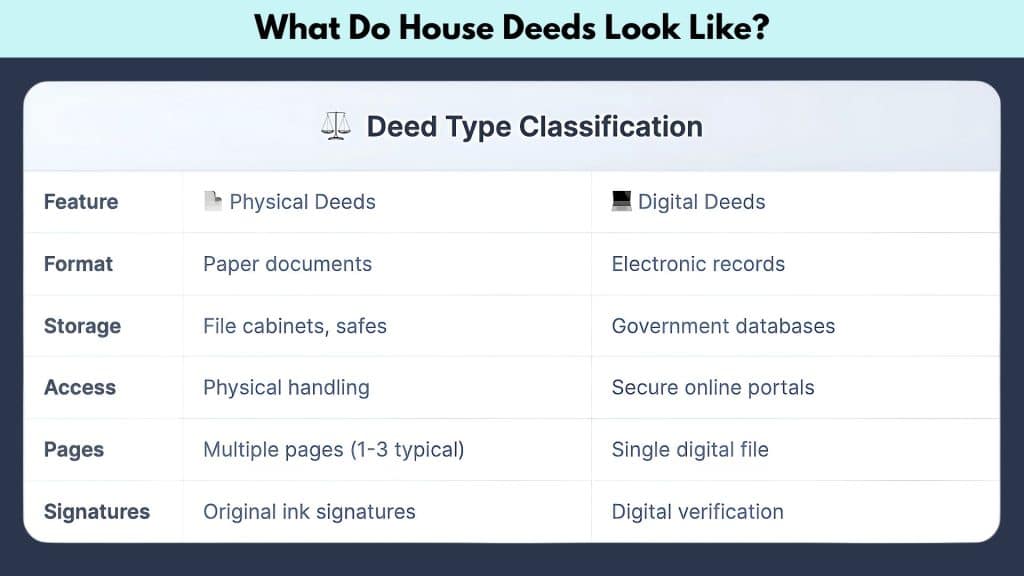
There’s no single universal template for a deed. It varies by state and sometimes by county. That said, most deeds share a recognizable structure.
Older properties often come with a physical paper document, sometimes bundled with prior deeds going back decades.
Newer properties are increasingly handled through county digital systems, so your “deed” may be a scanned file stored in a government database rather than a physical paper you hold in your hand.
Both versions contain the same legal information. The format doesn’t change what the deed means.
What an Authentic Deed Looks Like
If you’re looking at a deed and want to confirm it’s the real thing, here’s what to check:
- Recorder’s stamp: an official stamp or seal from the county recorder’s office, usually in a corner or across the top
- Book and page numbers (or a document number) showing where it’s filed in public records
- Filing date: the date the transfer was officially recorded
- Notary seal and information: the notary’s name, county, commission expiration date, and signature
- Clean formatting: consistent font, proper margins, no handwritten alterations
Fake or fraudulent deeds often have irregular fonts, missing notary details, no filing stamp, or vague property descriptions. If something looks off, it’s worth verifying directly with your county recorder’s office.
Key Components of A House Deed
Every house deed contains essential elements that make it legally valid and enforceable. These components work together to create a complete record of property ownership transfer.
Grantor and Grantee Information: Full legal names and addresses of both seller (grantor) and buyer (grantee), exactly as they appear on official identification documents.
Property Description: Detailed legal boundaries, lot numbers, survey measurements, and street address that precisely identify the specific property being transferred between parties.
Consideration Amount: Purchase price or value exchanged for the property, sometimes listed as nominal amounts like $1 to maintain privacy about actual transaction details.
Signature Requirements: Original signatures from all parties in the presence of witnesses, with notarization required to make the document legally binding and recordable.
Recording Information: County recorder stamps, file numbers, and official recording dates that prove government registration and create permanent public property records for registered properties.
Legal Warranties: Promises made by the seller about property title status, offering varying levels of protection against hidden liens, disputes, or title defects.
|
A Note on the Legal Property Description This is the section most people skip. Don’t. The legal description is not your mailing address. It’s the technical identification of the land itself, used to locate and define the exact boundaries of your property. Depending on where you live, it might reference a subdivision plat (“Lot 14, Block 3 of Riverside Estates”), use metes and bounds measurements (“commencing at an iron pin, N 45° E, 125 feet to a point…”), or cite the rectangular survey system used across most of the western US. If a neighbor ever disputes a fence line or easement, this section, not your address, is what gets read in court. It’s worth knowing what yours says. |
Types of House Deeds
Different types of deeds offer varying levels of protection and warranties to property buyers during ownership transfers.
1. Warranty Deed
A warranty deed provides the highest level of protection for property buyers. The grantor guarantees a clear title and promises to defend against any future claims.
This deed type includes comprehensive warranties covering the entire property history. Buyers receive maximum legal protection against title defects, liens, or ownership disputes.
2. Quitclaim Deed
A quitclaim deed transfers only the grantor’s current interest in the property. It provides no warranties or guarantees about a clear title or property condition.
This deed type is commonly used between family members or in divorce settlements. Buyers accept all risks regarding potential title problems or existing liens on the property.
3. Special Warranty Deed
A special warranty deed protects buyers only against title defects during the grantor’s ownership. It does not cover problems that existed before the grantor acquired the property.
This deed offers moderate protection compared to full warranty deeds available. Buyers are protected from the grantor’s actions but not from the previous owners’ issues.
4. Grant Deed
A grant deed implies certain warranties without explicitly stating them in writing. The grantor promises they own the property and haven’t transferred it elsewhere.
This deed type is common in some states for standard property transfers. It provides basic protection while being simpler than comprehensive warranty deed documents.
5. Executor’s Deed
An executor’s deed transfers property from a deceased person’s estate to beneficiaries. The executor acts on behalf of the estate during this transfer process.
What do title deeds look like when issued by executors? They include special language indicating estate authority and probate court approval for the transfer.
How to Obtain Your Property Deed?
Getting your deed at closing is fairly straightforward. The title company or closing attorney prepares it, both parties sign, and you receive a certified copy once it’s recorded.
Most people file it away and forget about it until they need it. If you’ve lost track of yours or never received one, getting a copy of your deed to record it for the future is simpler than most people expect.
- In person at the recorder’s office
- Online through your county’s property records portal. Many counties have digitized their records going back decades
- By mail, though processing times vary
You can request either a certified copy (official, court-admissible, costs more, usually $10 to $25) or a regular copy (fine for personal reference, costs less). If you need it for a legal matter, refinancing, or estate purposes, get the certified version. For just knowing what your deed says, a regular copy works fine.
Processing typically takes 3 to 5 business days for online requests, though some counties are faster.
How to Update Your House Deed?
Several situations require deed changes. When a co-owner passes away, you might need to update ownership details. Refinancing your mortgage also triggers deed modifications since lenders record new liens.
Common reasons for deed updates include
- Death of a co-owner: Surviving owners need a clear title.
- Mortgage refinancing: New lenders require lien documentation.
- Clerical mistakes: Spelling errors or wrong legal descriptions.
- Ownership transfers: Adding or removing names from the deed.
Since deeds are public records, changes often require court approval or at minimum a new deed drawn up by a real estate attorney. Once approved or prepared, you file the updated deed with your county’s Recorder of Deeds office to make the changes official.
Real estate attorneys know the specific deed requirements in your state. Given that errors in deed preparation can create problems down the road when you sell or refinance, professional help is worth the cost.
Can Someone Steal Your House Without You Knowing?
This is the question most deed guides don’t answer. They probably should.
Deed fraud, also called home title theft, is when someone forges ownership documents and files them in public records to make it appear they own your property. Once they’ve done that on paper, they can attempt to sell the home, take out loans against it, or collect rent from it before you notice anything is wrong.
The FBI’s 2023 Internet Crime Report recorded over 9,500 real estate fraud complaints, with losses exceeding $145 million. It’s not common, but it’s real and it’s growing.
The most common targets are properties with significant equity, vacant homes, inherited properties, and homes owned by seniors who may not be closely monitoring their accounts. But any property can be targeted.
Warning signs to watch for:
- Missing mail you’d normally expect: tax bills, mortgage statements, utility notices
- Unfamiliar activity on your credit report, especially new mortgages or liens
- Calls from real estate agents asking about a property you haven’t listed
- Notices addressed to someone else at your address
How to protect yourself:
Most counties offer a free notification service that alerts you by email or mail whenever a document is filed against your property. Sign up for it. It takes five minutes and costs nothing.
Title insurance also covers deed fraud in most cases. If you purchased an owner’s title insurance policy when you bought your home, review what it covers.
Monitoring your county’s online deed records once a year is a reasonable habit. It’s a public record and you can check it yourself.
How to Store and Safeguard Them Properly?
Your deed proves you legally own your home. Losing this important document creates serious problems when you want to sell or refinance your property later.
Proper storage protects your valuable investment. Smart deed management saves you significant time and money when you need access to it most urgently. And beyond storage, it’s worth knowing that deed theft and title fraud can affect even carefully maintained properties, so monitoring matters just as much as safekeeping.
- Store the original in a fireproof safe at home or a bank safety deposit box.
- Make several copies and keep them in different locations.
- Scan your deed and save digital copies to cloud storage.
- Email yourself a copy for quick access when needed.
- Check your stored deed once a year to ensure it remains legible.
- Replace any damaged copies immediately to avoid future issues.
Final Thoughts
A deed is not a document you sign and forget. It’s the foundation of your legal ownership. Like most foundations, you want to actually know it’s solid.
Check that yours is properly recorded. Know what the legal description says. Keep a copy somewhere safe. And sign up for your county’s free property alert service while you’re at it.
Most homeowners never have problems with their deed. But the ones who do usually wish they’d paid more attention earlier.
Frequently Asked Questions
Who Holds the Deed to My House?
The homeowner retains the deed once the house is paid off in full. If you still owe mortgage payments, your lender may hold it.
Which Is More Important, Title or Deed?
Both matter for different reasons. The deed transfers ownership legally. The title shows who owns the property and controls it completely.
What Is the Best Deed for A Married Couple?
Tenancy by the Entirety works best for married couples. This option provides the strongest legal protection for both spouses in most states.