

A father in Ohio signed a quitclaim deed in 2019 to add his daughter to the title of the family home. It took twenty minutes and cost him forty dollars at the county recorder’s office. He thought he had saved her a probate headache.
He had. He also handed her a capital gains bill of roughly $90,000, which she discovered four years later when she sold the house.
Nothing about the deed was invalid. The signature was good, the notary was real, the recording went through on the first try.
The problem was that he picked the instrument that transfers ownership fastest instead of the one that fit what he was actually trying to do.
That is the whole issue with the quitclaim deed vs warranty deed question. Both documents move a property from one name to another. What separates them is everything that happens after.
Key Takeaways
| Question | Quitclaim Deed | Special Warranty Deed | General Warranty Deed |
|---|---|---|---|
| What does the grantor promise? | Nothing about the title | Only that they caused no title problems while they owned it | That the title is clear going all the way back |
| Can the buyer sue if a title defect turns up? | No | Yes, but only for defects from the grantor’s ownership period | Yes, for any defect in the chain |
| Typical use | Divorce, family gifts, trust funding, fixing a name error | Bank-owned sales, commercial deals, estate transfers | Standard residential purchase |
| Will a lender accept it on a purchase loan? | Almost never | Usually, with a title policy | Yes |
| Typical cost | $30 to $250 | Bundled into closing | Bundled into closing |
| Time to prepare | Same day | Days to weeks | Days to weeks |
| Does it remove you from the mortgage? | No | No | No |
If you take one thing from the table: a deed changes who owns the property. It does not change who owes the bank.
What a Quitclaim Deed Actually Transfers
The name is literal. The grantor quits any claim they have to the property and passes that claim to the grantee. If the grantor owns the place free and clear and has proof of property ownership to show it, the grantee gets a clean transfer.
If the grantor owns a disputed one-third interest with a lien attached, the grantee gets a disputed one-third interest with a lien attached.
Two terms show up constantly in this area and are worth pinning down. The grantor is the person giving up the interest. The grantee is the person receiving it. Every deed in American real estate has both.
A quitclaim deed makes no representation that the grantor owns anything at all. I could sign a quitclaim deed on the Brooklyn Bridge tomorrow.
It would be a valid document. It would convey precisely nothing, because I have no interest to convey, and you would have no case against me afterward.
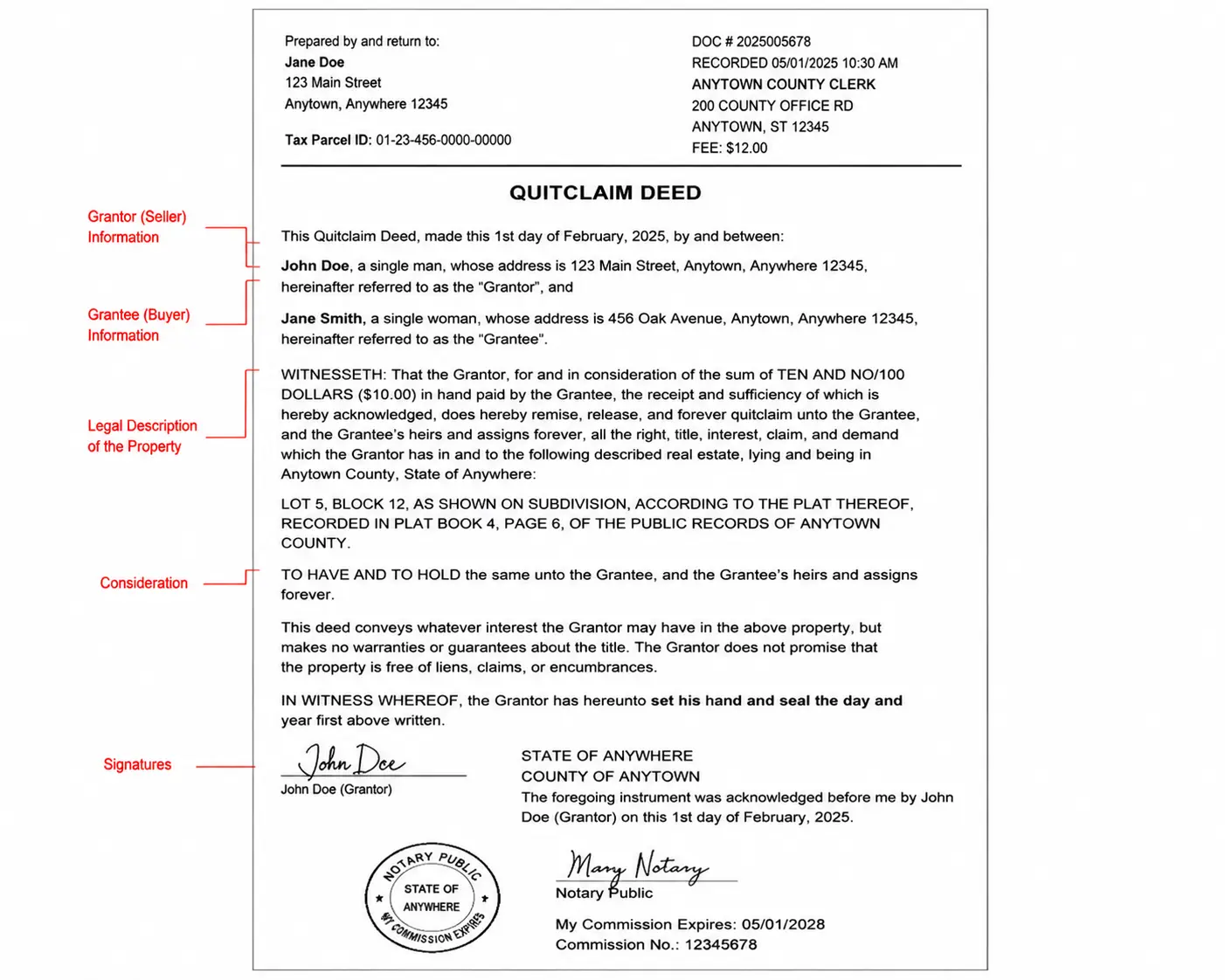
(Illustrative example of a property deed for educational purposes only. All names, addresses, document numbers, and other details shown are hypothetical and created for demonstration purposes. Actual deed formats, wording, and required sections vary by state, county, and jurisdiction.)
Quitclaim deeds get used for:
- Removing a spouse from title after a divorce
- Adding a spouse or partner to title after a marriage
- Gifting property between parents and adult children
- Moving a home into a revocable living trust
- Transferring a rental into an LLC you control
- Correcting a misspelled name or a bad legal description on a deed already on record
Every one of those transfers happens between parties who already know the history of the property. Nobody needs a stranger’s warranty when the grantor and grantee have shared a kitchen for thirty years.
What a Warranty Deed Guarantees
A warranty deed transfers the same interest a quitclaim does. Then it adds legally enforceable promises, called covenants of title.
- Covenant of seisin: The grantor owns the estate they claim to own.
- Covenant of the right to convey: The grantor has legal authority to sell it, which is a separate question from ownership. A trustee may own without authority to sell.
- Covenant against encumbrances: No undisclosed liens, easements, mortgages, or restrictions burden the property.
- Covenant of quiet enjoyment: No third party with a superior claim will show up and evict the grantee.
- Covenant of warranty: If someone does show up with a superior claim, the grantor will defend the grantee and cover the loss.
- Covenant of further assurances: The grantor will sign whatever additional paperwork is needed later to perfect the title.
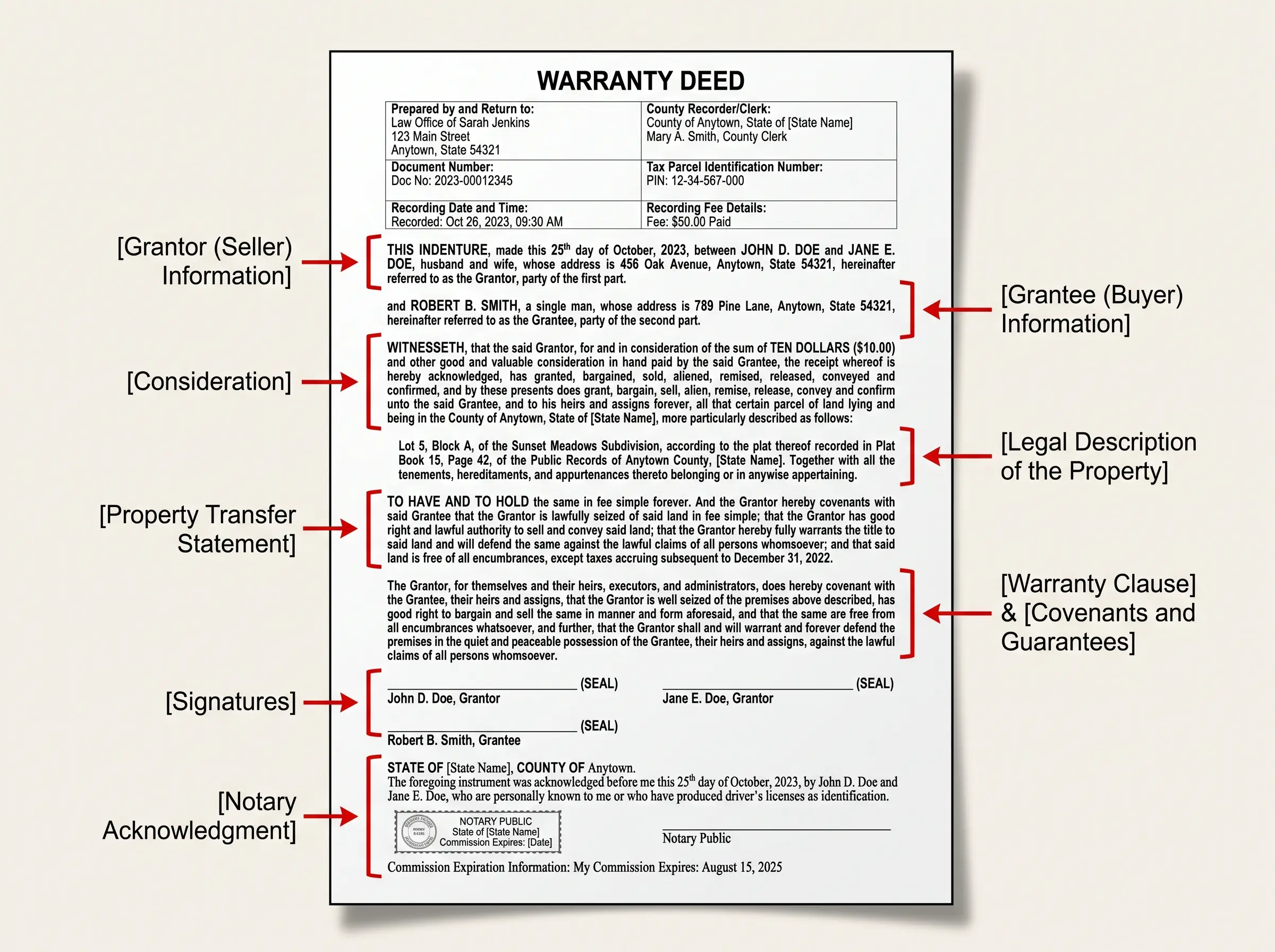
(Illustrative example of a property deed for educational purposes only. All names, addresses, document numbers, and other details shown are hypothetical and created for demonstration purposes. Actual deed formats, wording, and required sections vary by state, county, and jurisdiction.)
The first three apply at the moment of transfer. The last three continue indefinitely. That is why a general warranty deed signed in 1994 can still generate a claim against the grantor’s estate today.
General v/s Special Warranty Deed
A general warranty deed covers the entire recorded history of the property. If a 1963 boundary dispute surfaces, the grantor is on the hook even though they were not born yet.
A special warranty deed, sometimes called a limited warranty deed, covers only the period the grantor held title. Anything predating their ownership is the grantee’s problem.
The special warranty deed vs general warranty deed distinction matters most when you see who uses each. Banks selling foreclosed property use special warranty deeds.
So do estates, corporate sellers, and most commercial parties. They will stand behind their own conduct and nothing else, which is reasonable when a servicer has held a file for eleven months and never set foot on the land.
Treat a special warranty deed as the middle setting. More protection than a quitclaim, less than a general warranty deed, and completely standard in the deals where it appears.
Tax Consequences of Deeds That Cost You the Most Money
Return to the Ohio father. He bought the house in 1988 for $8000. By 2023, it was worth $500,000.
When you give property away during your lifetime, the recipient inherits your original cost basis. Tax code calls this carryover basis. His daughter’s basis became $80,000, not the market value on the day she was added to the deed.
She sold in 2023 and reported a gain of roughly $420,000. She had never lived in the house, so the primary residence exclusion under Section 121 did nothing for her.
Had he left the house to her through his will or a transfer on death deed instead, her basis would have reset to fair market value on the date of death. Same house, same daughter, same sale price, and a taxable gain near zero.
This is the single most expensive mistake in the quitclaim deed vs warranty deed conversation, and it has nothing to do with which deed offers better title protection. It is about timing the transfer.
A few related items belong on your list before you sign anything:
Gift tax filing. A transfer for less than fair market value is a gift. If the amount is above the annual exclusion amount, you owe a Form 709 with your return.
Transfer and documentary stamp taxes. Florida charges documentary stamp tax on deeds. Pennsylvania, Washington, and roughly three dozen other states charge some version of a realty transfer tax. Family transfers are often exempt.
Property tax reassessment. In states with acquisition-value assessment, transferring title can trigger a reassessment that raises the annual tax bill permanently. California’s rules here are famously particular.
Medicaid look-back. If long-term care is a possibility within five years, an uncompensated transfer can create a penalty period during which the person who gave the property away is ineligible for benefits. This one catches a lot of well-meaning families.
None of the above is tax advice for your situation. Run the numbers with a CPA before the deed is signed, because after recording, your options narrow considerably.
Choosing Between Quitclaim Deed and Warranty Deed
When transferring property ownership, choosing between a quitclaim deed and a warranty deed depends on the level of protection, the relationship between the parties, and the purpose of the transfer.
Work through these in order:
- Is money changing hands at market value? Use a warranty deed. There is no serious argument for anything else in an arm’s length sale.
- Is this a gift or a transfer between people with full knowledge of the property? A quitclaim deed is probably fine, subject to the tax section above.
- Is there a mortgage on the property? Stop and call the lender before anything gets drafted.
- Are you buying from a bank, an estate, a receiver, or a corporation? Expect a special warranty deed and plan on an owner’s title policy to cover the gap.
- Are you the seller? Here the calculus flips, which most coverage ignores. A quitclaim deed limits your exposure. Someone selling inherited land they have never visited, or a property they bought at a tax sale, has a legitimate reason to prefer one.
Buyers should understand that a seller pushing for a quitclaim is not necessarily hiding something. They may simply not know the history and refuse to warrant facts they cannot verify.
What Your State Calls It
Terminology shifts across state lines, and the legal weight shifts with it.
The same type of deed may carry slightly different requirements, protections, or interpretations depending on the state where the property is located.
| State or region | Common instrument | Note |
|---|---|---|
| California | Grant deed | Carries two implied covenants, sits between quitclaim and warranty |
| New York | Bargain and sale deed | Available with or without covenants against grantor’s acts |
| Texas | Deed without warranty | Legally distinct from a quitclaim, courts treat the difference as meaningful |
| Washington, Michigan, Minnesota | Statutory warranty deed | Covenants defined by statute rather than written into the document |
| Florida, Georgia, most Southern states | General and special warranty deed | Conventional terminology |
A Texas practitioner will tell you that a quitclaim deed there does not even convey title in the way most people assume, which is exactly why the deed without warranty exists as a separate instrument.
What To Do If You Signed the Wrong Deed?
Recording is not always final. You can still make changes at certain points. Below are the scenarios where you can still make the changes.
Clerical errors: can be corrected with a corrective deed or a scrivener’s affidavit, depending on the state. Misspelled names, a wrong parcel number, a transposed digit in the legal description.
Wrong deed type: can be repaired if the original grantor will cooperate. They sign a new warranty deed covering the same transfer, and it gets recorded on top.
An uncooperative grantor: means a quiet title action in the county where the property sits. Expect several months and legal fees that make the original savings look silly.
Void deeds: are a narrower category. Forgery, fraud in the execution, lack of mental capacity, or a defective notarization can invalidate a deed entirely, though proving it takes litigation.
What These Deeds Cost?
A quitclaim deed prepared from a state-specific form runs thirty to sixty dollars in recording fees plus a notary. Attorney preparation typically lands between one hundred fifty and four hundred, and for anything involving a mortgage, a trust, or more than two parties, that is money well spent.
A warranty deed inside a real transaction is not billed separately. It arrives as part of closing costs alongside the title search, the commitment, the owner’s policy, and settlement fees.
Owner’s policies generally run a few tenths of a percent of the purchase price and last as long as you own the property.
The comparison people make is between forty dollars and two thousand. The comparison that matters is between two thousand and the cost of a quiet title action three years from now.
Deed Fraud and Why Quitclaims Attract It
Title theft schemes almost always use a forged quitclaim deed. The reason is structural. A quitclaim requires no title search, no warranty, no closing agent, and no lender.
A forged signature, a complicit or careless notary, and a recording fee are enough to put a fraudulent transfer into the public record.
Recorders are ministerial offices. They confirm the document meets formatting requirements and collect the fee. They do not verify that the person who signed is who they claim to be.
The usual targets are vacant lots, rental properties with absentee owners, and homes belonging to people who have died or entered care facilities. Anywhere nobody is watching the mail.
Before You Sign Anything
Pull the current recorded deed from your county recorder and read the legal description on it. Whatever you sign next has to match.
If there is a mortgage, call the servicer and ask directly whether your intended transfer triggers the due-on-sale clause.
If the transfer involves a gift, run the basis math with a CPA before you choose between a lifetime transfer and an inheritance. The difference is frequently larger than every other cost in the transaction combined.
Frequent Questions About These Deeds
Why Would Anyone Accept a Quitclaim Deed?
A person may accept a quitclaim deed when they trust the person transferring the property or when the goal is simply to update ownership records.
How Many Names Can Go on a Quitclaim Deed?
A quitclaim deed can include multiple names as grantors or grantees, depending on the ownership transfer. The number of names allowed is usually based on state laws and recording requirements rather than a fixed limit.
Do I Need a Lawyer to Do a Quitclaim Deed?
You do not always need a lawyer to complete a quitclaim deed, but legal advice can help avoid mistakes with ownership rights, taxes, or title issues. Requirements vary by state, so it’s recommended to check local rules before filing.
How Much Does a Lawyer Charge to Do a Quitclaim Deed?
A lawyer typically charges $150 to $500 or more to prepare a quitclaim deed, depending on the state, complexity of the transfer, and whether additional title or property issues need review.
What Is the Strongest Form of Deed?
The strongest form of deed is generally considered a general warranty deed because it provides the highest level of protection to the buyer by guaranteeing clear title and protecting against past and future ownership claims.
References
IRS, Publication 551, Basis of Assets (rev. December 2025) – https://www.irs.gov/pub/irs-pdf/p551.pdf
IRS, Topic No. 703, Basis of Assets – https://www.irs.gov/taxtopics/tc703
IRS, Gifts & Inheritances FAQ – https://www.irs.gov/faqs/interest-dividends-other-types-of-income/gifts-inheritances/gifts-inheritances
IRS, Topic No. 701, Sale of Your Home – https://www.irs.gov/taxtopics/tc701
IRS, Publication 523, Selling Your Home – https://www.irs.gov/publications/p523
This article is for general information only and isn’t a substitute for advice from a licensed attorney in your state. Property law varies by jurisdiction, and the details of your specific transaction can change what applies to you.