
A client of mine once pulled a deed out of a folder at closing, glanced at it for about four seconds, and signed.
Six months later, she called me because a contractor had placed a lien on the property years before she bought it, and she wanted to know why her seller wasn’t on the hook for it.
The answer was sitting in that same document she’d barely looked at. The deed type she’d received only covered problems the seller caused during their own ownership, and this one predated them by a decade.
That folder moment happens to almost everyone buying property. The deed gets treated as paperwork to sign, not information to read.
Key Takeaways
| Point | Detail |
|---|---|
| Deed vs. title | The deed is the physical document. Title is the legal concept of ownership that the deed conveys |
| Not all deeds protect equally | General warranty, special warranty, and quitclaim deeds each cover a different slice of the property’s history |
| The deed tells you your risk | The type of deed you receive determines how much of the property’s past you’re financially exposed to |
| Deeds and loans are separate documents | A deed transfers ownership. A deed of trust or mortgage secures a loan against that ownership. They are not the same thing |
| Requirements are basic but strict | Most states require a deed to be in writing, signed, notarized, and recorded with the county |
| Recording protects priority | Filing your deed with the county doesn’t fix defects in the title. It protects your claim against later competing claims |
What is a Property Deed?
A deed is the legal document that transfers real property from one person (the grantor) to another (the grantee). Real property means land and anything permanently attached to it: a house, a garage, a fence line, a well.
Title and deed are often used interchangeably, but they’re not. Title is the underlying legal right to own the property.
A deed is the paper that transfers that right from one person to the next. Think of title as the fact of ownership and the deed as the evidence of it.
When a title company or an attorney talks about “clear title,” they mean the chain of deeds behind a property has no gaps, no forgeries, and no unresolved claims sitting in it.
What Does a Property Deed Actually Look Like?
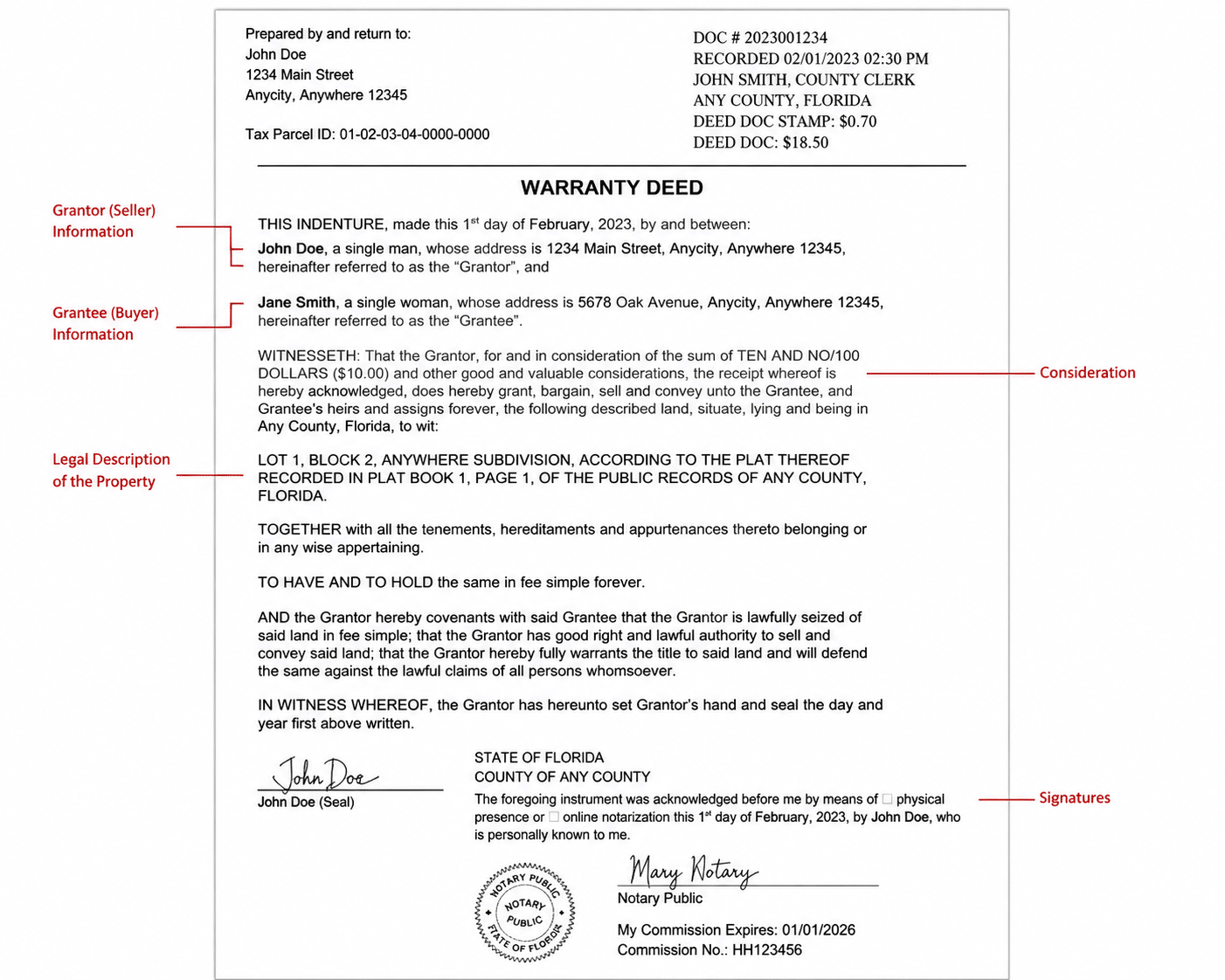
(Illustrative example of a property deed for educational purposes only. All names, addresses, document numbers, and other details shown are hypothetical and created for demonstration purposes. Actual deed formats, wording, and required sections vary by state, county, and jurisdiction.)
Strip away the formatting and every deed contains the same core pieces, whether it was drafted by a $500-an-hour attorney or filled out from a template.
It names the grantor and the grantee. It includes a legal description of the property, which is far more specific than a street address. A legal description might reference lot and block numbers, a recorded plat, or metes and bounds survey coordinates, because a mailing address can change while the underlying parcel description doesn’t.
It includes a conveyance clause, the specific language that legally does the transferring, usually something like “grants, sells, and conveys.”
It states consideration, meaning what was exchanged for the property, even if that’s a token amount when the transfer is a gift. It carries the grantor’s signature and is notarized.
And once it’s filed, it carries a recording stamp from the county clerk or recorder’s office, showing the book and page number, or the digital equivalent, where it now lives in the public record permanently.
What a house deed looks like in practice, laid out on paper, is essentially a short, formal letter: who’s transferring what, to whom, with what promises attached, notarized and stamped as proof it happened.
The Core Deed Types, Ranked by Protection
Three deed types make up the vast majority of residential and commercial transactions, and the difference between them comes down to one question: how far back does the seller’s promise reach?
| Aspect | General Warranty Deed | Special Warranty Deed | Quitclaim Deed |
|---|---|---|---|
| Time period covered | Entire history of the property | Only the grantor’s own ownership | None |
| Protection for buyer | Strongest | Moderate | None |
| Who absorbs older title defects | The grantor | The buyer | The buyer |
| Typical use | Standard residential resale | Foreclosures, estates, commercial deals, entity transfers | Family transfers, divorce, clearing up minor claims |
A general warranty deed is the gold standard for a regular home purchase. The seller stands behind the property’s entire history, even defects that happened decades before they owned it.
A special warranty deed narrows that promise to the seller’s own time holding title, which is why banks selling foreclosed homes and estates selling inherited property use it constantly.
A quitclaim deed promises nothing at all. It transfers whatever interest the grantor happens to have, without confirming that interest is even valid.
The quitclaim deed vs warranty deed distinction trips people up because both sound like formalities until something goes wrong.
A warranty deed gives you someone to hold accountable if a title problem surfaces. A quitclaim deed gives you nothing but the property itself, good title or not.
Which Deed Will You Actually See?
The situation you’re in usually predicts the deed type before anyone hands you paperwork.
Buying a regular home from an individual seller who’s lived there a while, expect a general warranty deed.
Buying a bank-owned or foreclosed property, expect a special warranty deed, because the bank only controlled the property from the foreclosure date forward and can’t vouch for anything earlier.
Receiving property through a divorce settlement or a family transfer where no money changes hands, expect a quitclaim deed.
Buying from an estate after someone has died, expect an executor’s deed, since the person signing never personally owned the property and can’t make promises about its history.
None of these are wrong for their situation. A quitclaim deed handed to a stranger paying market price is a reason to ask questions. The same quitclaim deed between siblings settling an inheritance is completely normal.
Special-Purpose Deeds You Might Run Into
Beyond the three core types, a handful of deeds exist for specific situations rather than standard sales.
A gift deed transfers property without a sale price attached, common between family members. A transfer-on-death deed, sometimes called a ladybird deed depending on the state, lets an owner name who inherits the property automatically at death, skipping probate entirely.
An executor’s deed moves property out of a deceased person’s estate into the hands of an heir or buyer, without the warranties a living seller could offer.
A deed in lieu of foreclosure transfers a struggling borrower’s property directly to their lender, avoiding the formal foreclosure process.
A mineral deed conveys the right to extract oil, gas, or other minerals, separate entirely from who owns the surface land above them.
Each of these solves a specific problem. None of them replace the basic question every deed answers: how much of the property’s history is this transfer actually vouching for?
Deed vs. Deed of Trust vs. Mortgage
This is where the word “deed” starts doing more than one job, and it’s worth untangling because a deed of trust gets confused with a property deed all the time.
A property deed transfers ownership from seller to buyer. A deed of trust, used in some states instead of a traditional mortgage, does something completely different: it puts the property up as security for a loan, with a neutral third party called a trustee holding legal title until the loan is paid off.
A mortgage accomplishes roughly the same goal through a different legal structure, giving the lender a lien against the property rather than routing title through a trustee.
You can own property with a warranty deed in hand and still have a deed of trust or mortgage sitting against it. They’re not competing documents. One says who owns the property. The other says what’s owed against it.
Deed Requirements and Recording
To be legally valid, a deed generally has to be in writing, signed by the grantor, and delivered to and accepted by the grantee.
Oral transfers of real property don’t hold up. Most states also require notarization, and some require witnesses in addition to or instead of a notary.
Recording the deed with the county, usually the recorder’s office, clerk, or land registry depending on where you are, is a separate step from the transfer itself being legally effective.
In many states, ownership technically passes the moment the deed is delivered and accepted. Recording it does something else: it puts the transfer on public notice, protecting your claim if someone else later shows up claiming an interest in the same property.
Skipping this step doesn’t undo your ownership, but it leaves you exposed if a dispute ever comes down to who filed first.
What Does It Cost to Get or Transfer a Deed?
Costs vary by state and county, but a few pieces show up almost everywhere. Preparing the deed itself, if you’re using an attorney or a title company rather than a template, typically runs somewhere in the low hundreds of dollars.
Notarization is usually a small flat fee. Recording fees charged by the county range widely, often somewhere between $15 and a few hundred dollars, depending on the jurisdiction and the length of the document.
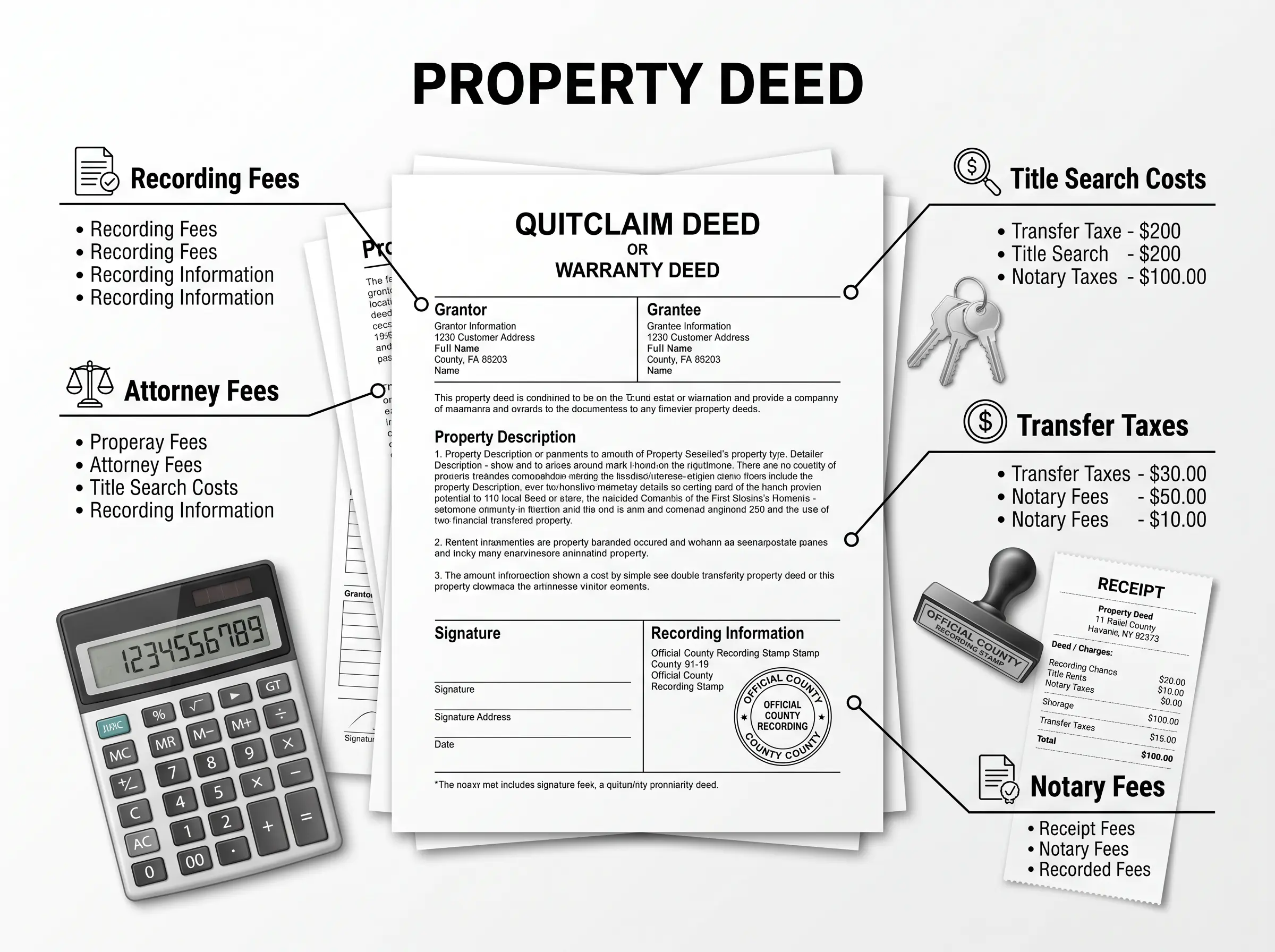
On top of that, some states and localities charge a transfer tax calculated as a percentage of the sale price, which can dwarf the administrative costs entirely.
Transfers between spouses, gifts, or transfers into a trust are often exempt from that tax, but the exemption rules are local, so this is one area where checking with your county rather than guessing is worth the phone call.
What Can Go Wrong With a Deed
A deed can be defective in ways that don’t show up until someone goes looking. A missing signature. An incorrect legal description that doesn’t match the actual property boundaries.
A notarization that wasn’t properly performed. A gap in the chain of title where a prior transfer was never recorded at all.
These problems create what’s called a cloud on title, meaning something in the public record casts doubt on who actually owns the property.
Clearing a cloud on title often requires a quiet title lawsuit, where a court is asked to formally declare who holds valid ownership despite the defect sitting in the record.
This is exactly the gap title insurance exists to fill. A deed’s warranties, if it has any, only give you a contractual claim against whoever sold you the property.
Title insurance gives you a financial backstop that doesn’t depend on tracking down a seller who may have moved, died, or simply disappeared.
Frequently Asked Questions
Is a Property Deed the Same as A Title?
No. The deed is the physical document. Title is the legal right to the property that the deed conveys. You need a valid deed to establish title, but they’re not interchangeable words for the same thing.
Do I need a lawyer to prepare a deed?
Not always, but it helps. Deeds have to meet specific state requirements to be valid, and a small error, an incorrect legal description, or a missing signature can create a costly problem years later. Complex situations, like transfers involving trusts, entities, or estates, are where a lawyer earns their fee.
Are property deeds public record?
Yes. Once recorded, a deed becomes part of the public record maintained by the county, searchable by anyone, including future buyers, title companies, and lenders.
How do I find a copy of my deed if I’ve lost it?
Contact the county recorder’s or clerk’s office where the property is located. They keep permanent records and can provide certified copies, usually for a small per-copy fee.
What’s the difference between a deed and a deed of trust?
A deed transfers ownership of property. A deed of trust secures a loan against property that’s already owned, using a trustee to hold legal title until the loan is repaid. They serve entirely different purposes and often exist side by side on the same property.
The Bottom Line
A property deed answers one important question: who legally owns the property, and what claims or promises may still be attached to its history.
While many deeds may look similar at first glance, the details within each document can reveal important information about ownership transfers, warranties, and potential restrictions.
That is why reading beyond the signature line matters. Understanding the language, protections, and limitations in a deed can help you make better decisions when buying, selling, or transferring property.
References
- ContractsCounsel, “Property Deed: Definition, How They Work & How To File”
- FindLaw, “What Are Property Deeds?”
- AmeriSave, “Complete Guide to Property Deeds”
- LawInfo, “House Deeds and Property Deeds”
- TexasLawHelp.org, “Property Deed Basics”